
🎧 NEW: We’ve created a podcast to discuss the main ideas of the article, which you can listen to here!
Sean, the son of a well-educated Chinese doctor, embodies a demographic Democrats have long relied on: young, educated, and living in a deep-blue state like Maryland. Yet Sean’s political evolution defied expectations. Once politically centrist, his growing engagement with election issues led him to become a supporter of Donald Trump and the Republican Party.
“I firmly believe illegal immigrants crossing the border affect me. Why should my family pay taxes while they don’t? I’ve seen schools in New York close to house illegal immigrants. And Democrats, who champion inclusion, seem to say ‘no’ when someone Chinese tries to join,” said Sean.
Though Sean, who goes by his middle name for privacy, cannot vote, his shifting political views reflect a broader trend among Asian Americans. Once a reliably Democratic bloc, the group has shown increasing support for Republicans, with 2024 marking a significant turning point.
Asian Americans have traditionally been a key constituency for Democrats, especially in blue coastal states like California, Hawaii, and New York. Many in the group are young and well-educated; as of 2023, around 36% held a bachelor’s or graduate degree. In 2020, 61% of Asian Americans voted for Joe Biden. Despite concerns about his performance in 2024, Democrats believed Kamala Harris, with her half-Indian heritage, would keep the group loyal.
They were wrong.
Donald Trump reversed decades of Democratic gains among Asian Americans, despite controversies like calling COVID-19 the “kung flu” and mocking Mitch McConnell’s Taiwanese-American wife, Elaine Chao, as “Coco Chow.”
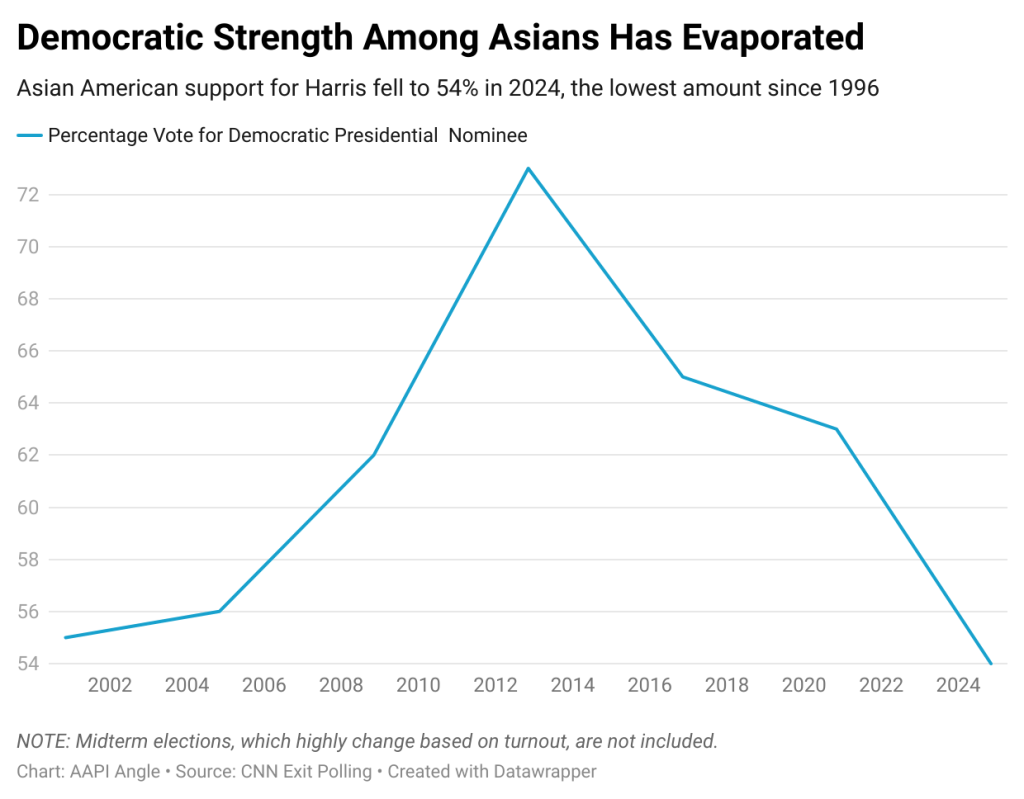
While Asian Americans were not courted as aggressively as other minority groups, their rightward shift proved pivotal in several battleground states.
In Nevada, where 1 in 10 residents are Asian, Trump gained 26 percentage points among the group, decisively winning their support. Along with his gains among Latino voters, this surge helped him flip the state into the Republican column for the first time in two decades, despite declines in his support among White and Black voters.
Even in safe blue states, the trend was noticeable. In Hawaii, where Asian Americans make up 57% of the population, Trump’s vote share rose steadily—from 30% in 2016 to 34% in 2020, and 38% in 2024. Filipino Americans, who make up a significant portion of Hawaii’s population, were a key driver of this shift, with 53% voting for Trump in 2024.
Even in safe blue states, AAPI voters swung towards the right. Hawaii saw a major red shift, with Trump winning around 38% of the vote there. To compare, he received around 34% in 2020 and 30% in 2016, showing a steady increase in Republican support in the typically safe blue state. These gains were also fueled by groups in the state like Filipino Americans, 53 percent of whom voted for Trump in 2024.
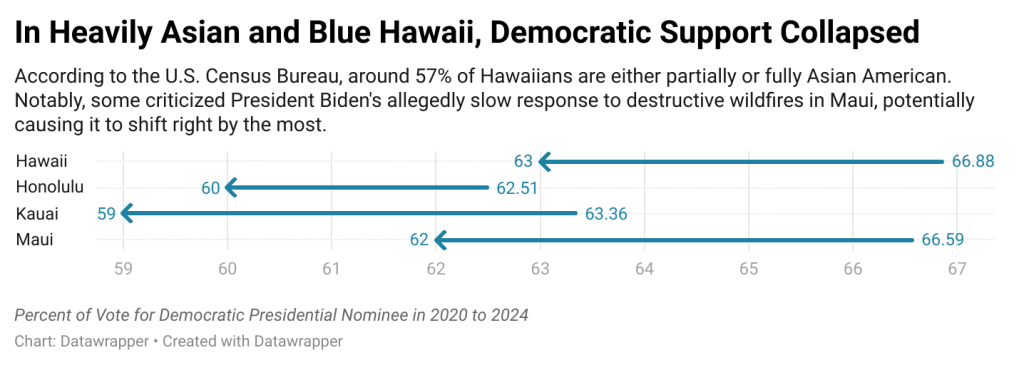
The reasons for this dramatic shift among Asian Americans are complex, and rooted in both policy and cultural values.
Economic concerns were a top issue. Many Asian Americans cited inflation, high prices, and the rising cost of living as reasons for supporting Trump. They believed his policies, such as tax cuts and reduced government spending, would address these challenges.
Cultural issues also played a significant role. Trump’s opposition to affirmative action resonated with Asian Americans who felt the policy unfairly impacted their college prospects—a top priority for many families. Additionally, Trump’s socially conservative stances, including opposition to transgender rights and LGBTQ+ policies, appealed to a demographic with strong socially conservative values.
For Democrats, the shift among Asian Americans is both a warning and an opportunity. While the group still leans Democratic overall, the erosion of support in critical states like Nevada highlights the danger of taking them for granted.
To regain trust, Democrats must address the unique concerns of Asian Americans, a deeply diverse and dynamic group. Otherwise, they risk further losses in future elections.
 The AAPI Angle
Leave a comment