
🎧 NEW: We’ve created a podcast to discuss the main ideas of the article, which you can listen to here!
If Your Time is Short:
– Asian Americans continued their trend of increased political engagement and representation in Congress. Notable candidates included:
– A son of Vietnamese boat people who uniquely fought against an incumbent Republican Asian American in the most competitive House race of 2024 and came out on top, becoming one of the first Vietnamese representatives in Congress.
– A young Korean-American who served in the Obama administration and as a House representative before overcoming odds to become the first Korean senator.
– A Chinese immigrant who worked her way out of poverty, becoming inspired by American principles and drawing attention for a viral debate moment where she angrily scolded her Democratic opponent.
The 2024 election cycle marked a pivotal moment in U.S. politics as Asian American and Pacific Islander (AAPI) candidates reached new heights in Congressional and Senate races. From around the country, AAPI leaders stepped forward to represent one of the country’s fastest-growing and most diverse demographic groups. This surge not only shows an increase in political engagement but also reflects the community’s growing desire for representation in the nation’s decision-making processes.
This election cycle saw an unprecedented number of AAPI candidates running for Congress and the Senate. 22 AAPI candidates were nominated by either the Democratic or Republican parties for federal office, with almost all of them winning the general election. This growth aligns with broader trends in AAPI voter turnout, which has steadily risen in recent years, especially following heightened political mobilization during the pandemic and the Stop Asian Hate movement.
The concentration of AAPI candidates was most notable in states with large AAPI populations, such as California and Hawaii. However, the trend also extended to regions like Arizona, Virginia, and New Jersey, where the AAPI population has grown rapidly. This shift signals a broader political awakening within the community, extending beyond traditionally established areas.
Here, we will tour the United States through its federal elections last November, starting with Hawaii and ending with New Hampshire. We will also examine each candidate’s background and campaign for each chamber.
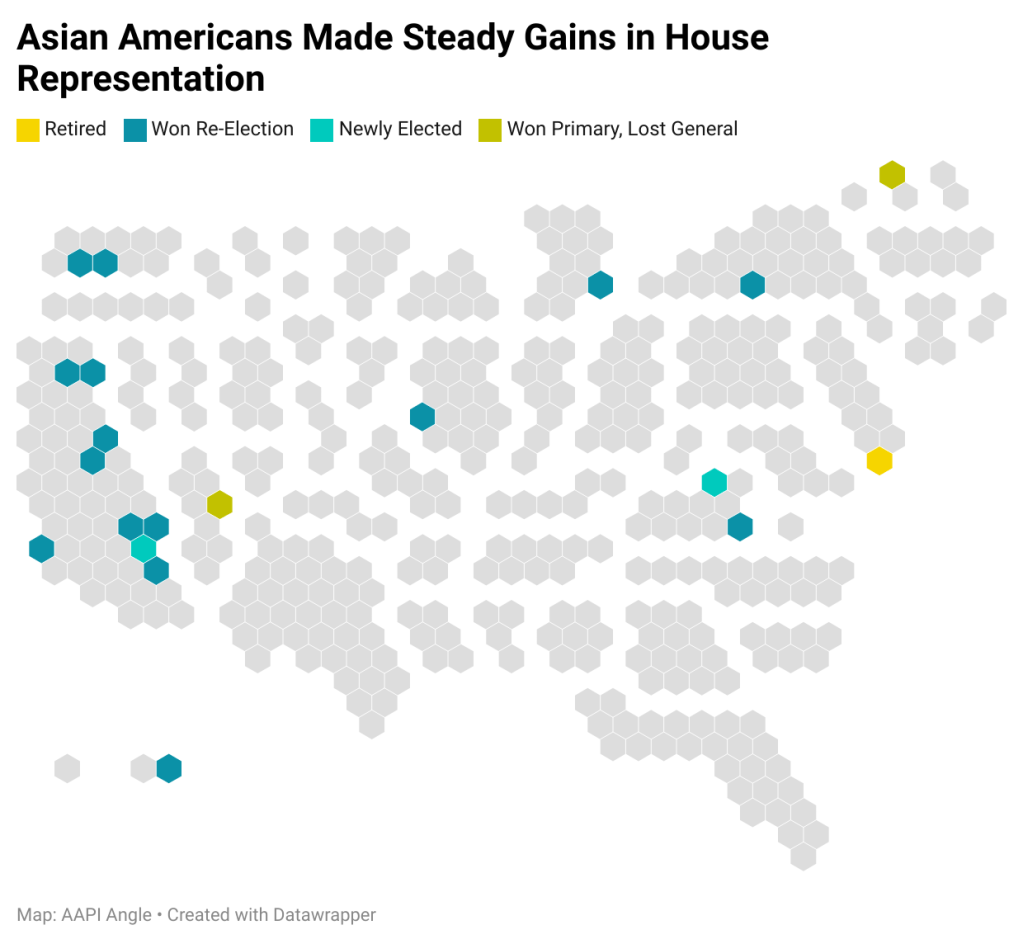
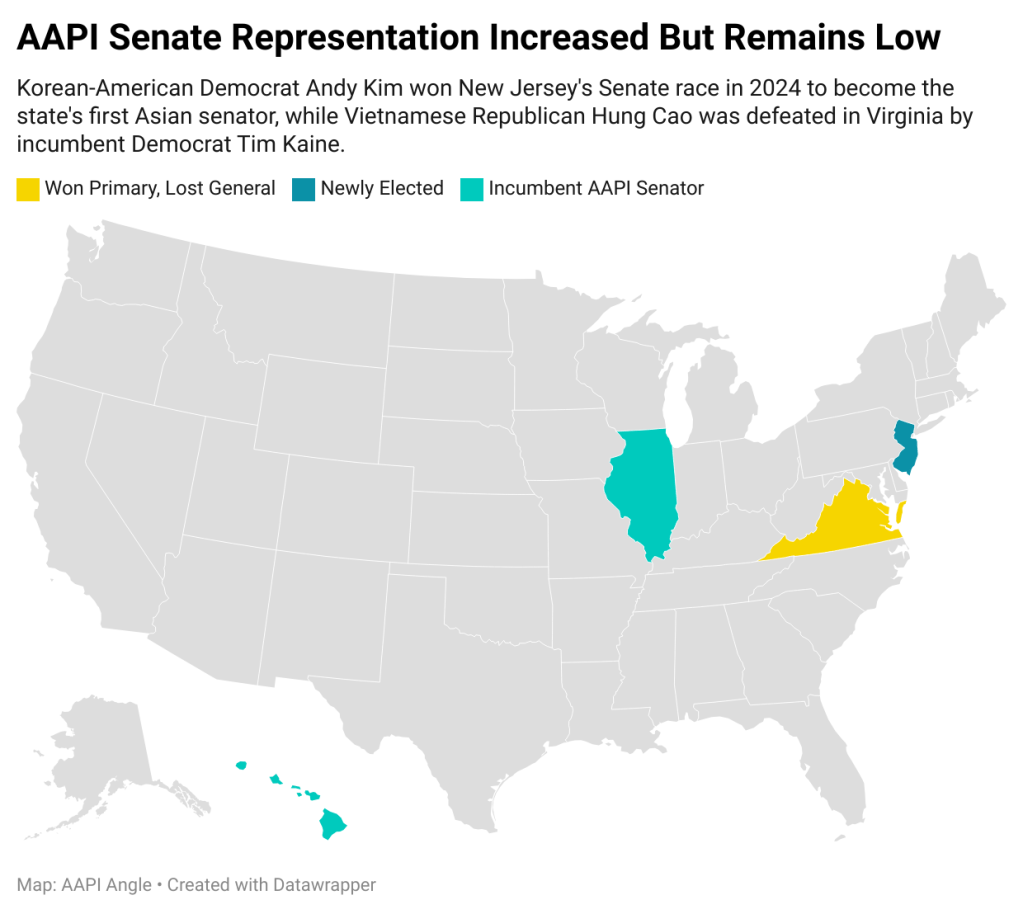
Hawaii (Jill Tokuda – 2nd District, Mazie Hirono – Senate)
Hawaii is the most Asian-American state, with around 56.6% of residents being Asian alone or in combination. As a result, it has elected many AAPI representatives to Congress, most recently Democrat Jill Tokuda, a fourth-generation Japanese American with origins in Okinawa who represents the state’s 2nd congressional district, which consists of most of the state, excluding Honolulu.
Tokuda grew up in her district, previously serving in the Hawaii State Senate, and was elected in 2022 by 27 points. During her first term, Hawaii faced deadly wildfires, which influenced the newly elected representative to introduce legislation such as the MAUI STRONG Act, which gave grants to small businesses influenced by the fires.
“The immediate work before we even hit the next Congress is we’ve got to pass supplemental disaster funding [for Maui] immediately,” said Tokuda when asked about her main agenda. She remains popular among her constituents and was re-elected in 2024 by a larger margin of around 36 points.

Representative Tokuda Campaigning in Hawaii. Source: The New York Times
Up the ballot, Japan-born Senator Mazie Hirono secured a third term, whose grandparents immigrated to Hawaii for job opportunities. Hirono first ran for political office in 1980 when she ran for Hawaii’s House of Representatives and won. She later served as the Lieutenant Governor of Hawaii and representative for Tokuda’s current seat before running for Senate in 2012, where she was easily elected. Hirono was re-elected by similarly large margins in 2018 and 2024.
One of only two AAPI senators until the election of Andy Kim, Senator Hirono is one of the most powerful Asian Americans in elected office and has remained active in politics. She has often emphasized the importance of Asians being politically engaged, having done actions such as traveling to Philadelphia to support AAPI Democratic canvassers.

Senator Hirono, right, talking with Democrat Canvasser Melinda Liu at a Harris-Walz Philadelphia Office. Source: The AAPI Angle
“It was extremely impressive to see Asian-American women in a high position of political power, breaking the bamboo ceiling,” said Liu, reflecting on her chat with the Hawaiian Senator. “I hope we can have more of us in higher positions like this one day.”
California
After crossing the Pacific Ocean, we arrive at California. As the nation’s largest state and with a sizable Asian American population (around 17.8% in 2020), it’s no surprise that California has the most AAPI representatives, with nine elected to Congress in 2024. However, the political diversity of the districts they represent is unique and goes against the state’s overall strong Democratic status. The districts range from being the most Republican in California to nearly evenly divided.
Ted Lieu – California 36th
We start at the coastal, Western Los Angeles-based 36th congressional district, represented by Democrat Ted Lieu, whose family immigrated from Taiwan when he was three years old. Lieu grew up in Ohio but moved to California to study computer and political science at Stanford University, later serving in the U.S. Air Force. He was later elected to the California General Assembly and Senate before being elected to the House of Representatives, where Lieu has served since 2015 (notably attracting attention for his fiery responses to President Trump’s tweets). He is currently the vice chair of the Democratic caucus.
Derek Tran – California 45th
Next, we will head east across LA to California’s 45th congressional district, a suburban seat where Asian Americans are the largest ethnic group and makeup around 38% of its residents. Despite having voted for former President Biden by around 6%, the district had narrowly favored Republicans in subsequent elections and elected Korean-born Republican Michelle Steel in 2022 (becoming the first Korean American to serve in Congress), causing both parties to put it at the top of their districts to target this election cycle. Democrats nominated Derek Tran, a Vietnamese-American attorney and army veteran whose father fled to the United States due to the Fall of Saigon in the Vietnam War.
Both candidates frequently emphasized their Asian American heritage on the campaign trail due to the district’s racial makeup. Tran talked about his family’s Vietnamese origins, as the district includes predominantly Vietnamese-American communities such as Little Saigon, Westminster, and Garden Grove. At times, the candidates’ efforts to connect with AAPI voters became heated, with Tran leaning on ethnic identities to call Steel “not the right fit for the district” due to being Korean and Steel promoting herself as “more Vietnamese than my opponent.”
The race was initially too close to call and remained contested for weeks, as Steel maintained a slight vote advantage over her opponent. However, Tran eventually cut into Steel’s lead, and was declared the winner by the Associated Press three weeks after Election Night.

Representative Derek Tran, left, and former representative Michelle Steel, right. Tran eventually won by a little over 650 votes, a margin of 0.2 percent.
Young Kim – California 40th
Heading further east is California’s 40th district, which Republican Young Kim represents. Kim was raised in Seoul, South Korea, but immigrated to the U.S. territory of Guam and later Hawaii when she was 13. Later on, Kim studied business administration at the University of Southern California, serving in the California State Assembly, and narrowly won a House race in 2020. She was re-elected in 2022 and 2024, where she overperformed other Republicans to win comfortably. Kim has been a relatively moderate Republican in Congress, voting with Biden’s position around 30% of the time, and has criticized racial comments made by President Trump, such as his calling the COVID-19 pandemic “Kung Flu.”
Mark Takano – California 39th
Continuing, we arrive at the outskirts of Greater Los Angeles to California’s 39th congressional district, represented by Japanese-American Mark Takano. Takano was interested in politics from a young age, and participated in civic engagement and debate in high school, later graduating from Harvard University. Takano was first elected to the House in 2012 and has been re-elected since, most recently by around 13 points. Notably, the Californian representative is part of the LGBTQ+ community and is the first gay person of Asian descent in Congress upon taking office.
Judy Chu – California 28th
A Chinese-American representative, Judy Chu was born to Chinese parents from the province of Guangdong. She grew up in Los Angeles and taught psychology for 20 years before being elected mayor of Monterey Park and serving in the California State Assembly. In 2009, Chu ran for the special election for California’s 32nd congressional district as a Democrat, uniquely defeating her cousin-in-law Betty Chu. Since then, she has been re-elected by large margins, most recently with 64.9% of the vote.
Representative Chu’s strong performances have also been supported by the ethnically diverse makeup of her district, where Asian Americans are the largest group and have grown to make up around 39% of all residents. Overall, Democrats have held the strongly liberal seat since 2003.
“We have gone from being a marginalized minority to becoming the margin of victory,” said Chu as she spoke to a group of Asian American supporters of Harris, reflecting on the increasing power of AAPI Americans in politics.

Representative Chu, center, at a Philadelphia office for Harris’s presidential campaign. Source: AAPI Angle
Vince Fong – California 20th
As you read through this large list of Californian representatives, you may notice a recurring theme: they represent extremely ethnically diverse districts located near the urbanized coast, and are Democrats. However, this trend breaks with Representative Fong, who represents the rural, Central Valley-based 20th district. The district is also far less racially diverse, as it is around 49% White.
In addition to its demographics and geography, the 20th District is also notable for being the former seat of House Majority Leader Kevin McCarthy. However, following his resignation, Chinese-American politician Vince Fong won a special election to succeed him, who McCarthy also endorsed.
Fong previously served in the California State Assembly, where he focused on economic growth and public safety, and was a Congressional staffer. He was comfortably re-elected in 2024, winning by over 30 points against another Republican (due to California’s top-two primary system).

Representative Fong, left, with House Speaker Mike Johnson.
Ro Khanna – California 17th
After a quick tour through California’s most conservative district, we return again to more liberal territory, this time in the wealthy, Bay Area-based 17th District. This congressional district is famous for being located in the heart of Silicon Valley and contains the headquarters of several large companies such as Apple, Intel, and Yahoo. However, its representative is well-known for his tougher stance on many large corporations and general economic progressivism.
That politician would be Indian-American Ro Khanna. The son of Punjabi immigrants, Khanna grew up in Pennsylvania and became involved in politics in college, canvassing for now-President Obama during his first campaign and interning at the Carter Center. After moving to California and serving in the Department of Commerce, Khanna ran for the 17th Congressional District in 2014, narrowly losing to incumbent Mike Honda. However, he decisively won two years later in a rematch and has been re-elected since, most recently in 2024 by 35.4 points against second-generation Chinese-American and former English teacher Anita Chen.
“I didn’t choose to run because the numbers told me that I would win. I didn’t choose to run, to really make me a role model or make a name for myself. It was just that I felt there was a story that needed to be told,” said Chen. Despite the heavily Democratic lean of the 17th district, Chen explained that she wanted to become a voice for those who felt disillusioned and ignored by the political system, which you can learn more about here.
Doris Matsui – California 7th
We head a bit east to California’s 7th District, which encompasses southern Sacramento County, parts of Yolo and Solano Counties. This seat has been represented by Representative Doris Matsui since 2005.
Born in a Japanese internment camp in Arizona during World War 2, Matsui attended the University of California, Berkeley, where she met her husband, and served as a volunteer on Bill Clinton’s 1992 presidential campaign.
However, her official entry into politics gets more interesting. Matsui decided to run when her husband, Representative Bob Matsui, died due to myelodysplastic syndrome in 2005. On January 9, the day after his funeral, she officially launched her campaign, overwhelmingly winning with 67% of the vote. Since then, Matsui has been reelected by large margins: in 2024, she received around the same amount as when she first ran.
Ami Bera – 6th District
Finally, we arrive at our final stop in California: the Sacramento-based 6th District, which Representative Bea represents.
Representative Ami Bera is the son of Indian immigrants from Gujarat who grew up in Los Angeles. He worked as a physician for several years before challenging Republican incumbent Dan Lungren for California’s 3rd District in 2010. He was defeated by around 7 points. Two years later, Bera announced a rematch against Lungren, narrowly prevailing with 51% of the vote. He has since been reelected several times, most recently in 2024 by 15 points.
Washington
Marilyn Strickland – 10th District
Representative Marilyn Strickland was born in Seoul, South Korea to a Korean father and an African-American serviceman. Prior to being elected to Congress, Strickland worked in the business and advertising fields, before becoming mayor of Tacoma, Washington from 2010 to 2018. In 2020, she ran as a representative for the seat vacated by incumbent Denny Heck, after winning Washington’s so-called jungle primaries against Democratic State Representative Beth Doglio. She won with “double digit leads in all three counties”, becoming one of three of the first Korean-American Congresswomen. Strickland is a Democrat and is estimated to have voted with former President Joe Biden’s stated position 100% of the time.
Pramila Jayapal – 7th District
Representing most of Seattle and some of King County, Pramila Jayapal was born in Chennai, India, but spent most of her childhood in Indonesia and Singapore, coming by herself at the age of 16 to study at Georgetown University. After working in finance and development, Jayapal became known for her advocacy for immigrant groups. She ran for Representative after incumbent Jim McDermott retired, and won with 56% of the vote, becoming the first
Indian-American woman to serve in the House of Representatives. Jayapal would go on to win four more terms in 2018, 2020, 2022, and most recently, 2024, often by large margins. Jayapal is a staunch Democrat, serving as the former chair of the House Progressive Chair, and supports measures like a decrease in military funding and introducing environmental justice bills.
Arizona
Amish Shah – 1st District (Lost)
After a brief stay in the Pacific Northwest, we move back South into northern Phoenix. The 1st District is considered one of the most politically competitive congressional seats in the nation, with former President Biden narrowly winning it by 1 point in 2020, but incumbent Republican David Schweikert still holding on by around 4. As such, both parties heavily targeted the seat, and it was considered the second-most contested district by some election forecasters.
Amish Shah was born in Chicago, Illinois, to parents who had immigrated from India in the 1960s. He first worked in medicine before running for the Arizona House of Representatives in 2018 as a Democrat, representing Arizona’s 24th Legislative District. After winning, Shah ran again in 2020, then a third time in 2022, this time representing the 5th Legislative District, following redistricting, winning both times.
In 2023, Shah announced his intention to run for the US Congress in the 2024 elections, representing Arizona’s 1st congressional district, dropping from the Arizona House of Representatives in order to focus on campaigning. However, Shah would go on to narrowly lose to Republican incumbent David Schweikert.

Representative Amish Shah, center. Source
Illinois
Raja Krishnamoorthi – 1st District
We arrive at the first Congressional District of Illinois after leaving the Western U.S. and heading to outer Chicago, which Democrat Raja Krishnamoorthi represents.
Born in New Delhi, Krishnamoorthi’s story is that of an immigrant family seeking the American dream: His family moved to the United States when he was three months old so that his father could attend graduate school. They faced initial economic difficulties in America and lived in public housing. Still, his dad eventually found a job as a professor at Bradley University, causing the family to move to Illinois and become part of the middle class.
Krishnamoorthi went on to attend Princeton University and Harvard Law School, serving as a law clerk and working for future President Barack Obama’s unsuccessful 2000 campaign for the 1st District. He continued working for Obama’s campaigns, even helping to draft his keynote address at the 2004 Democratic National Convention, and ran for Illinois’s 8th District in 2016 after previously being defeated by AAPI Illinois senator Tammy Duckworth for that seat. There, Krishnamoorthi decisively won both the Democratic primary and the general election, focusing on the middle class. He has been easily re-elected since, most recently with 57% of the vote.

Representative Krishnamoorthi, right, with President Obama, left. Source: R8cocin8 on Wikipedia Commons
Michigan
Shri Thanedar – 13th District
Going north and crossing the Great Lakes, we arrive at the Detroit-based 13th District of Michigan, which Shri Thanedar represents.
Thanedar grew up in Karnataka, India, and grew up in a low-income family, even working at age 14 to support his large family when his father was forced to retire. He went into the field of chemistry, earning a bachelor’s degree at 18 and moving to the United States to attend the University of Akron, where he earned a PhD in 1982.
After working at the chemical company Petrolite for around 24 years, Thanedar entered politics in 2018 by running to become the Governor of Michigan. His campaign initially gained steam, becoming the front-runner in the Democratic primary, but faced controversy over his past support for Republicans like Senator McCain. This, along with claims of animal abuse in one of his laboratories, largely sunk his campaign and resulted in a third-place finish in the primary.
One year later, Thanedar ran for and was elected as a representative in Michigan’s 3rd District for the Michigan State House. He ran for the 13th Congressional District in 2022, winning the general election by a large margin, and was re-elected with a similar percentage of the vote in 2024.
Virginia
Bobby Scott – 3rd District
A long trip east brings us to the coastal Norfolk-centered 3rd Congressional District, where Representative Bobby Scott was re-elected in 2024.
The son of an African American father and a Filipino mother, Scott grew up in Newport News, which is also in the 3rd District, and received his Bachelor of Arts from Harvard College. He entered politics in 1976 when he was elected to the Virginia House of Delegates as a Democrat and later entered the Virginia Senate in 1982. In the state legislature, Scott emphasized
“kitchen-table issues,” working to give the poor and children greater access to health care and increase the minimum wage and job training.
Scott first ran for federal office in 1986, losing to Republican Herb Bateman for the 1st Congressional District, but was able to win the election for the 3rd District in 1992 decisively. Since then, he has been re-elected by enormous margins, most recently with 70% of the vote.
Suhas Subramanyam – 10th District
Going north, we arrive at the 10th Congressional District, which is located in Northern Virginia. It is represented by Democrat Suhas Subramanyam, and is racially diverse, with a sizable Asian population.
This diversity, however, was best reflected in the congressional district’s competitive primary elections last year to replace retiring Democratic Representative Jennifer Wexton. In both the Democratic and Republican primaries, 6 out of the 16 Democratic and Republican candidates running were part of the AAPI community. During the race, many candidates emphasized a desire to amplify issues important to Asian Americans if elected to Congress and the need for greater representation in a largely White government.
“We need representation, and we need to stand up on issues that are concerns of our particular community,” said former candidate and Indian-American Krystle Kaul. In an interview with Yuan Media, Kaul recounted how she realized as a child no one in the Indian-American community was a politician or in Congress, so she aimed to one day become elected to Congress.
Subramanyam eventually won the Democratic primary with 30%, on a day where both AAPI voters and politicians made a strong showing. In the general election, he won by a comfortable margin of 4.6%.
Hung Cao (Senate, Lost)
Finally, we turn our attention up the ballot to the state Senate race, where incumbent senator Tim Kaine faced Republican Hung Cao, a Vietnamese immigrant with an inspiring story of service.
Having arrived in the United States with his family from Vietnam at age 4, Cao grew up in Northern Virginia, and entered the U.S. Navy as a seaman recruit in 1989, graduating from the United States Naval Academy seven years later. He spent 25 years in the Navy, even leading the team that recovered the body of John F. Kennedy Jr. (son of JFK) and his wife in 1999.
However, the military also brought him into politics, as Cao cites the Biden administration’s withdrawal from Afghanistan as why he wanted to get involved. He first ran for the previously-mentioned 10th District in 2022, winning a crowded Republican primary with 10 other candidates. However, his appeal as a veteran and Asian-American in a district that was largely both could not overcome its partisan lean. Cao was still defeated by the incumbent Jennifer Wexton by around 6 points.
Two years later, Cao decided to give politics another shot, declaring himself a candidate in the 2024 Virginia Senate race in July 2023 and receiving the endorsement of President Trump, who called him a “tireless fighter.” This largely propelled him to a comfortable victory in the Republican primaries, with 61% of the vote. However, his campaign was also marred by controversies, including his blame of former Secretary of Transportation Pete Buttigeg’s alleged focus on “racial equity with regard to highways” as the cause of the Francis Scott Key Bridge’s partial collapse in 2024 and claims of “witchcraft” dominating California.
This, along with Virginia’s Democratic lean, caused Senator Kaine to have a consistently large lead in the polls. His victory on Election Night roughly matched his polling, as Kaine was re-elected by around ten points.

Senator Kaine, left, and Hung Cao, right. Source: WSAV
New Jersey
Andy Kim (Senate)
A bit north, the New Jersey Senate race also saw barriers being broken, as Representative Andy Kim became the state’s first Asian-American senator and the first Korean senator as a whole.
Kim was born to Korean parents in Boston, Massachusetts, on July 12, 1982. He grew up in Southern New Jersey, and was uniquely accepted to Deep Springs College, a hyper-selective university with only 30 staff members and about 26 students. After spending two years there, he transferred to the University of Chicago, graduating in 2004.
Later, Kim worked for the U.S. State Department, serving as a civilian advisor in Afghanistan before becoming a national security adviser under President Obama and a United States National Security Council official.
In 2018, Kim was inspired to run against incumbent representative Tom MacArthur for New Jersey’s 3rd Congressional seat after being greatly alarmed by the latter’s support for repealing the Affordable Care Act (or Obamacare). As the sole candidate, he won every vote in the Democratic primary. In the general election, Kim drew support from several prominent Democrats, including President Obama, and former Vice President (and now President) Joe Biden.
Despite his New Jersey upbringing, Kim was racially attacked by MacArthur, who also sought to portray him as an elitist from DC. Notably, the New Jersey Republican Party ran an ad criticizing Kim as “real fishy” in stereotypical Wonton font, which was criticized as racially motivated.
Kim nonetheless prevailed in the closely contested election by around 1 percent, becoming the first Asian American representative from New Jersey, and was comfortably re-elected in both 2020 and 2022. However, in 2024, he chose not to seek re-election and instead ran to defeat U.S. Senator Bob Menendez, who was indicted and later found guilty of providing sensitive information to Egypt’s government.
In the Democratic primary, Kim was initially challenged by Tammy Murphy, the wife of New Jersey Governor Phil Murphy. However, she later dropped out, allowing Representative Kim to easily win the Democratic primary with around three-quarters of the vote and advance to the general election against Republican Curtis Bashaw, where Kim won by around 9 points, breaking the bamboo ceiling in the Senate and over performing Vice President Harris’s victory of around six.
New York
Grace Meng – 6th District
Moving to New York City, we arrive at the urban Queens-based 6th Congressional District, which Grace Meng represents.
Meng was born to a Taiwanese American family in her district in 1975, and originally sought to become a teacher. However, she was drawn to law later on, receiving a Juris Doctor from the Benjamin N. Cardozo School of Law at Yeshiva University.
Meng got involved in politics, however, in 2008, where she defeated Democrat Ellen Young in the New York Assembly. After serving two terms, she ran for New York’s 6th Congressional District in 2012, winning against Republican Dan Halloran and becoming the first Asian American representative from New York. Since then, she has won re-election by large margins, most recently by 23 points.
New Hampshire
Lily Tang Williams – 2nd District (Lost)
There are few stories in this list of Asian American politicians that are as interesting as Tang Williams, who ran against Democrat Maggie Goodlander this year.
Williams was born into poverty in Chengdu, China, and grew up during the Cultural Revolution. Having excelled in school, she studied law at Fudan University. However, Tang Williams’ interest in the United States began when she met an American foreign exchange student who showed her the Constitution and Declaration of Independence.
Eventually, she came to the United States in 1988 to study at the University of Texas in Austin, and became a naturalized U.S. citizen in 1994.
Following President Obama’s election, Williams became interested in politics and initially joined the Libertarian Party, working as a regional coordinator for former New Mexico governor Gary Johnson’s 2012 Libertarian presidential campaign. She also served as the Libertarian candidate for the 2016 Colorado senate race, winning 3.6% of the vote.
After living in Colorado, Williams moved to New Hampshire and ran for the U.S. House of Representatives in 2024 as a Republican. She won the Republican primary, but faced a tough challenge in a blue-leaning district.
On the campaign trail, Williams emphasized her experience growing up during the Cultural Revolution and expressed her fears that similar changes were happening in the United States. She lost but overperformed the partisan lean, losing by only around 5.9 points in a district that voted for former President Biden by 9.
 The AAPI Angle
Leave a comment