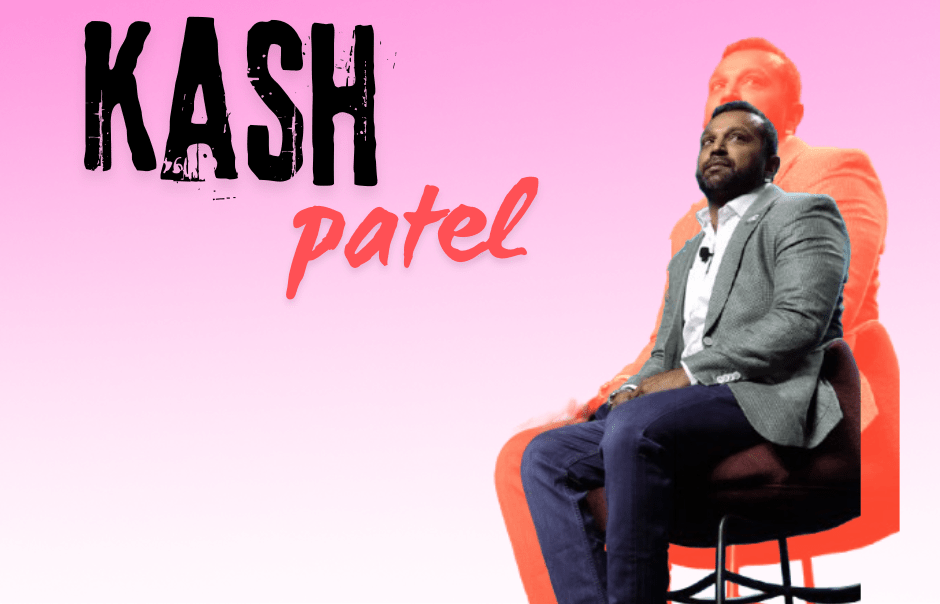
With the upheaval and rapid changes of Trump’s second term, it’s more important than ever to understand not just the man at the top, but also the team shaping his administration. Beyond Trump himself, there are lesser-known figures at the table whose decisions carry significant weight.
That’s why The AAPI Angle is launching Trailblazers and Trump—a series spotlighting Asian American leaders in his cabinet, their paths to power, and the influence they wield today, while keeping it bite-sized and using videos so you don’t have to be disrupted and bored by jargon.
INTRODUCTION
Ten days ago, the nation reeled and reacted after right-wing firebrand and populist activist Charlie Kirk was assassinated at Utah Valley University, a heavy topic discussed in last week’s episode of The AAPI Angle: On Air. Likewise, another figure came into the spotlight – FBI director Kash Patel, a figure who faced heavy scrutiny for his handling of the Charlie Kirk assassination investigation.

When discussing gun violence and answering a question about shootings, Kirk was shot in the neck. Kirk was confirmed dead a few hours later. Source: KSL News Utah
Six hours after his death, Patel announced that “the subject for the horrific shooting today that took the life of Charlie Kirk [was] now in custody,” only to clarify just an hour later that the FBI hadn’t yet found the shooter and that the investigation was ongoing, much to the chagrin of many Americans.
“We would be wise to take a moment and ask whether Kash Patel has what it takes to get this done,” commented conservative activist Christopher Rufo. “He performed terribly in the last few days, and it’s not clear whether he has the operational expertise to investigate, infiltrate, and disrupt the violent movements—of whatever ideology—that threaten the peace in the United States.”
Patel has been a deeply polarizing figure. He was confirmed by a narrow vote of 51 senators in favor and 49 against, and has attracted attention from Americans of all stripes, for better or for worse. Some have praised the Indian-American as a firebrand and fighter. In contrast, others have heaped criticism on Patel for his relative inexperience.
So how did Patel get here? How did he find himself heading one of the most powerful American organizations? What has he done as FBI director? Let’s dive in.
BACKGROUND
To better understand a politician’s career, it is important to examine their background, including how they rose through the ranks. In Patel’s case, he was born and raised in Garden City, New York, a Long Island suburb of New York City, with his father being a Ugandan of Gujarati descent who was expelled by dictator Idi Amin in 1972.
Patel was highly interested in the humanities and politics from a young age. When graduating from Garden City High School, his selected quote was “Racism is man’s gravest threat—the maximum of hatred for a minimum reason,” by Jewish philosopher Abraham Joshua Heschel, an odd selection given Heschel’s deep engagement with and supportiveness of liberal causes, and Patel’s early conservative beliefs.
Patel later attended the University of Richmond, where he earned a degree in criminal justice and history. He also participated in the American Bar Association’s diversity initiative known as the “Judicial Intern Opportunity Program” in 2003, one year after graduating from the University of Richmond. He later earned a certificate in international law from University College London in 2004.
Patel’s professional and legal career officially began in the Miami-Dade area, where he served as a public defender, representing violent criminals and drug traffickers. He also began working for the Department of Justice in 2012 as a junior staff member, focusing on routing arrest warrants. Patel quickly rose through the ranks, joining the National Security Division, a sub-department of the Department of Justice, in 2013 and serving in the Counterterrorism Division, which develops strategies to combat national security threats, including terrorism.
JOINING THE POLITICAL WORLD
However, Kash Patel’s relationship with his colleagues at the Department of Justice soured over time, and these cracks started to showcase his political beliefs. Patel officially and abruptly left the department in 2017, citing disagreements over the department’s response to the 2016 Presidential Election, which included several investigations into Russian interference and other foreign attempts to get President Donald Trump elected.
The same year, Patel joined the House Permanent Select Committee on Intelligence as a senior aide to former representative Devin Nunes (CA-21), where he investigated the theory that Ukraine was trying to stir allegations of the previously mentioned Russian interference in US elections. He was also the primary author of the Nunes memo, which alleged that the FBI “[relied] on politically motivated or questionable sources” to obtain a warrant.
Patel’s work for Nunes, the then-head of the Committee and a strong ally of President Trump, drew heavy attention from all corners of the country. Trump himself called the memo “totally vindicating” (clearing him of wrongdoing), also calling the FBI investigation a “Russian Witch Hunt.”

Patel, right, with Representative Nunes, left. Nunes was a staunch supporter of President Trump, even calling the president “a juggernaut of justice.” Source: Politico
Patel continued to rise through the ranks of the federal government, but not without his own controversies. After being nominated to join the National Security Council in 2019, he was criticized as having “taken few notes in meetings” and with “little expertise for his initial portfolio.” Furthermore, when serving as the chief of staff of then-Secretary of Defense Christopher C. Miller, Patel was accused of having dismissed security at the Capitol during the January 6 Capitol attack, allowing rioters to enter with much more ease.
Ironically, Patel’s connections to the January 6 rioters were not limited to only allegedly letting them in. Patel founded the Kash Foundation in 2021, which helped participants in the Capitol riot pay legal costs. Costs for managing and paying legal costs were also partially paid for through other business ventures he started. In 2022, Kash co-founded Based Apparel, a company that sells conservative clothing. K$H Wine entered the business two years later, in 2024, selling Trump mugshot-branded wine and donating proceeds to the Kash Foundation.

A t-shirt from Based Apparel and a bottle of Pinot Noir Trump-themed wine from K$H Wine. Patel has received mixed reactions from his business ventures, with some calling it unprofessional. Sources: Based Apparel and K$H Wine websites
After years of association with the right-wing and Trumpist movement, Patel’s efforts began to bear fruit. After the Republican Party and President Trump’s narrow victory in the 2024 election, President-elect Trump declared his intention to appoint Kash Patel for an FBI or DOJ leading position in November 2024. However, even with the conservative giant throwing his explicit support for his nomination, Patel’s confirmation in the Senate was hardly straightforward.
CONFIRMATION AND REFLECTIONS
Due to the Senate having 53 Republicans and 47 Democrats after GOP victories in Ohio, Montana, West Virginia, and Pennsylvania, Patel could only afford to lose 3 Republican votes (with Vice President J.D. Vance breaking the tie in that case), assuming a partisan ballot.
Though nearly all Republicans were unified in their support for Patel, a few emerged in opposition, making the final ballot razor-thin and forcing discussion over his ability to serve: Maine Senator Susan Collins, viewed as a swing vote and moderate Republican, called Patel “politically charged” and unfit “to serve in the apolitical role of Director of the FBI.” Alaska Senator Lisa Murkowski similarly voiced disagreement with Patel’s nomination, describing her opposition to the FBI being “focused on settling political scores.” Democrats were even more opposed to Patel, with Vermont Senator Peter Welch criticizing him for not acknowledging Biden’s victory in the 2020 election.
A clip taken during Patel’s confirmation hearing in the Senate. Source: PBS NewsHour
However, other Republican senators pushed back. Texas Senator John Cornyn, also seen as a moderate swing vote in the Senate, praised Patel’s focus on “restoring the reputation of the FBI as a nonpartisan law enforcement investigative agency.” At the same time, Iowa Senator Chuck Grassley, chairman of the Senate Judiciary Committee, said that Patel “[wanted] to make sure that congressional oversight works.”
Ultimately, Patel was confirmed in a 51-49 vote in February 2025, with all Democrats, Collins, and Murkowski in opposition.
After being sworn in, Patel moved to quickly restructure and downsize the Federal Bureau of Intelligence, mirroring Musk’s efforts through the Department of Government Efficiency to cut federal waste, a move that an official claimed could cost up to $100 million that the agency lacked, though Patel was nonetheless undeterred. He has also attempted and planned to move the FBI headquarters to what he called an “old Department of Commerce building,” a move critics suggested implied further staff reductions, though such plans were later scrapped.
Patel’s road to power was not as binary as simply stirring up anger like Ramaswamy did to gain Trump’s attention with speed, nor did he play Gabbard’s long game and brand himself as a populist outsider who saw the other side’s errors. Instead, he slowly worked his way into and up the political world. He branded himself as both an experienced figure with familiarity with Washington’s workings and a loyal ally to Trump from day one. Such is a rare combination, given the relative youth of the MAGA movement, as well as President Trump’s attacks on even his own legal appointees for what he perceives as a failure to investigate his political opponents or delays in doing so.
 The AAPI Angle

Leave a comment