
This article was written by Melinda Liu. Narration by John Gao:
The field of humanoid robotics has experienced steady growth and development over the last several months and years.
While some clips of these have gone viral online, such as an uncanny robot head with startlingly realistic expressions or a “slick-talking, cowboy hat-wearing robot dubbed ‘Jake the Rizzbot‘” wandering the streets of Austin, Texas, much of the progress has remained shrouded in confusion for the general public.
Chinese and American companies alike have invested millions in the humanoid robot industry, with China in particular making several impressive strides towards mass-produced, publicly available intelligent humanoid robots.
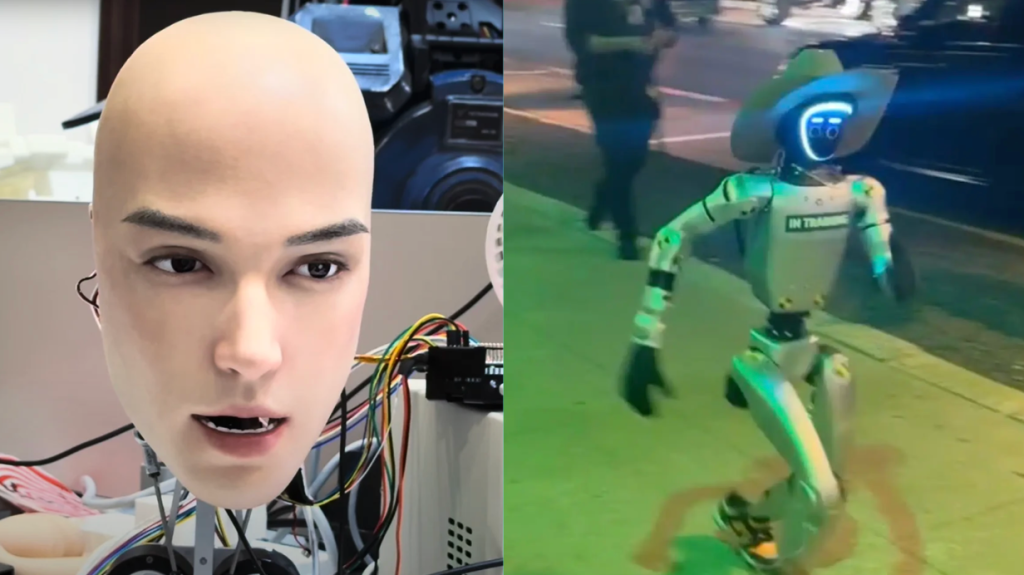
An AheadForm humanoid robot, left, and “Jake the Rizzbot,” right. Both humanoids drew attention for their impressive design and features. Source: Supercarblondie, New York Post
Today, the topic of China’s progress in humanoid robots will be explored in-depth, as well as what this progress means for American competitors. First, what exactly are humanoid robots?
A report by the US-China Economic and Security Review Commission defines humanoid robots as “differentiated by their physical resemblance to humans and [a] unique combination of three attributes: locomotion, dexterity, and intelligence.”
Chinese humanoid robot firms are in direct competition with non-Chinese firms and “are currently in a race [with the United States] to build out the hardware/software technology stack required for humanoid robots.”
Chinese companies have made numerous recent advancements. For example, Zhejiang-based start-up Unitree Robotics is planning an initial public offering that will value the company at $7 billion USD, making it a global leader in robotics and one of the largest recent Chinese tech listings as of September 2025. Unitree is only the latest in a wave of Chinese robotics companies, such as “Agibot, also known as Zhiyuan Robotics, and Galbot, a Beijing-based robotics start-up.”
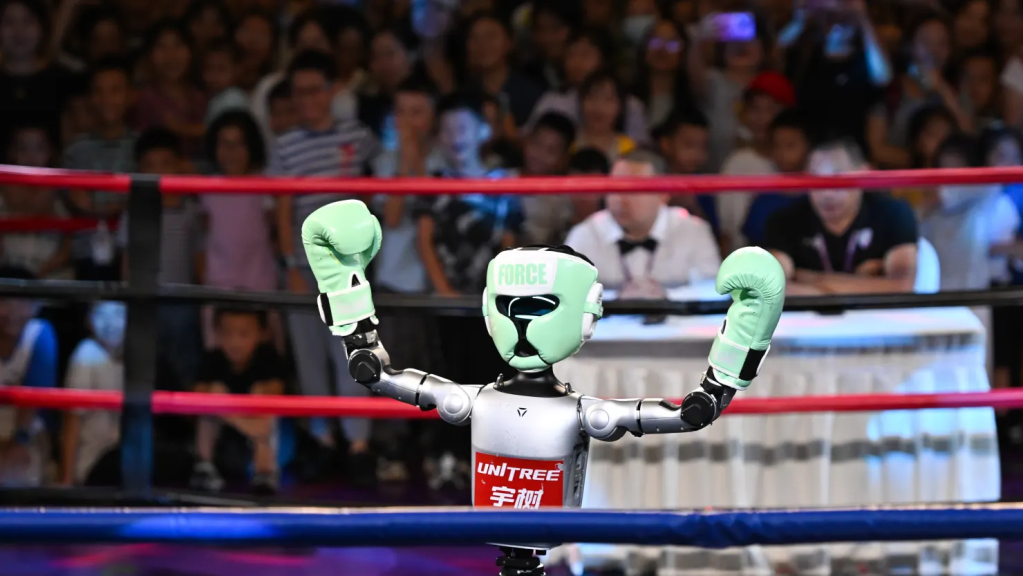
A Unitree Robotics humanoid robot in a boxing match. Source: China News Service/Getty Images
Meanwhile, in the same month, another Shenzhen-based robotics startup, X Square Robot, secured $100 million in funding from Alibaba, marking its eighth round of financing in just two years and bringing total investment to $280 million. It claims to be the first startup of its kind to open source the AI software required to operate a humanoid and is “already generating revenue from sales to schools, hotels, and retirement homes.”
In August of 2025, participants from 16 countries and 500 bipedal humanoid robots were “through various motions to showcase the promise and limits of embodied artificial intelligence” in a Beijing, China Olympic venue. Many robots broke down or were unable to complete tasks correctly; however, the games were ultimately more about testing the newly advanced capabilities of these robots.
A team from California-based tech company StarBot cited that it would be a “really good opportunity to come to China and be in an environment where everything is so modern and up to date.”
The same month, Chinese robotics firm Galbot opened a kiosk in Beijing, staffed entirely by its dual-armed humanoid robot. Crowds of people have lined up to see the robot, as seen in videos posted online. In September, a second location was opened in Beijing, and CEO Wen Airong states that the company plans to open 100 more locations throughout Chinese cities within the following year.
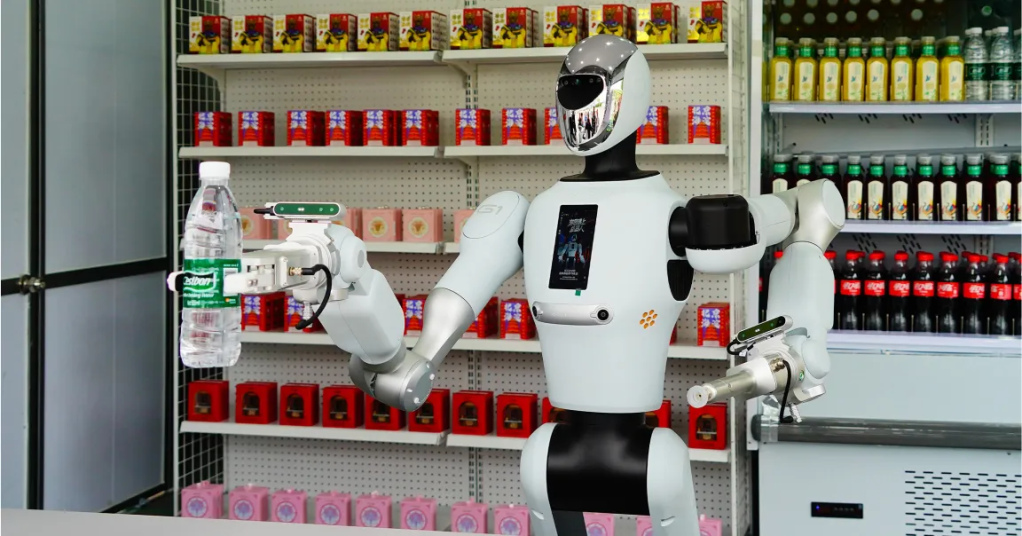
The Galbot G-1 robot at its Beijing bodega. G-1 drew attention, both public and private, for its operations. Source: Futurism
This position as a leading competitor in the humanoid robot industry has been bolstered by official government action. In late July, China released a global action plan for AI, just days after President Trump announced a similar strategy for the US, raising thoughts of increased competition between the two nations.
Meanwhile, at the World Artificial Intelligence Conference in Shanghai, Premier Liqiang delivered an opening speech announcing that “the Chinese government has proposed the establishment of a global AI cooperation organization.”
The Chinese government has already allocated over $20 billion to the development of humanoid robots. President Xi inspected domestic producer AgiBot’s robots in April of 2025, while another producer, Unitree, was present at a meeting hosted by Xi for private firms.
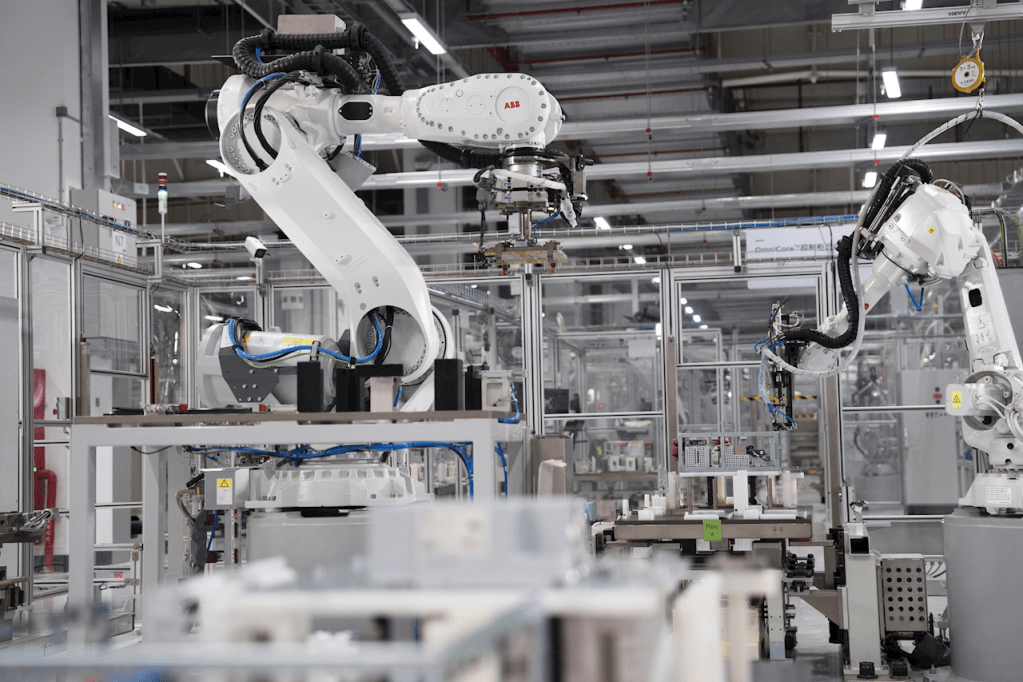
ABB’s robotics mega-factory – the 67,000 square meter production and research facility represents a $150 million investment by ABB. Source: ABB
In 2023, 276,288 robots were deployed in China, compared to just 55,388 in the US. China already has the most significant industrial robot market, accounting for 52% of installations worldwide in 2022. Since 2017, over 3,400 robot start-ups have emerged in China, and Shanghai is home to the world’s most extensive robot production facilities.
As AI chatbots become increasingly advanced, humanoid robots follow closely behind. The landscape of robotics is rapidly changing and growing. NVIDIA CEO Jensen Huang claims that in a few short years, “humanoid robots capable of performing surgery, replacing factory workers or serving as in-home butlers” will be a reality.
The humanoid robot market is expected to surpass $5 trillion by 2050, with China projected to have the largest number of units. Prices of individual units are expected to fall as they become more widely available.
Faced with an uncertain future and new technology that is only becoming more complex and capable, will China emerge as the leader? Only time will tell.
 The AAPI Angle
Leave a comment