Several weeks ago, President Donald Trump issued a new executive order requiring H-1B visa applicants to pay a one-time fine of $ 10,000. The five-figure number stands out — but who is paying this fee? What does an H-1B do? And who will this change affect?
Overview of the H-1B Visa Program
Generally, citizens of a foreign country must obtain a visa to enter the United States, with the type of visa required depending on the purpose of their visit. Citizens of certain countries may also be eligible to travel to the United States without a visa, depending on their country of citizenship and the purpose of their visit.
Visas are split into two broad categories: non-immigrant and immigrant visas. Both types are further divided into subcategories. Among employment-type visas, further subdivisions depend on the purpose of the work. Specifically, H-1B visas are called “Person in a Specialty Occupation,” where those who work in a “specialty occupation” are eligible to apply. According to the United States Department of Labor, “The H-1B program applies to employers seeking to hire nonimmigrant aliens as workers in specialty occupations.” Applicants must have at least a bachelor’s degree or equivalent experience.
Since its creation in 1990, the H-1B visa program has primarily been utilized by tech companies to hire skilled foreign workers. The program was indeed created for that purpose; the goal of the H-1B visa program, in response to the tech boom of the 1990s, was to help address the shortage of skilled workers in sectors such as medicine, technology, and engineering. As a result of the visa program, the United States attracted skilled individuals to immigrate, helping establish its status as a global technological superpower.
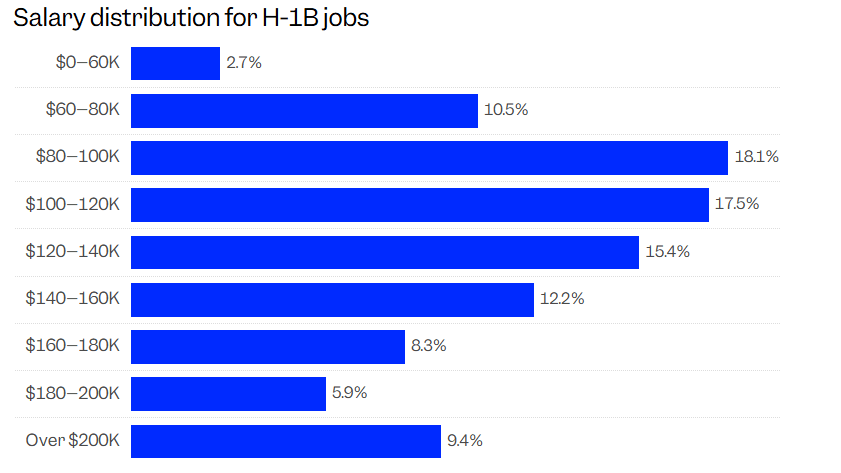
A few key elements of the original H-1B visa program are its cap and lottery system, duration, wage requirements, and allowance of dual intent. In particular, the H-1B visa’s cap and lottery system means that only 85,000 individuals can receive an H-1B visa per fiscal year, with 20,000 of those visas reserved for those with advanced degrees from American higher educational institutions. Once the cap is reached, a lottery is implemented to select applications to be processed. Furthermore, the wage requirements of the visa prevent employers from hiring foreign workers at a low cost, thus ensuring priority in hiring workers domestically.
The H-1B visa program has not remained static since its inception, undergoing several changes, including the most recent one from President Trump. For example, the H-1B Visa Reform Act of 2004 increased the minimum wage paid to H-1B workers from 95% to 100% of the prevailing wage, which refers to the hourly wage, benefits, and overtime that the majority of workers in a specific area earn for similar work. The act also required employers to attest to “[take] good faith steps to recruit a U.S. worker for the position for which the H-1B worker is sought; and to offer the job to any U.S. worker who applies for the job and is equally or better qualified,” according to the U.S. Department of Labor’s web page about the act.
Clearly, while the United States is interested in attracting talented workers to the country, it is also concerned with maintaining jobs for American workers. Trump’s new H-1B visa executive order underscores the enduring importance of preserving American workers’ jobs as a significant consideration for unions, lobbyists, companies, and the government, even today.
New Changes to the H-1B Visa Program
On Friday, Sept. 19, 2025, Trump signed an executive order, “Restriction on Entry of Certain Nonimmigrant Workers.” According to the U.S. Citizenship and Immigration Services (USCIS) website, the order takes “an important, initial, and incremental step to reform the H-1B visa program to curb abuses and protect American workers.”

The executive order now requires a one-time $100,000 payment to accompany any new H-1B visa petitions, a steep increase from the original $250 or so. This payment will be from companies wishing to hire foreign workers to the United States government. The prevailing wage level for H-1B workers will also be raised, so that only the “best of the best” temporary foreign workers are hired.
Following a period of confusion after the order was issued, the USCIS clarified, both through press conferences and its website page, that the order does not affect any current H-1B visa holders, those who submitted an H-1B visa application before September 21, or those intending to renew their H-1B visas.
However, in the period before these clarifications, H-1B workers about to leave the United States faced waves of panic as companies blasted out urgent warnings to employees, telling them not to leave the country if they were in the United States on an H-1B visa or returned to the United States within 24 hours if they were abroad.
The business sector that is most affected by this new application fee is the tech sector. According to an analysis by Business Insider, the company filing the most requests for H-1B visas was Amazon, with nearly 15,000 total filings. Microsoft, Google’s parent company Alphabet, Meta, Apple, and IBM are also in the top 10.
While Big Tech, with its massive capital backing, can remain mostly unaffected by the new policy by simply paying the fee, startups could be significantly harmed. “A $100K annual fee won’t bother BigTech, but it kneecaps startups … and that’s a mistake,” posted President and CEO Garry Tan of Y Combinator, an American startup accelerator, on X.
The fee, coupled with the high salaries required for H-1B workers, would make it difficult for startups to bring workers to America. This might then cause young companies to hire workers abroad instead of building talent domestically, risking the loss of jobs in America and their relocation to countries such as Canada, where immigration laws are less stringent. Large tech offices, which have already begun setting up offices in Canada and Mexico, would also hasten their expansion abroad due to this order.
In terms of nationality, Indian workers will be most greatly affected by the H-1B visa change. In the 2024 fiscal year, more than 70% of approved H-1B petitions went to Indian workers, while Indian students also comprise the largest body of international students, surpassing China in 2024. In comparison, China, the country with the second-highest number of H-1B approvals, held only 12% of the total visas.
The change to the United States visa policy, on top of a series of deportations affecting Indian nationals, means that young and skilled Indian workers are now hesitant about coming to the United States. With the uncertainty in the United States, other countries have extended olive branches towards Indian workers.
Philipp Ackermann, the German ambassador to India, posted on X, “Germany stands out with its stable migration policies, and with great job opportunities for Indians … Highly skilled Indians are welcome in Germany.” The post, coming four days after Trump’s announcement of the new H-1B visa policy, coincided with British and Chinese announcements to attract skilled workers to their respective countries, with China launching its own special visa for foreign tech talent.
Among Indian workers, the trend has shifted. The H-1B program provided a path for students to work in the United States after graduation, but that process has now been disrupted. The United States is no longer Indian students’ and workers’ top destination; many now lean more towards European countries like Germany, the Netherlands, and Norway, which have “a quicker and more reliable path to citizenship.”
Thus, not only will American companies conduct more business abroad, but U.S. companies will also lose a reliable source of workers, and U.S. higher education institutions will see a drop in the number of international students. Although the U.S. government framed the changes to the H-1B program as a way of helping American workers, the changes to the H-1B visa program are likely to have a net detrimental effect on the United States, driving away tech companies and skilled workers alike.
 The AAPI Angle
Leave a comment