
This year, Diwali, the Hindu festival of lights, happens to occur in the third week of October. For many students, this was an unfortunate coincidence, as the end of October marks the end of the first quarter for many schools. This means that students are busy with end-of-term projects and exams, giving them little time to celebrate Diwali and magnifying stress during what should be a joyous holiday.
The majority of schools around the United States give days, or even weeks, off for Thanksgiving, Christmas, and Easter. Many schools also have days off for Jewish holidays, like Rosh Hashanah and Yom Kippur, and U.S. national holidays, like Memorial Day and Labor Day. However, AAPI holidays do not get the same treatment.
In many schools, students either do not get a day off on AAPI holidays, or the day is marked as a “professional work day.” Professional work days are days where teachers must go to school, while students do not. Although this means that students do not have to attend school during the holiday, labeling a holiday as merely a professional work day demeans the cultural importance of the holiday to those who celebrate it, indicating a lack of acknowledgement of the holiday.
The AAPI Angle surveyed fourteen high schoolers from eleven different states about their school holidays, of which nine were public schoolers and five were private schoolers. For holidays like Christmas, New Year’s, and Thanksgiving, all (except one, in the case of Thanksgiving) students surveyed indicated they got the day off. A majority of students also stated that they got the day off for Easter, as well as some U.S. federal holidays, like Presidents’ Day, Memorial Day, and Martin Luther King Jr. Day.
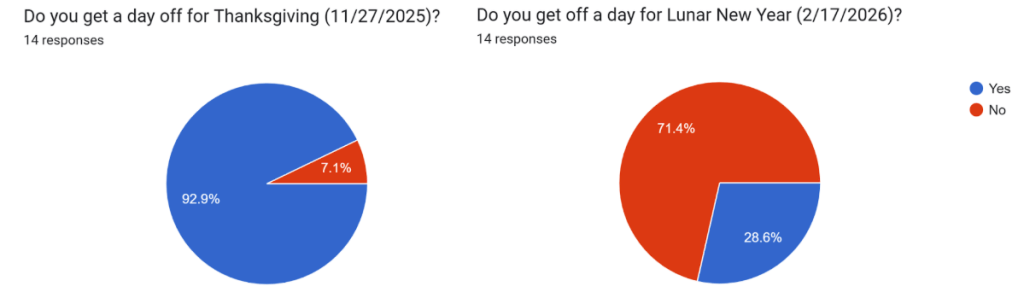
However, only four out of fourteen students had a day off for Lunar New Year, three out of fourteen for the beginning of Ramadan, and four out of fourteen for Diwali. Furthermore, seven responders stated that they either did not receive days off or their days off for cultural holidays are labeled as Professional Development/Work Days, rather than with the name as the holiday.
The lack of days off for AAPI cultural holidays reflects a lack of acceptance from the administration of many legislatures across the country. If AAPI holidays are not recognized in the same way as Christian holidays like Easter, it will only perpetuate the notion that AAPIs are “outsiders” to the country. As such, it is important to advocate for the inclusion of AAPI holidays as days off, as well as recognize the names of these holidays as more than Professional Development Days.
There are several ways to do so. One can contact members of their county’s Board of Education or their state’s legislature (by contacting either their district’s state delegate or state senator — though these specific positions will vary by state) with a proposal to mandate the AAPI holiday inclusivity. Should such a bill have already been proposed, they can testify for the bill in the relevant Board of Education or state legislative meeting.
For AAPIs, especially the younger generation, it is vital to speak up for the recognition of Asian culture. Starting from the lack of inclusivity for cultural holidays, AAPIs must fight for their seat at the table, both through political participation and advocacy, and change the stigma of AAPI faces as “perpetual outsiders.”

 The AAPI Angle
Leave a comment