
The late-afternoon sky over the Tai Po neighborhood in Hong Kong blazed an ominous canvas of orange and black as fire raged through eight blocks of Wang Fuk Court, a housing estate, and smoke filled the air. On Wednesday, November 26, 2025, at around 2:51 pm local time, the fire was first reported, but it quickly evolved into an inferno. What began as a renovation turned into a cataclysm, and as of the time of this story’s publication on November 30, at least 146 people are dead, with dozens still unaccounted for.
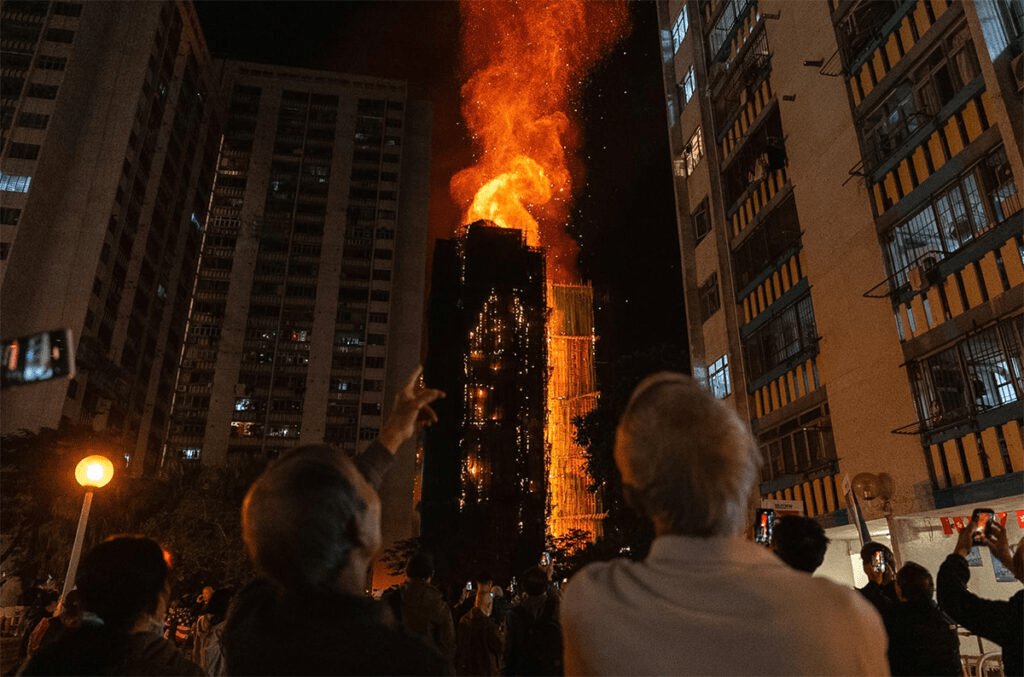
Residents look at the flames engulfing a building at Wang Fuk Court on Nov. 26, 2025. Source: AP Photo/ Chan Long Hei
Fires, tragically, are not unfamiliar to Hong Kong. Because of the city’s vertical living, aging towers, and frequent renovations, residents have witnessed horrific fires like the 1996 Garley building fire in the past, which claimed 41 lives. Yet, the Wang Fuk Court fire this past week is likely the deadliest Hong Kong has seen since World War II. Less than four hours after initial reports of the fire, it was declared a No. 5 alarm, the highest level of warning in Hong Kong.
According to a Reuters investigation, the fire started at the complex’s lower-level enclosure of Wang Cheong Court, but quickly spread to nearby blocks (towers) and eventually engulfed seven out of the eight housing blocks at Wang Fuk Court. A combination of bamboo scaffolding, foam panels, and safety netting accelerated the fire.

A graphic showing the origins of the fire at Wang Cheong Court. Source: Reuters
Despite just being in a 2nd-floor apartment, William Li, a 40-year-old office worker, told AP News that “everything went black before my eyes.” He continued, “I thought to myself: I’m in serious trouble.” Another resident, Lawrence Lee, believed that his wife had been trapped in the apartments as the fire raged on. “When the fire started, I told her on the phone to escape. But once she left the flat, the corridor and stairs were all filled with smoke, and it was all dark, so she had no choice but to go back to the flat,” he told Politico.
Thousands of residents, although physically unharmed, lost their housing and life’s possessions. Temporary shelters were established across the city, including the youth hostel and cultural hub Runway 1331, which opened 500 guest rooms to accommodate up to 2,000 affected residents.

One of the many temporary shelters established in support of residents affected by the Wang Fuk Court fire. Source: AP Photo/Chan Long Hei
John Lee, the Chief Executive of Hong Kong, announced on Thursday night that relief funds of 10,000 Hong Kong dollars (about $1,300 USD) would be provided to each household affected by the fire. Concurrently, Lee also established an HK$300 million (about $38.5 million USD) relief fund for the housing estate and affected individuals.
On a global scale, an outpouring of domestic and international support surged almost instantly. Among the leaders who expressed their condolences to the people of Hong Kong affected by the fire were President Xi Jinping of China, Prime Minister Sanae Takaichi of Japan, King Salman bin Abdulaziz Al-Saud of Saudi Arabia, and officials from the U.S. State Department.
Hong Kong’s upcoming Legislative Council elections on December 7th remain in jeopardy due to the fire. Two of Hong Kong’s primary political parties – the New People’s Party and the Democratic Alliance for the Betterment and Progress of Hong Kong – announced their decision on Wednesday to suspend campaigning amidst the crisis. However, as response efforts transitioned from search-and-rescue to broader stabilization work, it appears increasingly likely that the elections will take place as scheduled. One election candidate told the Hong Kong Free Press that he had not received any information about possible postponements and expected no changes in schedule.
The fire also highlighted significant systemic issues within the renovations at Wang Fuk Court. As far back as September 2024, residents of the estate had written to the city’s Labor Department that both the netting and the foam panels used were potentially flammable, according to The New York Times.
At the time, the Labor Department had dismissed the residents’ concerns, informing them that the materials met fire safety requirements.
Nonetheless, Hong Kong police arrested three men from a construction firm on suspicion of manslaughter and gross negligence on Wednesday night. It remains unclear whether the three men are associated with Prestige Construction & Engineering Company, the entity responsible for the renovations. The three men were released on bail, but subsequently arrested again by the Independent Commission Against Corruption. A separate corruption investigation is also underway.
China subsequently announced that it would conduct a sweeping inspection of fire-safety standards on Saturday. The Ministry of Emergency Management said in a statement that special attention would be paid to buildings undergoing external wall renovations and interior modifications.
The United States, China’s most prominent economic and political competitor, had previously dramatically updated its fire safety standards after the September 11 terrorist attacks, including changes to first responder networks and building codes. The National Institute of Standards & Technology, an agency under the U.S. Department of Commerce, maintains a Fire Research Laboratory to understand fire behavior and structural response to fire.
Hong Kong mourns – at least 146 dead, thousands irreparably affected. Yet this disaster must not only be remembered as a tragedy, but also a clarion call. For Hong Kong, a bustling metropolis, this blaze can serve as a turning point. When homes ascend into the sky, human dignity demands that safety standards rise with them.
 The AAPI Angle
Leave a comment