This article was written by Melinda Liu.
Editor’s Note: This article was written during the October-November 2025 government shutdown, but food security among Asian-Americans is such an underrepresented yet critical topic.
It’s October 1st, 2025, at midnight. The U.S. government has entered a shutdown because Republican and Democratic lawmakers in Congress are locked in a standoff over a budget. Most US government services are suspended, and “around 1.4 million federal employees are on unpaid leave or working without pay,” per BBC.
The Trump administration has also attempted to lay off around 4,000 employees, though a judge has thus far blocked that move. As of October 22nd, “votes to reopen the government have failed 11 times in the Senate.”
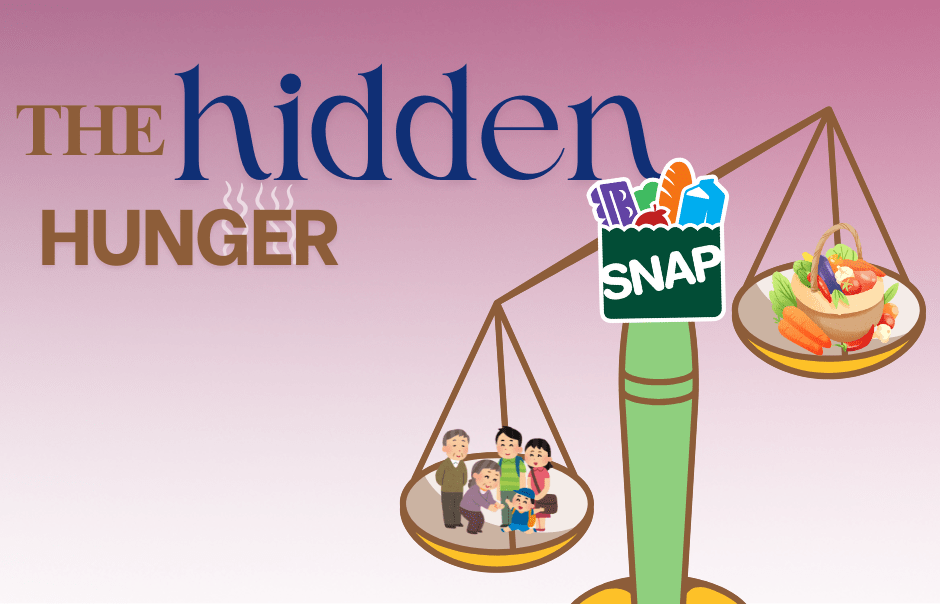
No government operation also means no funding for many vital programs. At the forefront of the current discussion is the Supplemental Nutrition Assistance Program (SNAP).
SNAP “provides food benefits to low-income families to supplement their grocery budget so they can afford the nutritious food essential to health and well-being,” according to the U.S. Department of Agriculture. Staple foods for a household can be purchased with SNAP, while items such as supplements and alcohol cannot be. SNAP eligibility depends on various factors, including household income and number of dependents.
On the USDA’s website, a banner announced that SNAP benefits would no longer be distributed using federal funding as of November 1st. “Bottom line is, the well has run dry,” the message states, while simultaneously blaming Congress Democrats for the current predicament. “Senate Democrats have now voted 12 times not to fund the food stamp program,” it says– Democrats who are supposedly “[continuing] to hold out for healthcare for illegal aliens and gender mutilation procedures.”
Some individual states pledged to use their own funds in the absence of federal money, but they were not reimbursed upon the government shutdown’s end. Massachusetts, where one million people would lose benefits without federal funding, does not have enough money to completely cover the hole that will be left by SNAP, just like many other states.
Forced to find alternatives like food banks, California, for example, deployed its National Guard to help distribute food.
On October 31st, just one day before funding was due to run out, a Rhode Island federal judge ruled that the USDA must distribute the money owed to SNAP recipients as soon as possible. Previously, on the same day, another judge had ruled that it was unlawful not to pay out SNAP during the shutdown.
Following the reopening of the federal government in November, SNAP benefits were reinstated and paid for the month of November. However, despite the end of the shutdown, changes are still coming to SNAP, “which will include new work requirements, decreased eligibility for refugees and states shouldering some of the cost of the program,” as part of President Trump’s “Big Beautiful Bill,” signed into law in July. It’s estimated that more than 3 million Americans, among them Asian Americans, could lose crucial benefits as these changes go into effect.
Food security in the AAPI community is a scarcely discussed but still fundamental issue. A 2024 Johns Hopkins University study notes that “there remains a significant gap in knowledge about food insecurity among Asian Americans,” and Asian Americans are often missing from national discourse on food insecurity. They are frequently not directly included in national studies and reports on this issue.
The same study found rates of food insecurity as high as 47.6% among groups of Hmong origin. In addition, upper estimates for Filipinos were put at 41.1%, 28.2% for Vietnamese people, and 22.2% for Koreans (note: these are the very upper range of estimates provided by the study).
According to calculations done in 2022 by Feeding America, recent immigrants from several Asian and Pacific Island nations faced high rates of food insecurity – Bhutan having the highest, at 30% and China having the lowest, at 3%. Nations like Bangladesh (17%), India (12%), Thailand (10%), and Vietnam (8%) fall somewhere in the middle of that range.
A 2023 study by Health Affairs in California found that Asian Americans had lower participation in CalFresh (California’s implementation of SNAP) than Black, Hispanic, Latino, and white people. The study concluded that barriers to CalFresh enrollment among Asian Americans may include “cultural stigma, lack of knowledge, complicated application and verification processes, insufficient outreach, and federal immigration policies.”
Some have also speculated that the model minority myth –which is the belief that Asian Americans are more successful and less disadvantaged than other minorities–perpetuates the belief and stigma around food insecurity.
Another barrier is language, with information about free food and groceries often only being available in English, “which [may limit] Asian American access to critical food supports and increase their stress when they do.”
Also, “many foods offered at free grocery and meal sites aren’t the traditional foods [AAPI] families are accustomed to, know how to prepare, and feel culturally connected to,” strengthening the distance between the AAPI community and food benefits programs. As one interviewed individual put it, “[I’m] trying to change my taste, but it’s hard not to eat Korean food.”
In addition, Asian Americans are a complex group originating from many cultural and ethnic backgrounds. While some of these groups generally struggle less with food insecurity, many frequently do.
There is a massive income inequality between different groups of Asian Americans, seeing as “household incomes for Americans of Asian Indian, Filipino, Japanese, and Chinese descent are often found on the higher end of the wealth spectrum, while Americans of Cambodian, Laotian, Hmong, and Vietnamese descent often live well below the federal poverty level or struggle with chronic unemployment.”
The Pew Research Center found, in particular, that income inequality is rising most rapidly in Asian Americans. “Asians displaced blacks as the most economically divided racial or ethnic group in the U.S,” the Center reported after analyzing available government data.
Treating all Asian Americans as a uniform whole, rather than an economically, socially, and culturally diverse group, when researching economic issues, could pose a problem, as seen in the particular case of food insecurity.
The overgeneralization of all Asian Americans into one broad racial category has “minimized the individual struggles of each ethnic group, including disparities in poverty levels and health outcomes across multiple populations.”
With the distribution of SNAP benefits now deeply uncertain, food insecurity is at the forefront of the nation’s consciousness once more. While commonly overlooked, food insecurity among Asian Americans is an essential and widespread issue, worsened by a variety of societal and cultural factors. As the situation regarding SNAP and the government shutdown continues to change and develop, it is essential to remember the specific and often hidden struggles that minority populations like Asian Americans face.
 The AAPI Angle
Leave a comment