
This article was written by Hansen Zhang.
In the midst of the Trump administration’s release of the United States’ National Security Strategy in early December, much emphasis has been placed on the president’s warnings of a “prospect of civilizational erasure” in Europe within the next twenty years. Yet, President Trump has had plenty to say about his administration’s dealings and plans in Asia. These include significant economic and foreign policy with China, continuing relations with Japan and India via “the Quad” alliance, and tapping into resources in the Gulf States. Nonetheless, throughout the entire document, the administration maintained a continuous theme of ‘America First.’
The National Security Strategy (NSS) is a report usually sent by the President to Congress that conveys the executive branch’s vision for national security to legislators. The Goldwater-Nichols Department of Defense Reorganization Act of 1986, under the Reagan administration, established the precedent for the report, which is meant to be transmitted annually but is often released only once a term.
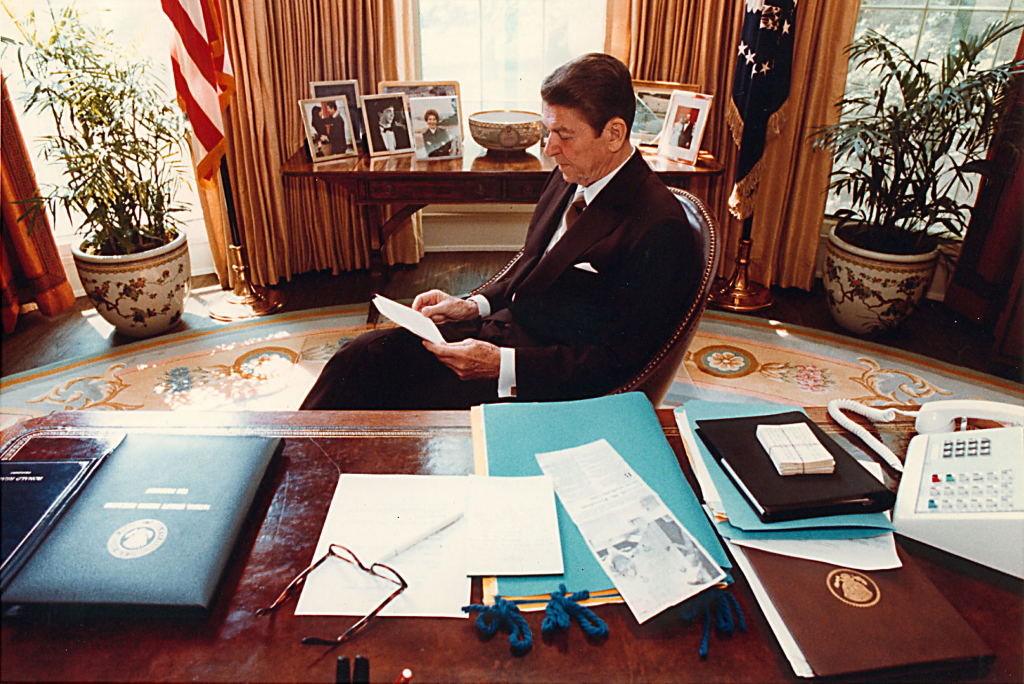
President Ronald Reagan, whose administration introduced the National Security Strategy. Source: U.S. Army War College
In terms of foreign policy, the NSS is obligated to provide an update on the United States’ international interests, objectives, and policies. Mr. Trump’s first administration released its National Security Strategy in December 2017, and noted how Russia and China “seek to challenge American influence, values, and wealth.”
In contrast to his predecessor, Barack Obama, who saw China as a potential partner in combating mutual global threats, Mr. Trump wrote in his first NSS that China was a “revisionist” power with significant economic influence and reach. He also declared his prioritization of the “national security innovation base” through limiting China’s investment in American technology companies.
However, in the NSS released just days ago, Mr. Trump seems to adopt a less vigorous tone toward China’s economic policies. The document declares, “we will rebalance America’s relationship with China,” and proposes continuing mutually advantageous, balanced trade with China– albeit with America maintaining its status as the world’s leading economy.
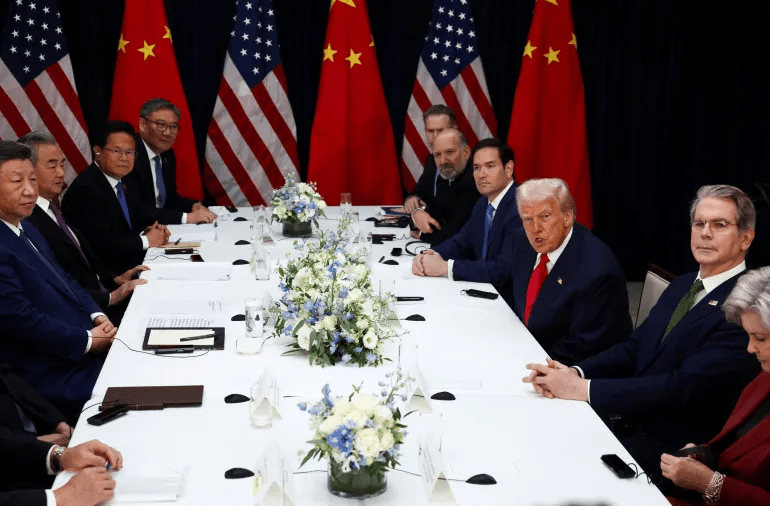
President Trump and Chinese President Xi Jinping meeting in Busan, South Korea, on Oct. 30, 2025. Source: Evelyn Hockstein/Reuters
A passage about ‘America First’ diplomacy within the NSS also encouraged America’s allies– namely, the European Union, Japan, Korea, Mexico, Canada, and Australia– to change their own trade policies to indirectly fix China’s economic model. Through these nations’ policy changes, Mr. Trump proposes that China would be forced to consume more at home rather than flood the rest of the world with its exports.
Accompanying this economic policy, Mr. Trump writes, must be a “robust and ongoing focus on deterrence to prevent war in the Indo-Pacific.” The Indo-Pacific region, which broadly encompasses the maritime area between the Indian and Pacific Oceans, has emerged as what many consider the most important economic region of the 21st century.
In the NSS, Mr. Trump identifies numerous threats to America within the Indo-Pacific in the status quo, including but not limited to predatory state strategies, unfair trading practices, espionage and intellectual theft, limitations of U.S. access to critical resources, propaganda, and drug exports.
To combat such harms, Mr. Trump emphasizes the importance of improving relations with India alongside the other members of “the Quad,” Japan and Australia. Japan’s Prime Minister Sanae Takachi, a hard-line conservative, is a close friend of Mr. Trump. Still, she also angered China just weeks into her job in November 2025, when she indicated that Japan would take military action if China tried to seize control of Taiwan.
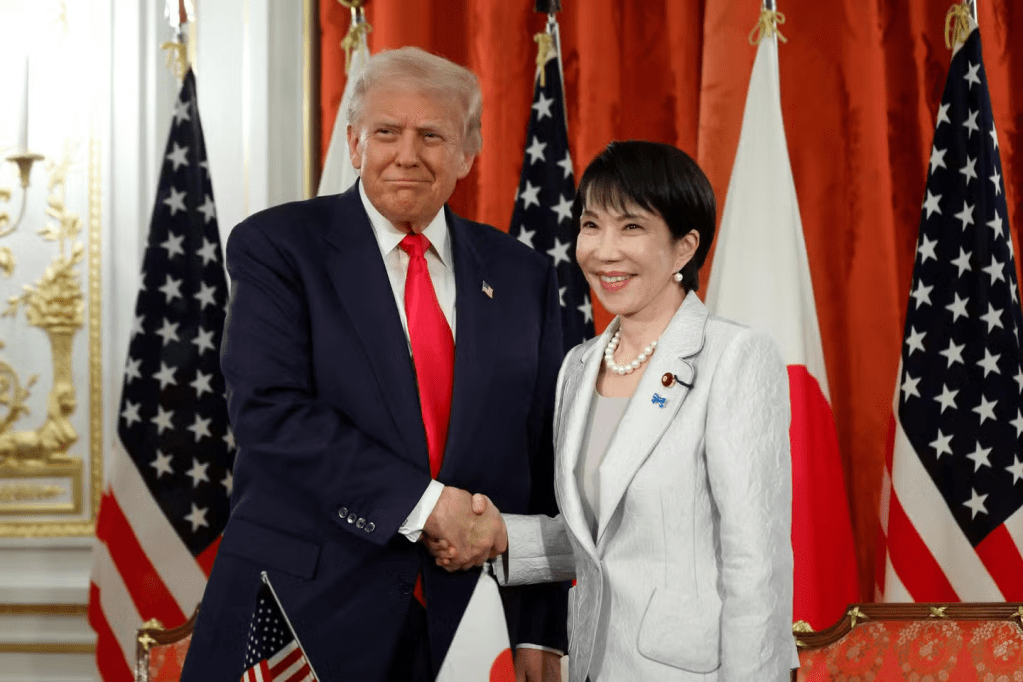
President Donald Trump and Japanese Prime Minister Sanae Takachi in Tokyo on Oct. 28, 2025. Source: Kiyoshi Ota/Reuters
Taiwan has been a long-standing part of American foreign policy– and this year’s NSS shows no difference. Unsurprisingly, America’s declaratory policy on Taiwan has not changed, where it does not support “any unilateral change to the status quo in the Taiwan Strait.”
Furthermore, Mr. Trump notes that while America will build a military capable of defending against aggression, it “should not have to do this alone.” He calls on America’s allies in the region to build up their own defenses and work together to combat any “hostile power” seeking to control the South China Sea.
Finally, the NSS mandates that the United States must invest in research in technological aspects, including undersea, nuclear, and space, but also recently developed domains– AI, quantum computing, and autonomous systems– that will propel and shape the U.S. military in the future.
To achieve this, the United States must maintain deep partnerships with the Persian Gulf countries. Mr. Trump’s May 2025 state visits to Qatar, Saudi Arabia, and the United Arab Emirates were instrumental in securing these nations’ continued support for U.S. artificial intelligence. Relations with Saudi Arabia appeared even more amicable in November 2025, when Mr. Trump hosted Crown Prince Mohammed bin Salman and elevated Saudi Arabia to the role of a major non-NATO ally.

U.S. President Donald Trump with Saudi Crown Prince Mohammed bin Salman in the White House on Nov. 18, 2025. Source: Evelyn Hockstein/Reuters
Evidently, the Trump administration’s 2025 National Security Strategy intricately casts the geopolitics within Asia. From economic policy in China to threats in the Indo-Pacific, from technology in the Gulf States to persistent vigilance over Taiwan, a coherent theme of ‘America First’ emerges in Asia’s hotbed.
 The AAPI Angle
Leave a comment