This article was written by Melinda Liu. The article cover was designed by Eileen Wu.
If you spend a fair amount of time online, you may have encountered the meme dubbed “You Met Me At A Very Chinese Time In My Life,” a phrase parodying dialogue from Fight Club (1999). Popularized in 2025 and still increasing in visibility in 2026, the phrase is often “[shared] alongside videos or images related to visiting China, being a Chinese person or doing something stereotypically Chinese.”
The meme originated in April on X (formerly Twitter), in a post gaining thousands of likes and reposts very quickly, and then it “spread over the following months, inspiring a variety of memes on sites including X, Instagram and TikTok.” Know Your Meme calls the phrase “ultimately meaningless and purposefully absurd,” like a great deal of other internet humor. However, the trend of “being Chinese” and interacting with Chinese culture is a symptom of a larger phenomenon in American and Western society.
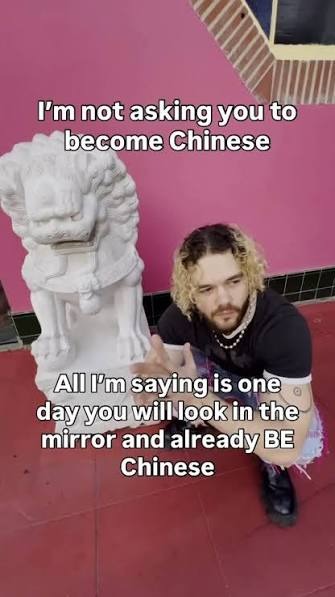
There is evidence that material conditions in the US have deteriorated. As the American Compass puts it, American capitalism in the last fifty years has “[failed] to deliver widespread prosperity for the American people.”
A study published in nature cities reports that “systemic, compounding pressures on households’ capacity to reproduce themselves on a daily and societal basis is forcing urban households into more precarious living arrangements.” The increasing economic pressures in the US have made the appeal of China greater in the eyes of many young Americans.
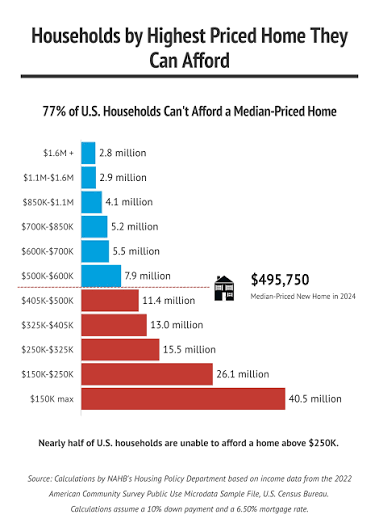
Young Americans are “aesthetically, morally and politically defecting to another superpower.” On social media, people can be seen “drinking hot water in the morning, doing tai chi in their kitchens, [and] perfecting their chopstick skills and sporting Adidas track suits to achieve the elderly man in Beijing look.” As journalist Taylor Lorenz puts it, “It seems like this paradise almost that Americans can kind of, like, project their hopes onto because our country feels so hopeless.”
Rikki Schlott, writing in the New York Post, points out that “[China’s] Communist Party is complicit in countless human right violations, as well as genocide of the Uyghur people,” in addition to stifling free speech and other liberties such as religion and access to news sources. She ultimately claims that “all-out cosplaying as Chinese is embarrassingly naive.” Though many may have a negative view of economic conditions in the US, Schlott argues that it is dangerous to blindly idolize another complex country that also has flaws and imperfections.
Another explanation for the emergence of the trend is China’s growing cultural influence. China’s influence has “[reached] global audiences through animated blockbusters, designer toys and innovations in artificial intelligence and robotics.” China’s soft power is “a phenomenon reflected in the country’s high ranking on the Brand Finance 2025 Global Soft Power Index, and the surging popularity of Chinese social platforms like RedNote, or Xiaohongshu.”
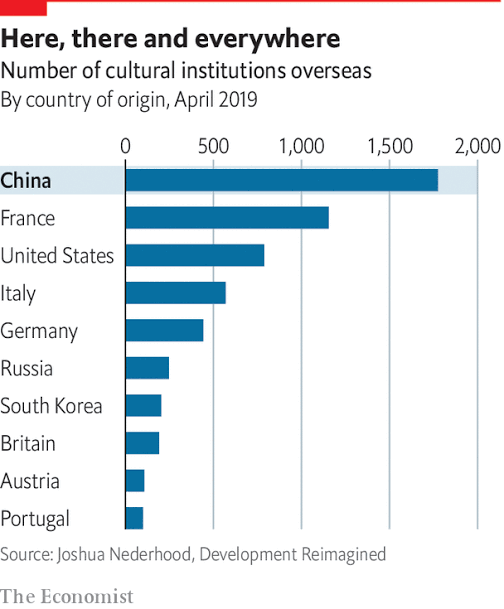
Qu Qiang, an expert in regions and country studies at Minzu University in Beijing, states that the trend is a product and reflection of “the enduring appeal of Chinese civilization and a Western search for balance amid social fatigue and division.”
Following “a nationwide TikTok ban was looming in the United States, [where] many American users flocked to the Chinese social media app RedNote,” there was also a significant cultural exchange between American internet users and their Chinese counterparts. A great deal of travel content featuring foreigners interacting with Chinese citizens and culture has also helped put the country — which has a separate internet ecosystem — on the radar of more people in the West.” One Chinese-Italian TikTok user summarized her thoughts as, “For a long time, Chinese culture was stereotyped as poor, rude, uneducated, smelly or loud, [and now] people are seeing it as a culture with centuries of history and wisdom.”
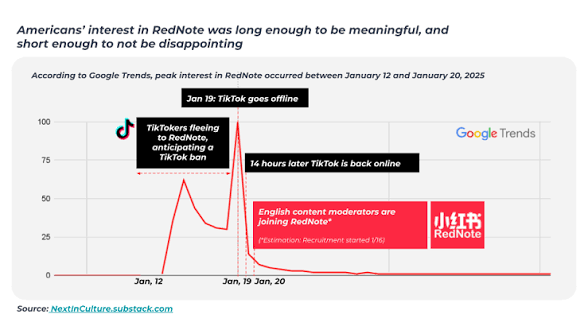
Interest in RedNote over time, compared to the timeline of the TikTok ban in the US.
This is a marked change from the post-Covid-19 (a disease that originated in Wuhan, China) surge in anti-Asian and anti-Chinese hate. In 2021, according to the Pew Research Center, one third of Asian American adults reported that they “feared someone might threaten or physically attack them – a greater share than other racial or ethnic groups.” In addition, Asian Americans reported “being shamed in both public and private spaces” and “being afraid to speak out because of how it might impact their immigration status.” Now, Chinese culture is welcomed, shared, and consumed, rather than being judged and mocked. Being Chinese, in Western society and culture, is now a commodity.
As the South China Morning Post puts it, “white people eagerly claiming that they are ‘becoming Chinese’ is not something we would have ever predicted back in 2020 when very similar people were lambasting Chinese people for eating bats and setting off a global pandemic.”
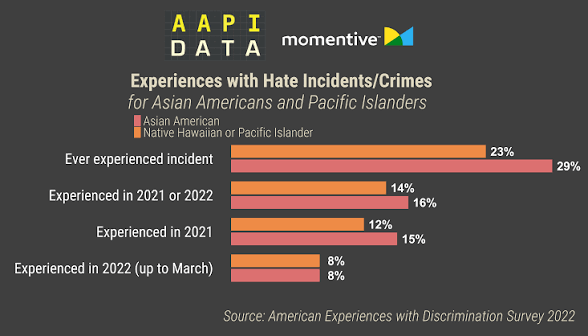
Thus, one criticism of the “chinamaxxing” trend comes directly from the Asian and Chinese American diaspora. Cultural appropriation “takes place when members of a majority group adopt cultural elements of a minority group in an exploitative, disrespectful, or stereotypical way.”
The same culture that was mocked in the years following 2020 is now something to strive towards. But does the trend cross the line from cultural appreciation into appropriation?
Many don’t think so. Jiefan Alan, a Chinese-Canadian thinks “the trend feels more like appreciation than mockery.” He states that “[the trend] is something that is really solid that you can take with you for the rest of your life.”
Similarly, another Chinese-Canadian content creator named Felisha Liu says that, “I love it so much because any kind of positive Chinese representation in the media … it’s like cool to be Chinese now, which I absolutely love.”
Both of them, and many other members of the Chinese diaspora “[encourage] people to explore these traditions respectfully while learning from the practices,” and it seems that “a lot of people are seeing it as a celebration, not appropriation.”
Others critique the “massive social media movement” as “[frequently] walks the line between cultural appropriation and appreciation.” After all, being Chinese is not as simple as “[discovering] the joy of goji berries and jujubes for women’s health” or “drinking hot water instead of iced water.” Critics point out that “some videos perpetuate stereotypes or cross the line into cultural appropriation.” They state that people should “approach cultural traditions with respect and understanding, rather than reducing them to viral content.”
So is the trend cultural appropriation or appreciation? Is it just a meaningless meme or is it a symptom of American politics and China’s soft power? Whatever the answers, those who find themselves at a “very Chinese time of their lives” are at the crossroads of increasingly complex relations between the East and the West, facilitated by social media that brings clashing worlds closer together.
 The AAPI Angle
Leave a comment