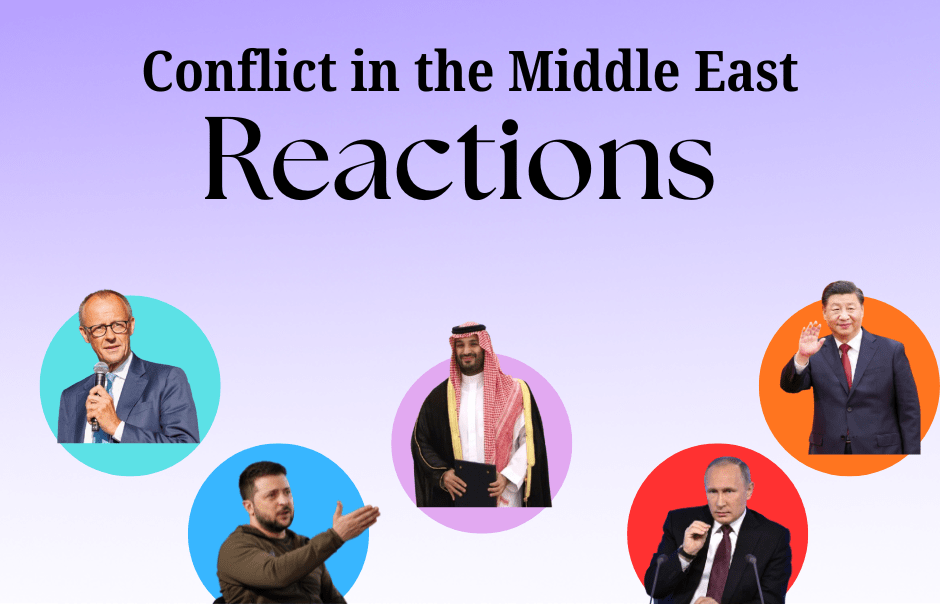
With the United States and Israel being increasingly isolated from the world stage due to the Gaza conflict and associated humanitarian crisis, while Iran remains an international pariah, the current war in Iran has drawn a mixture of celebration, concern, and outright condemnation.
As such, examining international reactions is critical for understanding the Iran conflict in the eyes of other governments, as well as for catching early signs of other nations joining the war. This article will provide a region-by-region overview of how various ministries, foreign affairs departments, and spokespersons have responded so far.
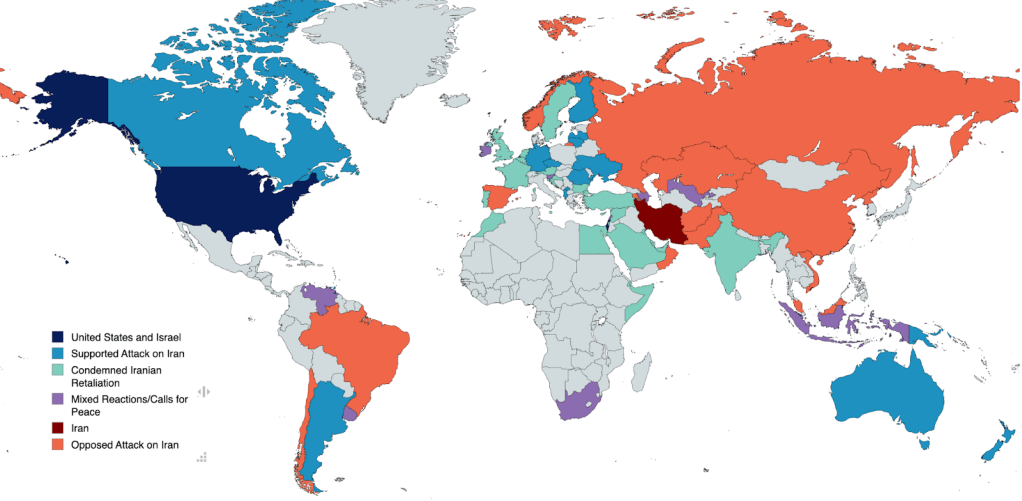
A general country-by-country summary of individual reactions.
The Middle East: Ground Zero
Many countries in the Middle East – the center of the Arab world – including Saudi Arabia, the United Arab Emirates, Kuwait, and Qatar, have historically been key allies of the United States and hostile to Iran. Iran has maintained an “Axis of Resistance” that seeks to combat and uproot the influence of the current Saudi-led coalition. Additionally, most have also been directly targeted by Iranian attacks recently, causing further strain to the already-tense relationship.
- Saudi Arabia’s foreign ministry, whose Crown Prince Mohammed bin Salman reportedly secretly lobbied Trump to attack Iran, condemned Iranian strikes on its capital, Riyadh, and oil-rich eastern territories as “blatant and cowardly Iranian attacks.” However, Saudi Arabia has also publicly adopted a stance of diplomatic neutrality, with the great power forbidding the United States from using its territory or airspace to attack Iran.
- The United Arab Emirates condemned in the “strongest terms” Iran’s attacks on its territory, which have also included civilian targets in Dubai. It called the attack “a dangerous escalation and a cowardly act that threatens the security and safety of civilians”, stressing that the UAE has the “full right” to respond.
- Oman, which previously hosted peace talks between the United States and Iran, expressed dismay at the escalation. Foreign Minister Badr Albusaidi said the conflict would not serve US interests, expressing a need for America “not to get sucked in.”
Reactions were far more polarized in terms of stateless entities and militias, of which there are many in the Middle East.
- Lebanon’s Hezbollah, a key ally of Iran and an influential force in the deeply unstable country, condemned the US-Israeli attacks as a “blatant violation of international law and the United Nations Charter.” Hezbollah later launched several strikes on Israel, prompting Israel to enter southern Lebanon.
- Kurdish, Iranian, and Iraqi dissident groups, which have been fighting the Iranian government for several decades due to government repression and marginalization, have been notably positive to the current attacks. Since then, Iraqi Kurdish leaders have been in contact with the Trump administration and are reportedly planning to invade Iran.
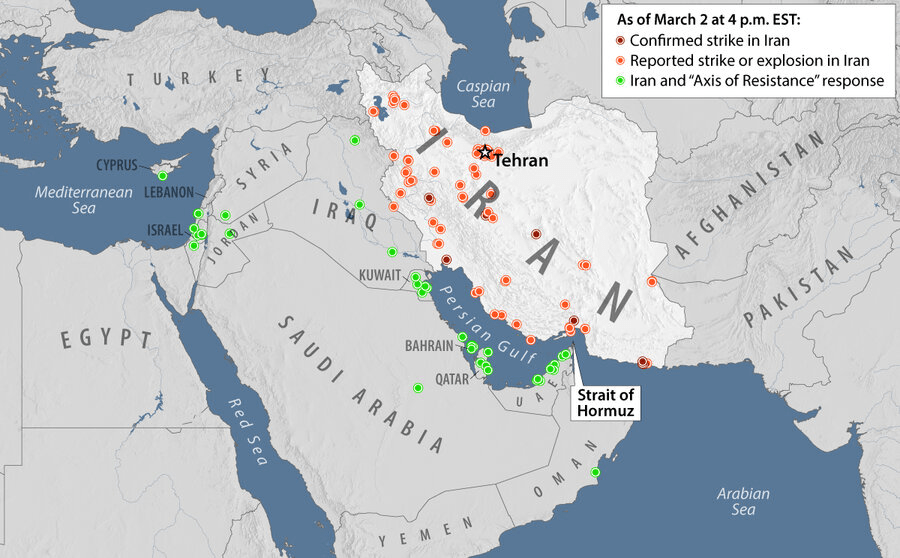
In response to the attacks, Iran has launched a barrage of missiles at several Middle Eastern nations that have historically been its rivals in the region, including Kuwait, Saudi Arabia, and the UAE. Most of these nations have since condemned Iran’s escalation. Source: CSMonitor
Europe: Mixed Reactions
America’s European allies, many of which have historically criticized American intervention in the Middle East and “nation-building” campaigns, showed a variety of reactions, from open support to condemnation to calls for peace.
- German Chancellor Friedrich Merz lauded the attacks as striking “a terrorist regime responsible for decades of oppression of the Iranian people,” stating that Germany “share[s] the interest of the United States and Israel in seeing an end to this regime’s terror and its dangerous nuclear and ballistic armament.”
- Ukrainian President Volodymyr Zelensky, who has undergone a complex series of ups and downs with the United States under President Trump, similarly praised the attacks as showing how “the United States is acting decisively.” Zelensky called Iran, which has supplied Russia with weapons and supplies during its invasion of Ukraine, a “terrorist regime.”
- President of France Emmanuel Macron issued a joint statement with British Prime Minister Keir Starmer, along with Merz, condemning “Iranian attacks on countries in the region in the strongest terms.” Both France and the United Kingdom have sent warships to the Mediterranean since then.
- Heavy criticism came from Spanish Prime Minister Pedro Sanchez, breaking with the generally positive reactions from most of America’s traditional European allies to call the escalation a “breakdown of international law.” Sanchez, a prominent critic of Trump, refused to allow the US to access jointly run bases at Morón and Rotafor to attack Iran, prompting Trump to threaten economic retaliation.
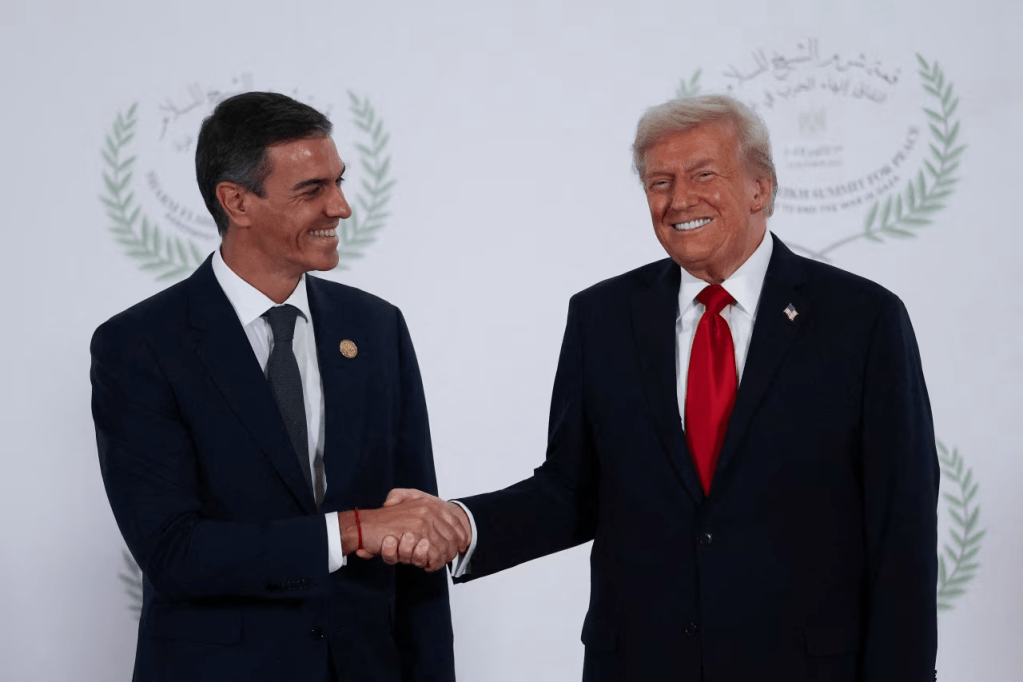
Spanish Prime Minister Pedro Sanchez, left, meeting President Trump at Sharm el-Sheikh, Egypt, in 2025. Sanchez has emerged as a prominent critic of Trump, calling his escalation a “disaster.” Source: Reuters
Eurasia: Unfriendly Territory
It is little surprise to say that the joint American and Israeli attacks were strongly condemned by countries like Russia, China, and North Korea, all of which have been long-term partners of Iran and traditional enemies of the US.
- China’s Foreign Minister Wang Yi derided the attacks, which involved the assassination of Iranian Supreme Leader Ali Khamenei and other state officials, as a “blatant killing of a sovereign leader” and “unacceptable.” Iran has been a crucial partner of China due to the nation’s large oil reserves, with nearly 80% of Iranian oil going to China in 2025.
- Russia’s foreign ministry condemned the strikes as a “reckless step” and a “deliberate, premeditated, and unprovoked act of armed aggression.” It also stressed that the attacks carried out “despite Tehran’s openness to dialogue,” referring to the previous Oman-mediated talks that were ultimately terminated by the incitement of the current conflict.
- North Korea, which has often collaborated with Iran to develop ballistic missiles and other heavy weaponry, said that the attacks were “illegal aggression” that represented the “hegemonic and gangster-like” nature of the United States.
In general, these reactions, whether positive, negative, or somewhere in between, show the deeply polarizing nature of Trump and Netanyahu’s foreign policy actions, even against generally unpopular nations such as Iran. As the war drags on, two major things to consider are what steps Middle Eastern countries take (if at all) to assist the United States and combat Iran, and whether or not America’s traditional European partners can come to a consensus on the justness of the attacks, something the split bloc currently has not achieved.
 The AAPI Angle
Leave a comment