
This article was written by Melinda Liu.
In a time when China is increasingly at odds with the Western world, it may be surprising to learn that much of its younger generation holds quite positive views towards China.
For example, one needs to look no further than the “chinamaxxing” trend, a showcase of a growing appreciation and fascination with Chinese culture, as well as an example of China’s cultural soft power. While political and economic tensions remain high, the ordinary young people of the United States and Europe hold marginally different views on China.
The reasons for this phenomenon are numerous – distaste for the economic and political situations of Western nations, cultural exchange facilitated by the internet, Chinese soft power, and more. Whatever the causes, it is clear that young people increasingly admire and express positive feelings towards China. To provide a clear and complete picture of the general attitudes among Europeans and Americans, one should examine recent surveys and statistics.
For instance, the Pew Research Center found that across most countries, young people had a more favorable view of China than older people. It also found that the largest gaps between generational views were “in Poland, the United Kingdom and Canada, where adults under 35 are 27 or 28 points more likely than those ages 50 and older to view China positively.”
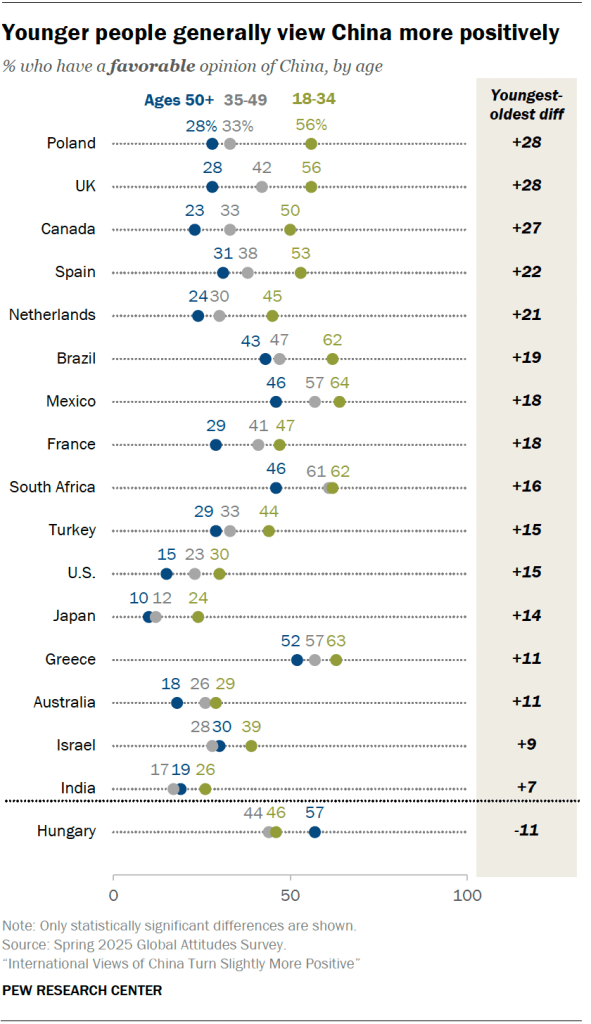
Young people vs older people’s views of China across multiple countries. Source: Spring 2025 Global Attitudes Survey, Pew Research Center.
In January of 2025, with a possible ban on TikTok looming, millions of US TikTok users moved to Chinese platform Xiaohongshu (RedNote) as “refugees.” American creators and internet users were given “their first glimpse into the lives of ordinary Chinese youth, including contemporary Chinese subcultures.” 4 in 10 TikTok users are between the ages of 24 and 35, while most creators are Gen Z, meaning that many who made the move are young adults.
In addition, the trend continues in Europe with “a majority of young Spaniards, Brits, Poles, and Greeks view[ing] China favorably.” These positive views are not reflected as clearly in the Indo-Pacific, a region where China poses the most threat militarily, though “views are still somewhat softening across the board, although on a scale much smaller than in Western countries.”
A study published in the journal Contemporary China and World, created by the Academy of Contemporary China and World Studies (ACCWS), a Chinese national think-tank, concluded that “young Americans are a positive and transformative force [in US-China relations].”
The abstract of the study added that “they are generally more favorable toward China, maintain an objective understanding of China’s strengths, and are more inclined to engage in China-U.S. exchanges.”
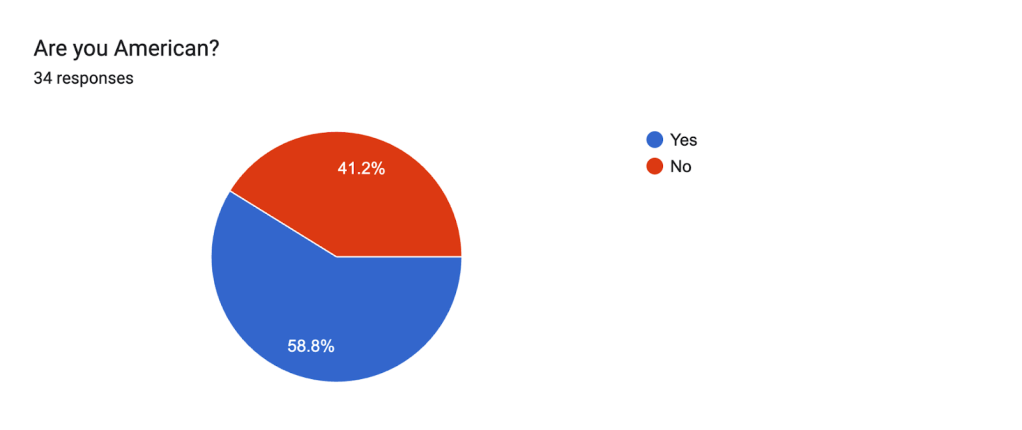
Meanwhile, The AAPI Angle itself just conducted an independent survey of 34 young adults and teenagers, 41.2% of which were not American and 58.8% of whom were.
Around 45% of respondents had neutral or somewhat positive views of China’s government and society, while the rest had somewhat negative or generally negative views.

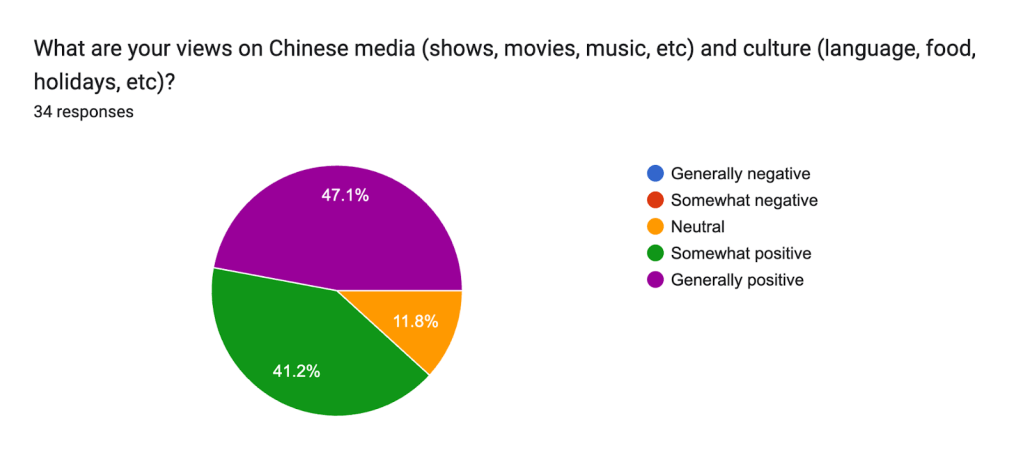
All of the respondents viewed China’s culture and media as neutral to generally positive.
One person who identified as Chinese-Canadian said that they had “[seen] first hand the amount of progress China has made towards infrastructure and transit, [and] the quality of life [is] getting so good and better still.” However, they expressed concerns about the quality of privacy in China.
Another young adult reported that they felt “mostly neutral towards China as a whole, and [their] only negative feelings for it comes from it being a communist country,” while they “[didn’t] hold any animosity towards China either.”
One respondent who identified themself as Turkish said that “[the] people are really nice, the culture is very interesting and is overall positive;” however, they feel they have only been exposed to very negative or very positive views on China.
Another respondent said that they saw China as just another country with problems – “political problems, social problems (ex, internet drama, crime, etc), class disparity, discrimination, and poverty.”
Others expressed that their views had changed as they grew older and educated themselves more, while distaste towards China’s authoritarian regime was also a common sentiment. The range of opinions was primarily neutral to positive.
In conclusion, although the West and China remain at political and economic odds, the views of younger generations in Europe and the US are fluid and constantly shifting. Cultural phenomena such as the RedNote migration and the “chinamaxxing” trend show a gradual shift towards neutral or positive views, some of which were tracked and outlined above. As complex political and cultural landscapes continue to develop, no doubt will views and beliefs change along with them.
 The AAPI Angle
Leave a comment