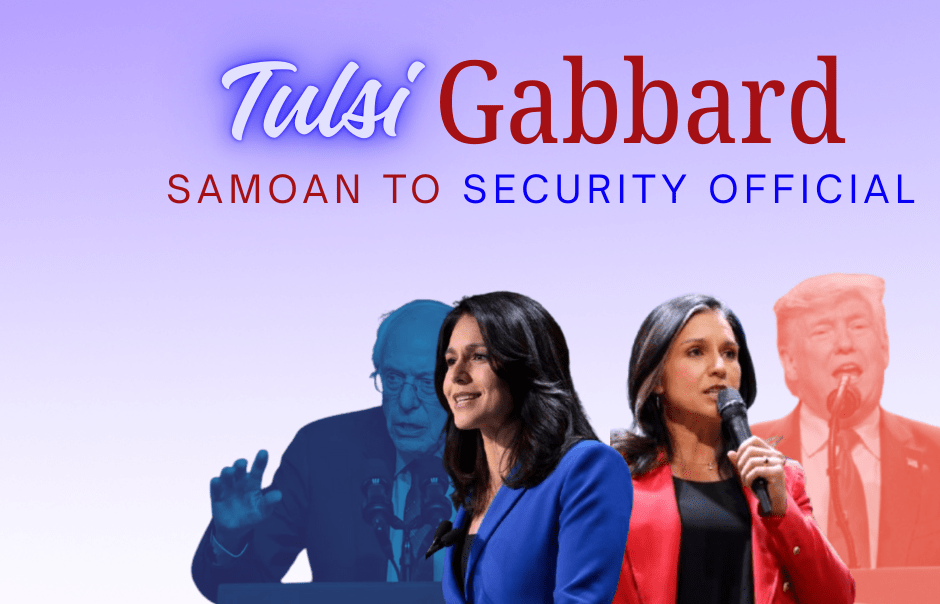
With the upheaval and rapid changes of Trump’s second term, it’s more important than ever to understand not just the man at the top, but also the team shaping his administration. Beyond Trump himself, there are lesser-known figures at the table whose decisions carry significant weight.
That’s why The AAPI Angle is launching Trailblazers and Trump—a series spotlighting Asian American leaders in his cabinet, their paths to power, and the influence they wield today, while keeping it bite-sized and using videos so you don’t have to be disrupted and bored by jargon.
Tulsi Gabbard was born a continent away from our previous subject, Vivek Ramaswamy, who started in a vastly different career. However, she shares more similarities with Ramaswamy than one might think.
Like Ramaswamy, she is a devoted Hindu who has described herself as “[having] made no secrets about it,” even taking the oath of office for the House of Representatives in 2013 with her personal copy of the Bhagavad Gita, a famous Hindu scripture.
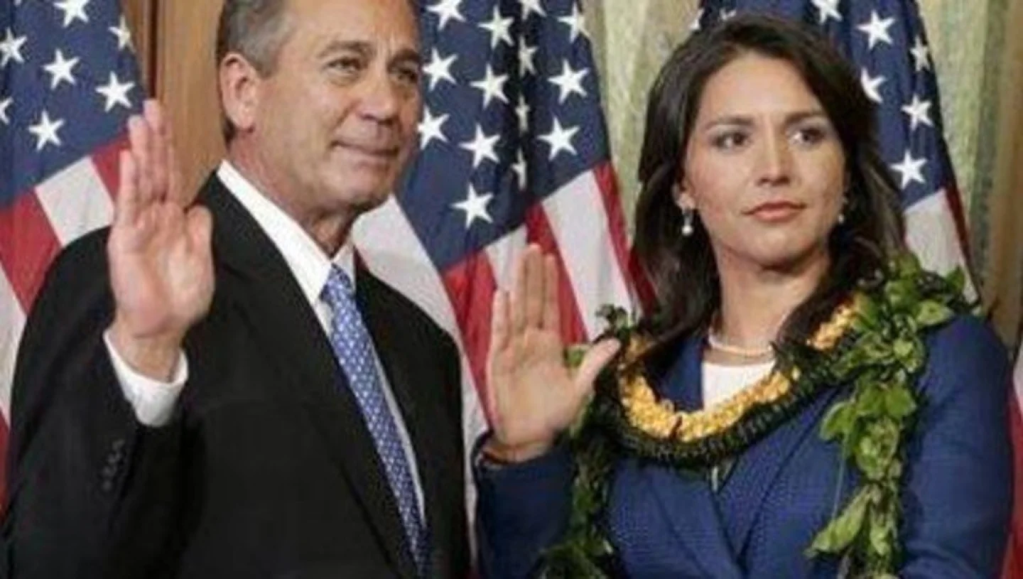
Gabbard was sworn in as the first Hindu in Congress. Source: HuffPost
Like Ramaswamy, Gabbard is a staunch critic of wokeism, believing deeply in its danger, even denouncing the Democratic Party as “an elitist cabal of warmongers driven by cowardly wokeness” when she left it in 2022.
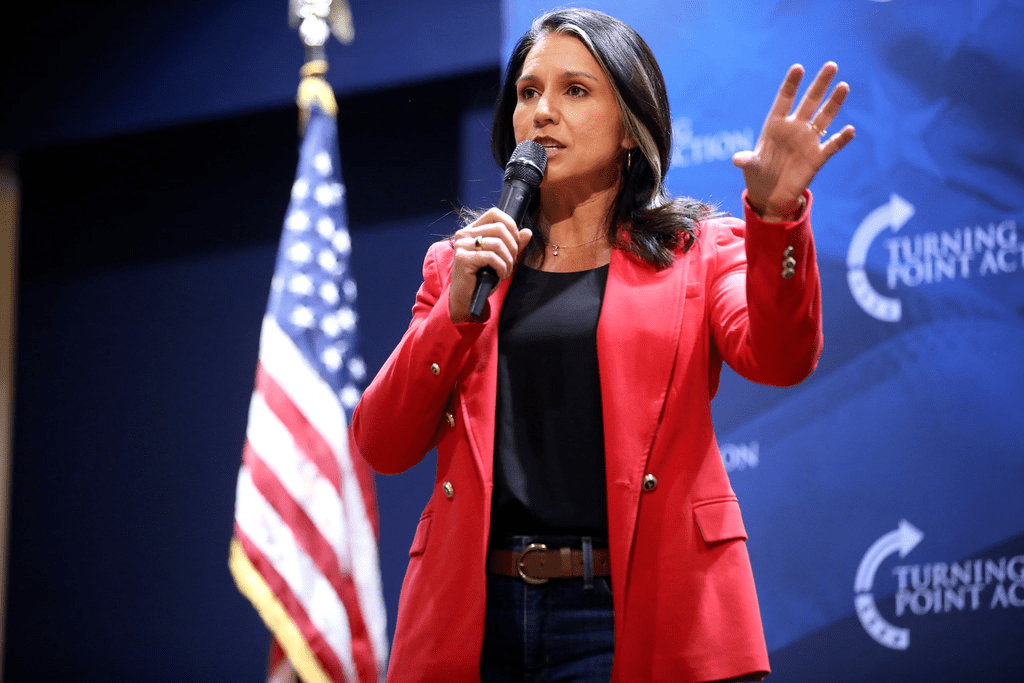
Gabbard, speaking at conservative organization Turning Point USA. Source: Gage Skidmore
And like Ramaswamy, Gabbard is supportive of non-interventionism abroad. She was outspoken in what was viewed as “sympathy for dictators,” such as for the now-deposed Syrian leader Bashar al-Assad. At that time, Gabbard was the only Democrat to oppose a motion to condemn the Government of Syria for crimes against humanity.

A bullet-ridden mural of deposed dictator Bashar al-Assad, who was forcibly removed from power in December 2024. Gabbard has secretly met with Assad in the past, an action that led to controversy during her nomination. Source: AP Photo by Omar Albam
Federal defense and security have been a contentious and rapidly evolving topic – from the recent efforts by the Trump administration to rename the Department of Defense to the Department of War, to tensions over the deployment of the National Guard to Washington, DC, and Los Angeles.
Yet, amidst all the recent developments, the current Director of National Intelligence, Tulsi Gabbard, has remained relatively unmentioned. Today, the AAPI Angle will shine a light on the political evolution of the Samoan from Hawaii, while analyzing how her views have shifted over time.
Gabbard’s participation in politics, unlike many other Republicans, was partially sparked by her parents’ involvement in policymaking – her father, Gerald Michael Gabbard, was (and still is) a Hawaiian state senator. At the same time, her mother, Carol, served on the Hawaii Board of Education.
Despite her family’s Democratic alignment, Gabbard showed support for conservative values at a young age through work on political committees: she worked for Stand Up for America, an organization aiming to increase patriotism in the wake of the September 11 terrorist attacks in 2001, and the Alliance for Traditional Marriage and Values, a political action committee against same-sex marriage. She was elected to the Hawaii State House one year later in 2002, becoming the youngest woman ever elected as a state representative.
“I decided to run for office at 21 years old here in Hawaii because I saw a lot of people in our state legislature who were completely out of touch with the needs of our community,” said Gabbard. “They were more interested in having this cushy, post-retirement, part-time gig as a state legislator, and the attention that goes with it, than they were about actually going into the community to figure out the problems and challenges, and find ways to solve or address them. So I thought, you know what… I can try to do something about it.”
However, before entering federal politics, Gabbard first served in the military. While serving in the state legislature, she enlisted in the Hawaii Army National Guard. Gabbard explained how “in history, some generations have been given everything” before expressing her “honor to have the opportunity to give something.”
Serving in Iraq’s Balad Air Base, she quickly rose through the ranks, being awarded the Meritorious Service Medal and Combat Medical Badge during her service there. Later, she was stationed in Kuwait, where she became the first woman to receive an award of appreciation from the Kuwait National Guard. In 2015, Gabbard was promoted to the rank of major; in 2021, she was deployed to the Horn of Africa as a civil affairs officer.

Gabbard was promoted to the rank of major in 2015.
However, she soon returned to politics. After a stint on the Honolulu City Council, in 2011, Gabbard announced her candidacy for the 2nd Congressional District of Hawaii after incumbent representative Mazie Hirono decided to run for United States Senate, citing a desire to “be of service to all the people of Hawai’i” and “fight for you, our beautiful Hawai’i, and our great country.”
As seen by the interviewer’s tone, Gabbard was seen as an underdog in the Democratic primary, with Honolulu mayor Hannemann generally leading most polls. Source: Island News
Despite facing a contentious primary with candidates such as Honolulu mayor Mufi Hannemann being involved in the race, Gabbard ultimately prevailed with 55% of the vote in a campaign that was described as a “rise from a distant underdog to victory” by the Honolulu Star-Advertiser.
During her nearly 10-year tenure in the House of Representatives, Gabbard was seen as a rising star in the Democratic Party, in part due to her background and youth, as she was in her thirties when first elected. After a decisive victory in the primaries, Gabbard was invited to speak at the 2012 Democratic National Convention by House Speaker Nancy Pelosi, where she commented on her military background and support for then-President Obama and then-Vice President Biden.
Gabbard’s then-strong support for President Obama and national Democrats paints a stark contrast to after she departed from the Democratic Party. Gabbard accused Obama in July 2025 of trying to interfere in the 2016 Presidential Election and called him part of a “treasonous conspiracy.” Source: KHON2 News
That view of the Hawaiian representative as a rising star in the Democratic Party was realized for several years. A year after her victory in the 2012 general election with 80% of the vote, Gabbard was unanimously elected as a vice chair of the Democratic National Committee. In 2016, she was selected to give the nominating speech for Vermont senator and presidential candidate Bernie Sanders, stating that there was a “clear contrast between our two candidates” on the “belief that we must end the interventionist, regime change policies that have cost us so much.”
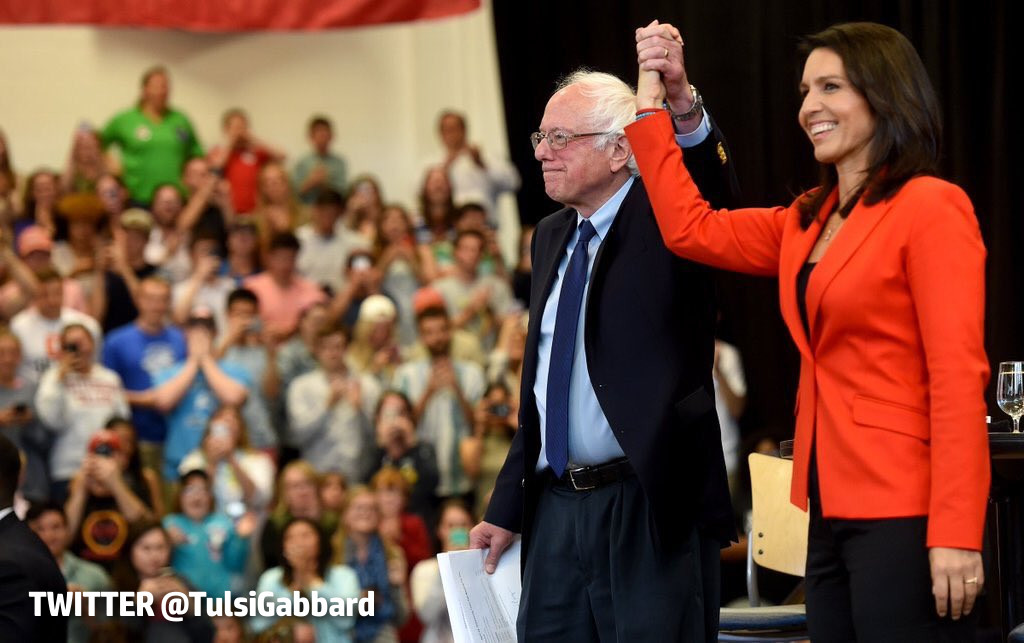
Representative Gabbard, right, with Senator Sanders, left. Source: Big Island News
However, a split and fission between her and the national Democratic Party began to appear, deepening during the contentious 2020 presidential election season. Having declared her candidacy for president in February 2019 on a platform generally described as anti-interventionist and populist, Gabbard sparred with other candidates, notably heavily criticizing then-Senator Kamala Harris as “pathetic” and someone who can only “lob cheap smears.”
Then-Representative Gabbard traded blows with then-Senator Harris throughout the Democratic presidential debates, as exemplified in this video from the second debate held in Detroit. Gabbard also attacked Harris for allegedly supporting “regime change” and “endless wars.” Source: Tulsi Gabbard YouTube channel
Though Gabbard ultimately dropped out of the presidential race and endorsed President Biden, her support was somewhat muted, with her merely describing Biden as “the person who will take on President Trump in the general election.”
After retiring from Congress, Gabbard’s shift to the right only sped up, with her publicly announcing the defeat of Democratic Virginia governor candidate Terry McAuliffe as a “victory for all Americans” in November 2021, calling U.S. Representative (and former Democratic colleague) Adam Schiff a “domestic terrorist” amid the January 6 Capitol riots, and speaking at the Conservative Political Action Conference in February 2022, a move that drew criticism from other Hawaiian Democrats.

Gabbard speaking at the Conservative Political Action Conference. Fellow Hawaii Democrats were critical of her support for Republicans there, even passing a 15-2 resolution that condemned her actions as “harm[ing] Democrats across the country.” Source: Getty Images
Finally, Gabbard’s split from the Democratic Party became official on October 11, 2022. She called her former party “under the complete control of an elitist cabal of warmongers driven by cowardly wokeness” who “actively work to undermine our God-given freedoms.”
Shortly after, Gabbard endorsed and campaigned for several Trump-endorsed Republican Senate candidates for the year’s midterm elections, including candidates Don Bolduc, Adam Laxalt, and now-Vice President JD Vance.
Gabbard is seen here heavily criticizing the economic policy of former President Joe Biden as “fascism” and “national socialism.” Primarily due to her political evolution, Gabbard was a frequent guest on Fox News, commenting on the Democratic Party. Source: Fox News
In 2024, Gabbard’s political evolution had largely been completed. The now-former Democrat endorsed Trump’s re-election bid in August, to praise from Trump, who called her “very special” and “better than all the other stuff I read.” Two months later, she announced that she was joining the Republican Party, calling it “the party of common sense…led by a president who has the courage and strength to fight for peace.”
Gabbard was embraced with open arms by President Trump into the Republican Party. She cited foreign policy and Trump’s willingness to allegedly end “forever wars” as primary reasons for her party switch. Source: LiveNOW from Fox
President Trump rewarded Gabbard’s loyalty with a nomination for the Director of National Intelligence, a position that oversees 18 spy agencies and provides the president with a daily intelligence briefing. He called her someone who has “fought for our Country and the Freedoms of all Americans” with “broad support in both parties.” Despite controversy over her beliefs, Gabbard was approved by the U.S. Senate in a 52-48 vote on February 12th.
To some, Gabbard is a political opportunist who switched parties for greater power. In contrast, others view her as a hero who stood up to the corrupt Democratic establishment and tried to help before seeing the inevitable. Still, no matter where one stands, it cannot be denied that Tulsi Gabbard is both a living representation of the diversity of the current administration in both race and political background, as well as a reminder that even the political beliefs and loyalty of staunch supporters to a party are not set in stone, a lesson that both parties have been forced to learn over the years.

 The AAPI Angle
Leave a reply to The Medical Wizard of Oz, and His Story – The AAPI Angle Cancel reply