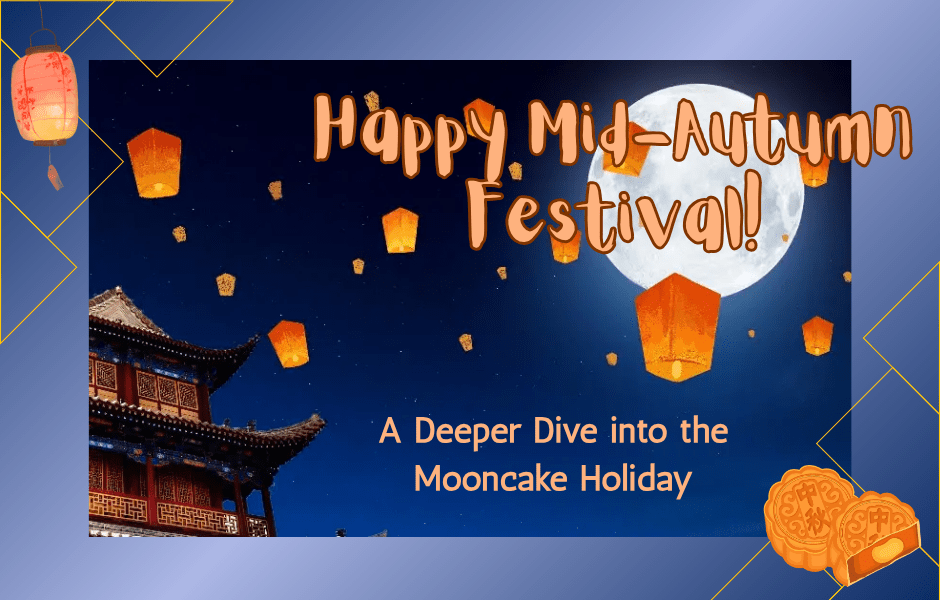
Introduction to the Mid-Autumn Festival
The Mid-Autumn Festival (中秋节) is a traditional Chinese holiday that is celebrated on the 15th day of the 8th month of the Chinese lunisolar calendar (colloquially known as the lunar calendar). On the Gregorian calendar, the Mid-Autumn Festival typically falls in September or October. In 2025, the Mid-Autumn Festival is on October 6.
With its date based on the moon’s cycles, the Mid-Autumn Festival always falls on the day of a full moon; one of the festival’s other names is the Moon Festival. The festival is also known as the Mooncake Festival for the tradition of eating mooncakes.
In China, the Mid-Autumn Festival is the second-most important holiday, after the Lunar New Year. In fact, the Mid-Autumn Festival is a public holiday on the Chinese mainland, typically accompanied by three days off. In Hong Kong and Macau, the day after the Mid-Autumn Festival is a public holiday, rather than the day itself, as most celebrations are held at night.
Other East Asian countries also celebrate their own variant of the Mid-Autumn Festival. For instance, Korea’s Chuseok (추석, lit. ‘autumn eve’) and Japan’s Tsukimi (月見, lit. ‘moon-viewing’) are both celebrated on the same day in the Chinese lunisolar calendar. However, this article will focus on the Chinese version of the holiday.
Mid-Autumn Festival Traditions
The Mid-Autumn Festival celebrates three fundamental concepts: gathering, giving thanks, and praying. First, gathering is a reunion of the whole family. The full moon during the Mid-Autumn Festival represents the unified family. Second, giving thanks means giving thanks for the harvest, as the Mid-Autumn Festival is traditionally a harvest festival. Finally, praying can refer to praying for babies, marriage, prosperity, longevity, or a smooth future.
Another important part of the festival is moon-worship (赏月). This can be considered to be part of the aforementioned “gathering” concept, as a family will typically appreciate the full moon during the evening. Offerings may be made to the moon goddess, Chang’e, whose myth will be explained in the next section of this article.
The Mid-Autumn Festival, as a joyful celebration of the harvest, is accompanied by many traditions. For instance, a notable part of the Mid-Autumn Festival is the lighting and carrying of lanterns. Lanterns will be hung throughout the streets, and people will also release floating sky lanterns.
However, the Mid-Autumn Festival’s most distinctive tradition is undoubtedly the custom of eating mooncakes during the festival. The round shape of the mooncake, similar to the full moon, represents the completeness and unity that the holiday embodies. The earlier tradition of making mooncakes as a family has, with the transition into modernity, evolved into a tradition of giving and sharing mooncakes to and with family and friends.
One of the most popular mooncake varieties is made from lotus bean paste with an egg yolk in the middle. However, mooncakes come in many different flavors, with different fillings, crust textures, and some forsaking egg yolks for other materials.
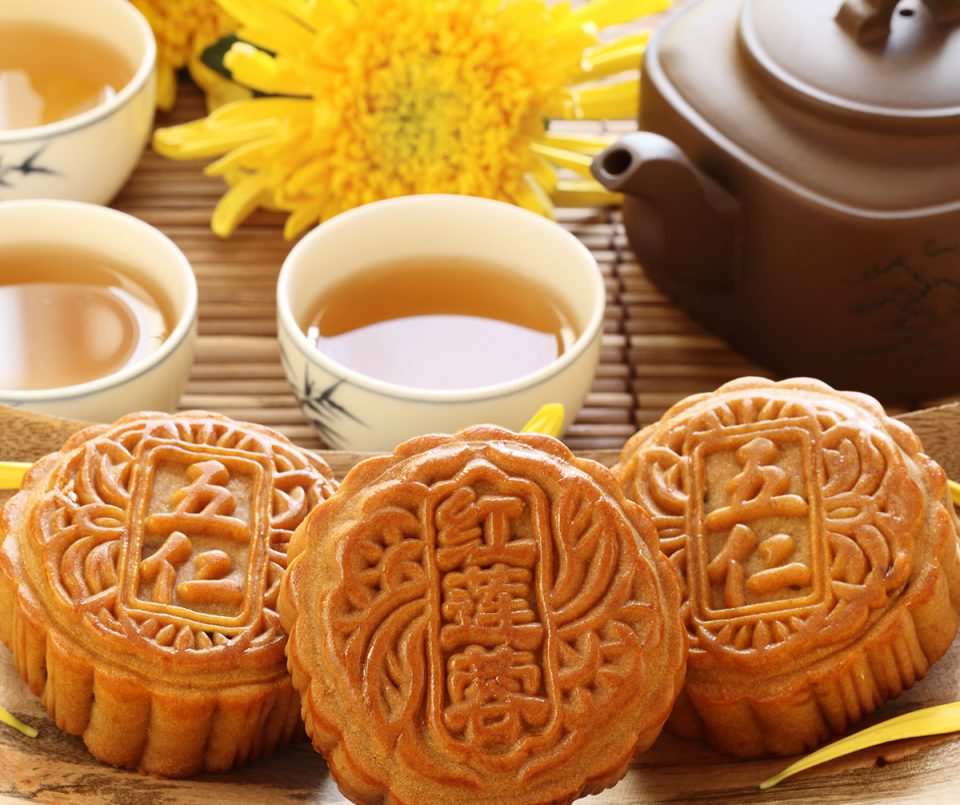
Like many other aspects of Chinese culture, mooncakes also demonstrate the interconnection between the past and present. Contemporary mooncakes may use materials such as taro paste, cream cheese, or even tiramisu. Some regions favor savory fillings, such as those made from meat. These newer varieties, which are more popular among the younger and cosmopolitan generation, are sold alongside more traditional varieties.
The History of and Myth behind the Mid-Autumn Festival
While the Chinese have celebrated the harvest during the autumn full moon since the Shang dynasty (c. 1600-1046 BCE), the term mid-autumn first appeared in Rites of Zhou, a written collection of rituals from the Western Zhou dynasty (1046-771 BCE). On the other hand, the celebration of mid-autumn as a festival only gained traction in the Tang dynasty (618-907 CE). By the Ming dynasty, the Mid-Autumn Festival had already become one of the main folk festivals of the Chinese people.
Although the Mid-Autumn Festival was associated with a different moon goddess during the Western Zhou dynasty, Chang’e is now the primary deity linked to the holiday. Chang’e is the Chinese moon goddess, and serves as the namesake for the Chang’e Project, which is another name for the Chinese Lunar Exploration Program.
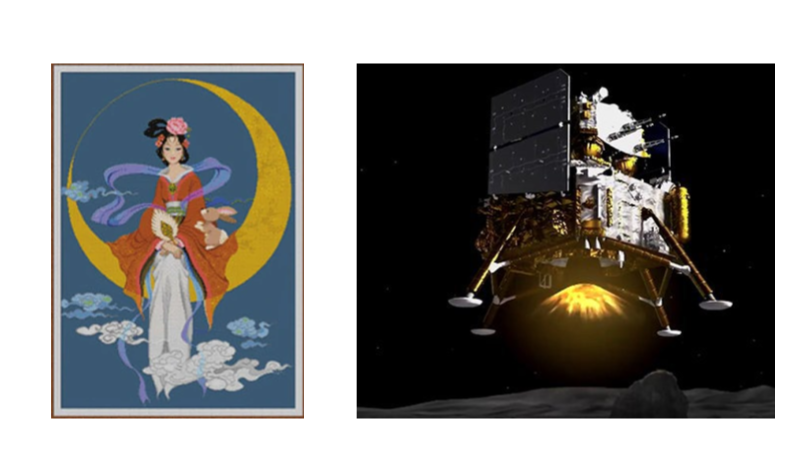
Source (left): Myth and Folklore Wiki, Source (right): BBC
The myth of Chang’e is a tragedy. While there are multiple versions of the story, one version is the following:
Chang’e’s husband, the archer hero Hou Yi, shot down nine of the ten suns, saving the mortal realm from calamity. As a reward, the Queen Mother of the West gave Hou Yi an elixir of immortality. Hou Yi saved the elixir, wanting to share it with Chang’e. Hence, he left the elixir with Chang’e for safekeeping and went out hunting. However, Hou Yi’s apprentice had evil intentions, and intended to steal it for himself. In a desperate struggle, in order to prevent the apprentice from obtaining the elixir, Chang’e drank the entire elixir herself. As an immortal, she could no longer stay with her husband, so she chose to reside on the moon with her jade rabbit friend, overlooking the earth.
As such, over time, the jade rabbit became synonymous with the moon.
Furthermore, Chang’e’s story has been adapted by many modern writers. Some English-language retelling of Chang’e’s myth include Daughter of the Moon Goddess, by Sue Lynn Tan, and Chang’e on the Moon, by Katrina Moore. Of course, there are many more Chinese media representations of Chang’e, with multiple different interpretations of her character.
🌕 Mid-Autumn Festival Celebrations in the United States
The Mid-Autumn Festival is clearly widely celebrated in China and other East Asian countries, but what about the United States? Large-scale Mid-Autumn Festival celebrations only gained traction in the United States in the past decade, and such celebrations typically remain within daytime hours (whereas overseas, the festival is celebrated into the late night).
Nowadays, cities such as Boston, Chicago, Los Angeles, New York City, Philadelphia, and San Francisco all hold their own Mid-Autumn Festival celebrations. However, smaller cities are not left out; even if they do not hold a formal celebration, the many celebrating families across the United States will host their own parties and gatherings.
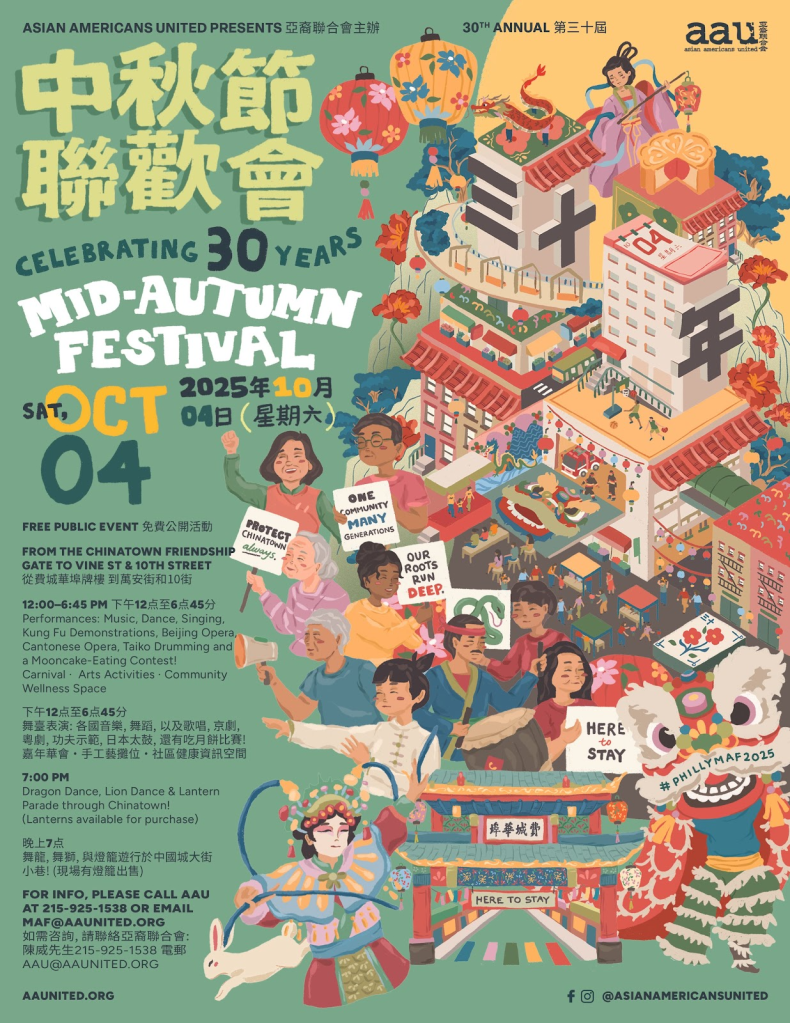
Among the largest Mid-Autumn Festival celebrations is Philadelphia’s Mid-Autumn Festival. Organized by Asian Americans United (AAU), this year’s celebration, marking the festival’s thirtieth anniversary, took place on Oct. 4, 2025. In the afternoon, the event featured dances, singing, kung fu demonstrations, Beijing opera, and a mooncake eating contest. In the evening, a dragon and lion dance, as well as a lantern parade, traveled through the streets of Philadelphia’s Chinatown.
Another notable Mid-Autumn Festival celebration was the Mid-Autumn Family Festival hosted by the Museum of Chinese in America (MOCA) in New York City on Oct. 4, 2025. With performances, workshops, and activities, the event truly disseminated Chinese culture. Some activities included a photo corner with Chang’e, Hou Yi, and the jade rabbit, while another included a shadow puppet performance.
Even in the relatively small city in Maryland where the AAPI Angle is based, Mid-Autumn Festival celebrations attract community engagement, and mooncake-giving abounds. From scarce recognition to widespread celebration, the Mid-Autumn Festival embodies the long way the Chinese-American community has come in the United States. For Chinese-Americans, it is truly important to continue observing traditional holidays and sharing Chinese culture, carving out their own piece of the mooncake.
Bonus: The Mid-Autumn Festival in Verse
One of the most celebrated poems in Chinese literature is about the Mid-Autumn Festival. The poem, “Prelude to Water Melody”《水调歌头》, by acclaimed Song dynasty poet Su Shi (also known as Su Dongpo), was written about the Mid-Autumn Festival. The poem, written in the lyrical ci style, was meant to be sung. Although the original tune has been lost, the poem has been converted into a song, called《但愿人长久》, sung by Teresa Teng, then, later, Faye Wong.
Here is the poem; the translation included is by Xu Yuanchong:
míng yuè jǐ shí yǒu? bǎ jiǔ wèn qīng tiān.
明月几时有?把酒问青天。
How long will the full moon appear? / Wine cup in hand, I ask the sky.
bùzhī tiān shàng gōng què, jīn xī shì hé nián?
不知天上宫阙,今夕是何年?
I do not know what time of the year / It would be tonight in the palace on high.
wǒ yù chéng fēng guī qù, yòu kǒng qióng lóu yù yǔ, gāo chù bù shèng hán.
我欲乘风归去,又恐琼楼玉宇,高处不胜寒。
Riding the wind, there I would fly, / Yet I’m afraid the crystalline palace would be / Too high and cold for me.
qǐ wǔ nòng qīng yǐng, hé sì zài rén jiān?
起舞弄清影,何似在人间?
I rise and dance, with my shadow I play. / On high as on earth, would it be as gay?
zhuǎn zhū gé, dī qǐ hù, zhào wú mián.
转朱阁,低绮户,照无眠。
The moon goes round the mansions red / Through gauze-draped window soft to shed / Her light upon the sleepless bed.
bù yīng yǒu hèn, hé shìcháng xiàng bié shí yuán?
不应有恨,何事长向别时圆?
Why then when people part, is the oft full and bright?
rén yǒu bēi huān lí hé, yuè yǒu yīn qíng yuán quē, cǐ shì gǔ nán quán.
人有悲欢离合,月有阴晴圆缺,此事古难全。
Men have sorrow and joy; they part or meet again; / The moon is bright or dim and she may wax or wane. / There has been nothing perfect since the olden days.
dàn yuàn rén cháng jiǔ, qiān lǐ gòng chán juān.
但愿人长久,千里共婵娟。
So let us wish that man / Will live long as he can! / Though miles apart, we’ll share the beauty she displays.
Other English translations of the poem can be found here.

 The AAPI Angle
Leave a reply to Dr. Chao Wu Cancel reply