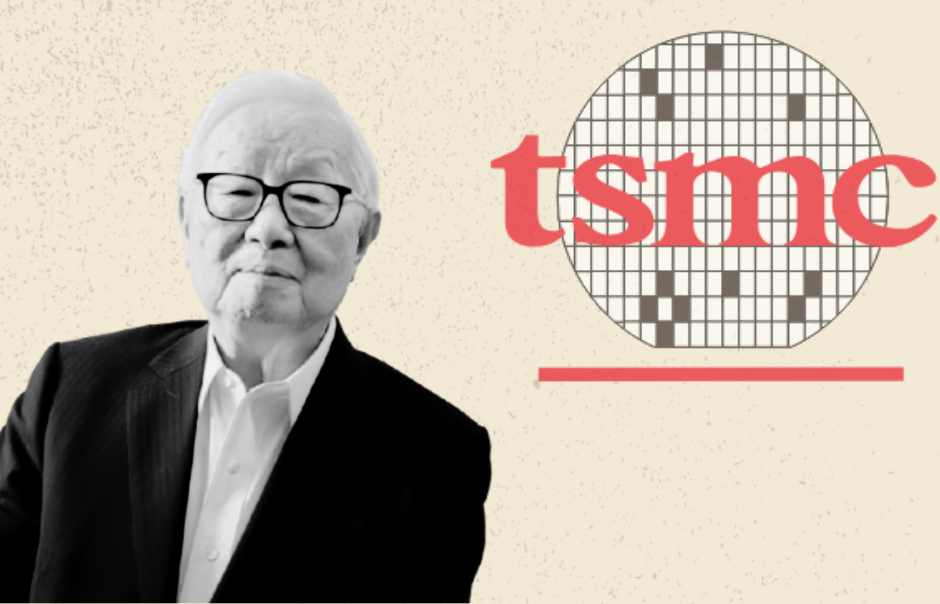
If you were to name the most critical chokepoint in the global economy, where would you look? Most people would likely point to the Suez Canal or the Strait of Hormuz, but the true answer lies along a 55-mile stretch of land on the western coast of Taiwan: Hsinchu Science Park. Here, inside TSMC’s headquarters and ultra-sterile fabrication plants, microscopic circuits are etched into silicon wafers using some of the most advanced manufacturing techniques in the world. At the center of all of this stands Morris Chang, founder of Taiwan Semiconductor Manufacturing Company (TSMC).
Yet this tech giant wasn’t built by some nameless conglomerate. It was conceived by an immigrant who fled war-torn China as a teenager, spent decades climbing the corporate ladder in Texas, and executed his greatest breakthrough after his peers had retired.

Hsinchu Science Park, Taiwan. Source: Wikipedia
In 1985, at the age of 54, Morris Chang walked away from a quarter-century career as an executive at Texas Instruments, deciding to take a gamble. He left the United States to head Taiwan’s tech research institute, bringing with him a deep understanding of Silicon Valley, including its blind spots. Chang realized that designing chips and manufacturing chips were two completely different skill sets, something that Western tech giants were oblivious to. By pitching this model where a company would specialize in manufacturing chips for others, Chang positioned Taiwan as the engine of global technology.
As it is with many successful people in history, Chang’s early career didn’t begin with immediate success. After immigrating to the United States as a teenager, he enrolled at Harvard before transferring to MIT. However, his career hit an obstacle here: he failed his PhD qualifying exams at MIT. Pivoting to the workforce, Chang accepted a job in 1958 at a Dallas-based electronics company called Texas Instruments.
At Texas Instruments, Chang found his true calling in the fledgling semiconductor industry. Assigned to run the struggling transistor production line, he showed an uncanny talent for yield optimization – the science of maximizing the percentage of chips on a single manufacturing line. Approaching the problem with surgical precision, Chang dramatically increased TI’s profit margins.
Recognizing Chang’s talent, TI decided to sponsor Chang to complete his PhD in electrical engineering at Stanford in 1964. Over the next two decades, Chang climbed the corporate ladder to become Group Vice President of TI’s worldwide semiconductor business, managing tens of thousands of employees and cementing himself as one of the great operational minds of Silicon Valley and Texas.

Morris Chang, founder of TSMC. Source: Sahil Bloom | Substack
Despite achieving his legendary status at TI, Chang still faced limits as to how far Asian Americans could rise in corporate leadership – a barrier often called the bamboo ceiling. Chang gets increasingly frustrated with his bosses at TI. Eventually, after multiple disagreements and even demotions, Chang is fed up and quits in 1983. After a short stint at General Instrument, Chang decides to take his quarter-century of American manufacturing experience back across the Pacific to forge a new path.
When Morris Chang landed in Taiwan in 1985, he was not planning on starting a global empire. He had accepted an invitation from the Taiwanese government to head the Industrial Technology Research Institute (ITRI), a state-funded non-profit tasked with developing the island’s high-tech industries.
Here, Chang brought a perspective that no domestic official possessed: decades of frontline experience inside Silicon Valley, along with a clear view of the American tech industry’s weaknesses.
In the mid-1980s, the global chip market was dominated by Integrated Device Manufacturers (IDMs) like Intel, Motorola, and Texas Instruments. These were companies that designed, manufactured, and sold their chips. Often, these companies rent out their excess manufacturing capacity, but it’s hard for other companies to rely on it; there are too many risks involved. Chang has seen this firsthand: Texas Instruments was involved in a lawsuit in which companies had argued that TI was unfairly prioritizing manufacturing chips for its own use; a lawsuit that TI had won because Chang had disobeyed his boss and refused to do so.
With this experience in mind, and with the knowledge that building a chip-manufacturing plant (also known as a “fab”) was becoming exponentially more expensive, Chang came up with a groundbreaking insight: Chip design and Chip manufacturing needed to be separated.
The core pledge of TSMC was ingenious: TSMC will never compete with its clients, completely alleviating concerns about intellectual property theft.
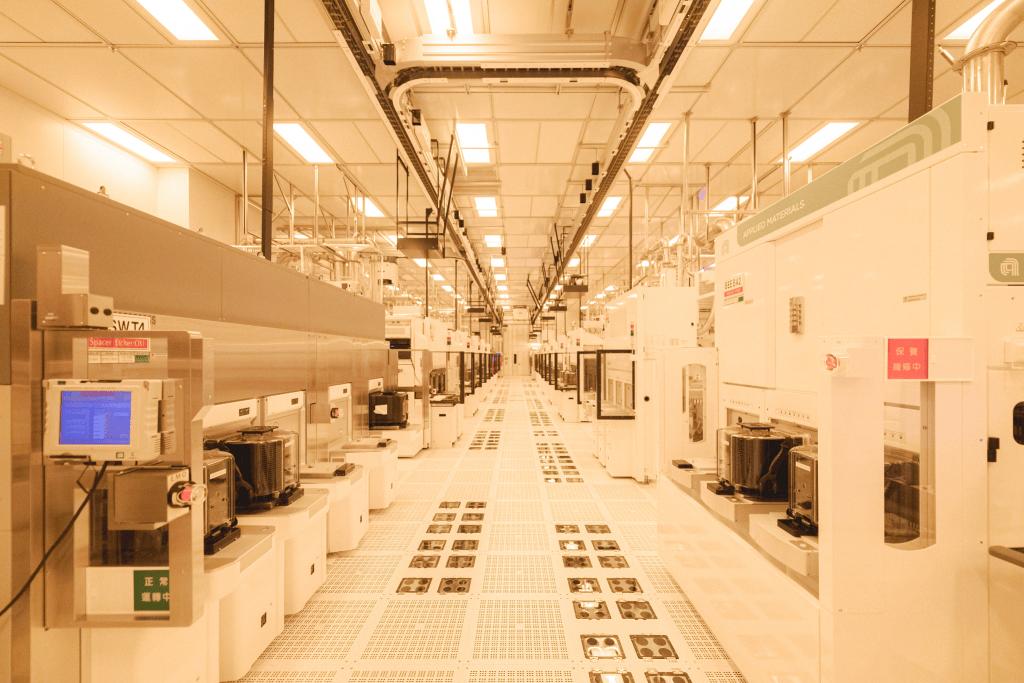
TSMC semiconductor cleanroom fabrication facility. Source: TSMC
At first, the pitch was a tough sell. TSMC pitched to every major manufacturing firm for investment, and all but one – Philips – rejected them. And even then, philips wasn’t keen on TSMC; rather, they wanted to take advantage of Taiwan’s low-cost labor, and investing in TSMC seemed like a good way to win the Taiwanese government’s favor. Executives scoffed at the idea of outsourcing their production, as highlighted by AMD co-founder Jerry Sanders’ famous quote: “real men have fabs.”
In 1987, with funding from the Taiwanese government, the Dutch electronics company Philips, and local private investors, Chang officially founded TSMC.
A late-1987 visit from Intel immediately boosted TSMC’s credibility, and soon many other major semiconductor manufacturers began outsourcing some of their production: Motorola, Texas Instruments, Philips, etc.
Four decades later, TSMC is the 6th most valuable company in the world with a market cap of over $2 trillion. It has given rise to a new species of tech company: the “fabless” chip startup. Companies such as Nvidia and Qualcomm – and later Apple – could now focus solely on designing their chips and software, leaving the complex, atomic-scale physics to Morris Chang. TSMC produces over 90% of the world’s advanced computer chips, standing as the backbone of the global economy. What started as an audacious pitch by a 54-year-old executive passed over by Silicon Valley became the ultimate geopolitical leverage point of the 21st century.
Leave a Reply