
Introduction
Like the Chinese holidays previously discussed on The AAPI Angle — Lunar New Year and the Mid-Autumn Festival — Qixi Festival, which can be considered China’s equivalent of the Western holiday Valentine’s Day, follows the lunisolar calendar, meaning it falls on a different date each year.
This year, Qixi Festival falls on Wednesday, August 19, 2026. Qixi Festival originates from Chinese mythology, but other East Asian countries also observe the holiday. For instance, Korea celebrates Chilseok, and Japan celebrates Tanabata, both inspired by the Qixi Festival. The Vietnamese holiday Thất Tịch is the country’s version of Qixi Festival.
The Myth
Qixi Festival is also known as the Double Seventh Festival, a name derived from the myth “Cowherd and Weaver Girl.” In the myth, characters Cowherd (牛郎) — symbolizing the star Altair — and Weaver Girl (织女) — symbolizing the star Vega — are star-crossed lovers.
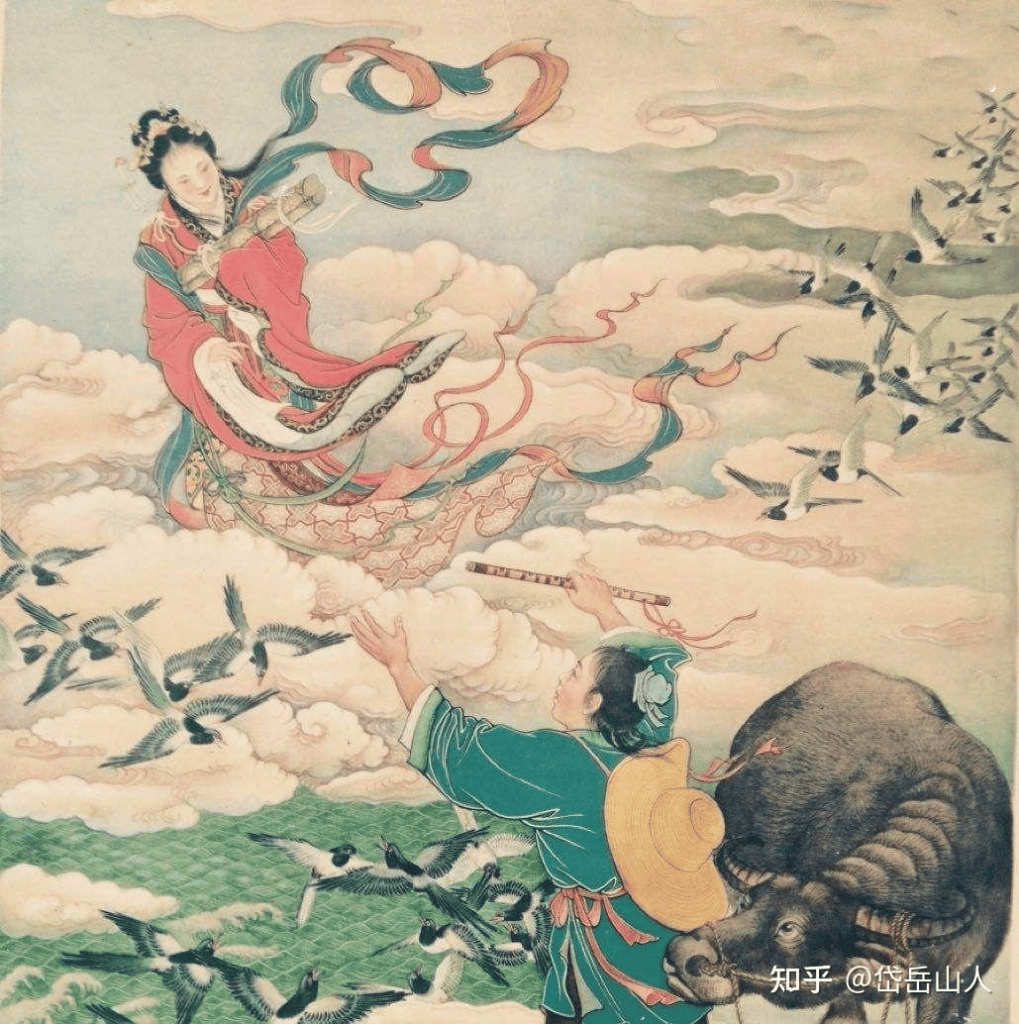
Weaver Girl is a denizen of the heavens, but one day she descends to the mortal world. She meets Cowherd, a mortal, and falls in love with him. They get married and have two children, a son and a daughter. However, fairies like Weaver Girl are forbidden from romancing mortals, as per the law of the Queen Mother.
In Chinese mythology, one day in heaven is a year in the mortal world, so Weaver Girl’s absence goes unnoticed at first. Thus, Cowherd and Weaver Girl spend several happy years together.
When the Queen Mother finds out that Weaver Girl eloped with a mortal, she is furious. She sends her people down to take Weaver Girl back to heaven. Cowherd’s loyal oxen sacrifices itself, becoming a pair of flying sandals, but he still can’t catch up to his lover.
Seeing Cowherd’s pursuit, the Queen Mother throws down her hairpin, creating the Milky Way to separate the couple, leaving Cowherd alone with the two children. However, moved by their love, she allows them to meet once a year, when magpies form a bridge that the Cowherd and the Weaver Girl cross.
The day of their reunion is known as Qixi, providing the origin for Qixi Festival.
The Traditions
As with many holidays celebrated since antiquity, many of the traditions behind Qixi Festival are increasingly less practiced, especially in urban areas. Yet, these traditions remain remembered and cherished by many.
Some traditions of Qixi Festival include…
- Threading competitions — In ancient times, threading was an important skill for women. A popular custom was for women to show off their threading skills during the night of Qixi Festival. Threaders would compete to see who could thread seven needle holes the fastest, using only the light of the moon.
- Offerings to Weaver Girl — During Qixi Festival, observers of the holiday would lay out a whole table of offerings to Weaver Girl, including tea, wine, fruits, and nuts. Young girls would often pray to Weaver Girl for a good husband and a happy life.
- Honoring oxen — In honor of Cowherd’s ox, which sacrificed itself for him, children will place wildflower bouquets on the horns of oxen.
- Eating food — As with many Chinese holidays, food is central to the festivities during the Qixi Festival. During Qixi Festival, people make and eat specific foods, such as “skill fruit” (巧果子), “flower melon” (花瓜), sweet rice cake, and red bean soup, among others.
- Skill fruits are fried, thin pastries made in various shapes, such as flowers or cute animals.
- Flower melons are melons with designs carved on the skin, usually flowers, but also including unusual animals, especially birds.

Modern Qixi Festival and Valentine’s Day
In the modern day, however, people tend to celebrate Qixi Festival differently. In fact, they celebrate the holiday in a very similar way to how Americans celebrate Valentine’s Day: by exchanging gifts — including flowers, chocolates, jewelry, and more — and going on romantic outings.
China also celebrates Western Valentine’s Day. Although it is not an officially recognized holiday, it is widely celebrated in cities across China. Part of this may be commercial — with the popularity of the holiday, malls and online shopping centers can market products like chocolate, flowers, and jewelry. On the other hand, the holiday’s widespread acceptance is in part due to young people’s desire to express love openly. Still, some members, typically of older generations, regard Valentine’s Day as “overly commercial or culturally inappropriate.”
The advent of Valentine’s Day has proven that Chinese culture is willing to welcome new traditions. Still, the historical and cultural significance of Qixi Festival cannot be overlooked. From mythology to modernity, Qixi Festival has remained a treasured and widely celebrated holiday in China and across the rest of East Asia.
Leave a Reply