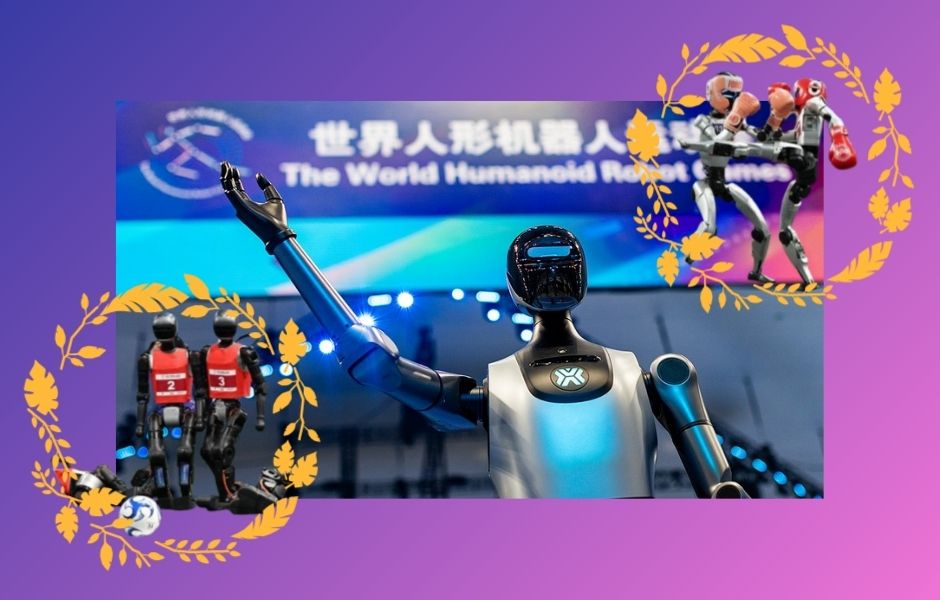
The World Humanoid Robot Games is the world’s first international event with humanoid robots as the primary competitors. Organized by the China Media Group, Beijing Municipal People’s Government, the World Robot Cooperation Organization, and the Asia-Pacific RoboCup International Council, the first instance of the event was held in Beijing in 2025.
The second instance of this annual event was also held in Beijing, China over the course of half a week, from August 22 to August 26. At this year’s event, over 2,000 robots from 666 teams, more than double the previous year in both statistics, competed in 51 events and over 1,000 matches. Despite the presence of sixteen participating countries and six participating continents, 96% of the entries are still Chinese.

The events at the World Humanoid Robot Games are divided into two categories: competition events and scenario-based events. The competition events are more similar to traditional sports, including football, martial arts, and gymnastics. On the other hand, scenario-based events showcase how well a robot can perform service tasks, including firefighting and hotel services.
The events require different degrees of autonomy, with track events requiring robots to run without any human control or intervention. Forbes described the Games as a “market map” of which events humanoid robots are able to perform autonomously and which still require teleoperation.
Notably, several world records were broken in succession at the World Humanoid Robot Games. The robot TianGong Ultra beat Usain Bolt’s time in the 100m dash by nearly a full second, covering the distance in merely 8.64 seconds. This final time beat its own previous records, 9.39 seconds in the preliminaries and 8.86 seconds in the semi-final, both of which are still faster than Bolt’s time of 9.58 seconds.
When faced with the news that his record had been broken, by a robot no less, Bolt took the news in stride, saying, “I guess that’s where the world is going right now … It just made me smile.”
Furthermore, a robot also set a new high jump record of 2.88 meters, more than tripling the best robot performance from the previous year — this distance also surpasses the human high jump record holder, Javier Sotomayor’s 2.45 meters. The robot came from the same company as TianGong Ultra, the 100m record breaker, a Beijing-based lab called X-Humanoid.
However, in many of the other events, the robots have a long way to go. For instance, soccer fields at the Games were much smaller compared to regulation fields, yet the robots were barely able to perform the basic move of kicking the soccer ball, let alone fast-paced plays and interceptions.
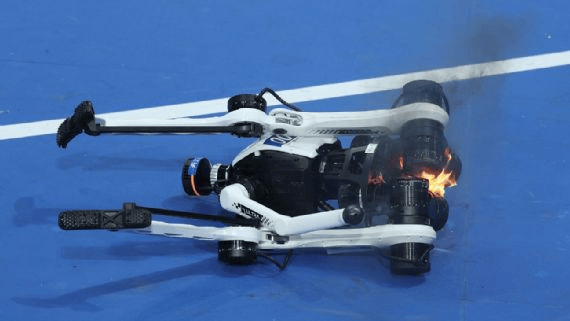
Even in the relatively more mature field of robot running, there was one noticeable instance where a robot literally crashed out, catching fire on the track.
In the “AI arms race” — a term that has been increasingly popularized to describe the United States’ and China’s competition to expand their spheres of influence in terms of artificial intelligence technology — China’s advanced robotics, including humanoid robots, is widely considered to be ahead of the U.S. On the other hand, their frontier AI models, like chatbots, are somewhat weaker.
In July of 2026, the United States banned all foreign-made humanoid robots, with the Federal Communications Commission cautioning that they “pose an unacceptable cybersecurity and safety risk,” as they could be possibly remote controlled or used to gather intelligence.
This sanction most strongly affects China, which is currently the largest market for and one of the largest manufacturers of robotics technology. It is another step by the United States to heavily limit China’s power; despite being the world’s biggest exporter of energy vehicles, China, facing heavy tariffs from the American market, has effectively been shut out of it.
Despite underlying geopolitical tensions, the World Humanoid Robot Games was, from another perspective, also a lighthearted demonstration and celebration of humanity’s progress in robotics. Undoubtedly, robotics and artificial intelligence will drastically change the planet. Although frontier AI has dominated more of the headlines, the World Humanoid Robot Games exemplify how great leaps and bounds have also been made on humanoid robotics technology.


Leave a Reply