
In June 2002, millions of people flooded the streets of Seoul to witness South Korea become the first Asian team to reach a World Cup semi-final. For fans across the host nation, triumphs over European giants like Italy and Spain felt like a shift in global soccer. However, in Europe, the matches were branded a disgrace, with headlines dominated by controversial red cards and disallowed goals. Two decades later, South Korea’s historic run, and the tournament as a whole, remains one of the most contested chapters in sports history—a run driven by South Korea’s groundbreaking high-press tactics under Guus Hiddink, yet permanently shadowed by controversial refereeing decisions.

Former South Korea national soccer team head coach Guus Hiddink. Source: Korea Times
To understand why South Korea’s 2002 World Cup run provoked such intense debate, one has to examine the matches where key refereeing calls altered the course of play. While South Korea’s conditioning and tactics allowed them to compete with the European powerhouses, high-profile calls in three consecutive matches drew heavy scrutiny.
Group Stage vs. Portugal
In their final group-stage match, South Korea faced a star-studded Portugal side featuring Luís Figo and Rui Costa. Portugal entered needing at least a draw to reach the knockout stage, while South Korea was playing to secure top spot in the group.
The match turned on its head when Argentine referee Ángel Sánchez issued two red cards to Portuguese players. In the 27th minute, João Pinto launched a late slide tackle from behind into Park Ji-Sung, resulting in a straight red card. The challenge was certainly deserving of a sending-off; however, the Portuguese players certainly didn’t believe so. They reacted furiously, leading to a confrontation where Pinto struck the referee—an action that resulted in a six-month FIFA suspension. Later, in the 66th minute, Beto received a second yellow for a foul on Lee Young-Pyo, leaving Portugal down to nine men. Shortly after, in the 71st minute, Park Ji-Sung scored the winner to secure a 1-0 win and eliminate Portugal. While both bookings aligned with the rulebook, the two dismissals established an early narrative that refereeing decisions were consistently favoring the co-hosts.

Former South Korea and Manchester United midfielder Park Ji-Sung. Source: New York Times
Round of 16 vs. Italy
South Korea’s next match was against the mighty Italy, which featured legends of the game such as defender Paolo Maldini and goalkeeper Gianluigi Buffon. The game was an intense, physical contest. Italy took an early lead through a Christian Vieri header, but South Korea scored a late equalizer to force extra time.
In extra time, two decisions by Ecuadorian referee Byron Moreno generated immediate international backlash. In the 103rd minute, Italian playmaker Francesco Totti went down in the penalty area after a challenge from Song Chong-gug. Moreno judged that Totti had dived and issued a second yellow card. Replays showed clear contact between the defender and forward, making this call extremely controversial. Shortly after Totti’s sending off, Italian midfielder Damiano Tommasi ran through on goal and slotted the ball home for what appeared to be the match-winning golden goal. However, the assistant referee flagged Tommasi as offside, disallowing the goal. Later, replays showed that Tommasi was in fact level with the last defender when the ball was played, meaning the goal should have stood. Minutes later, Ahn Jung-hwan headed home the golden goal, sealing a 2-1 victory for South Korea and knocking Italy out of the tournament.

Referee Byron Moreno, officiating a match. Source: SO FOOT.com
Quarter-Finals vs. Spain
Four days after their triumph against Italy, South Korea entered as heavy underdogs against Spain. Egyptian referee Gamal Al-Ghandour oversaw the match, which featured two disallowed goals for Spain.
Early in the second half, a Spanish free kick was deflected into the net off a Korean defender, but the goal was disallowed due to an alleged shirt-pulling by Spanish defender Iván Helguera. Replays showed minimal contact between the players. Then, in extra time, Spanish winger Joaquín delivered a cross along the byline to Fernando Morientes, who headed it into the net. However, the assistant referee raised his flag, indicating that the ball had gone out of play before Joaquín’s cross. Once again, replays showed that the referees had gotten this wrong: the entire ball had not crossed the line, making the call an error that denied Spain a golden goal. South Korea would ultimately advance 5-3 on penalties, eliminating Spain. The loss fueled immense outrage from the Spanish press, cementing the perception that the host nation was being aided on the pitch.

South Korean soccer fans, cheering for their team. Source: Korea Herald
In the semi-finals, South Korea faced a disciplined, pragmatic German squad. Unlike the previous matches, this fixture was free of any major refereeing controversies. Depleted by their previous 120-minute wars on the pitch, South Korea’s high-pressing attack finally ran out of steam against Germany’s organized defense and goalkeeper Oliver Kahn. A 75th-minute goal by Michael Ballack gave Germany a 1-0 win, ending South Korea’s magical run.
In the ensuing third-place playoff game, South Korea would face off against Turkey. Turkey’s Hakan Şükür scored the fastest goal in World Cup history just 10.8 seconds into the game, setting the tone for a 3-2 thrilling Turkish victory.
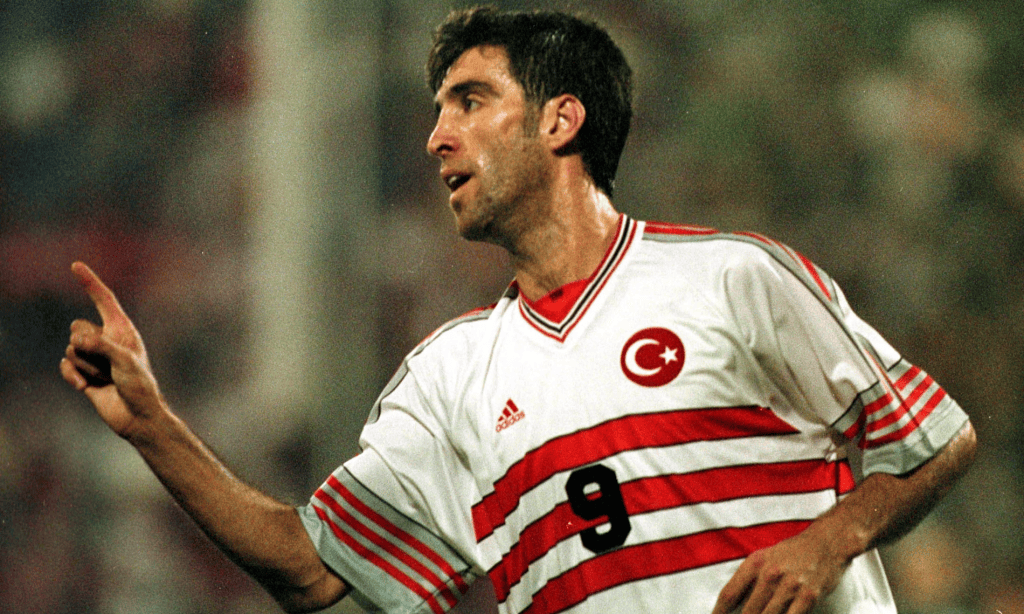
Turkey’s all-time record holder for most goals, Hakan Şükür. Source: The Guardian
While the scorelines and match reports record what happened on the pitch, they tell only half the story. The true drama played out in the headlines. For Western Europe, the officiating controversies were proof of a grand conspiracy. For the global Asian community, they were a mere footnote.
In Western Europe, post-match coverage turned into paranoia. The Italian and Spanish press splashed headlines accusing FIFA of rigging the tournament to keep the host nation alive. The hostility also began to spill into club soccer: Luciano Gaucci, the owner of the Italian club Perugia, immediately fired South Korean attacker Ahn Jung-hwan—the man who had scored the golden goal eliminating Italy. He vented to the press, saying that he had no intention of paying the salary of a player who had “ruined Italian football.” To the European press, South Korea’s run was a heist.
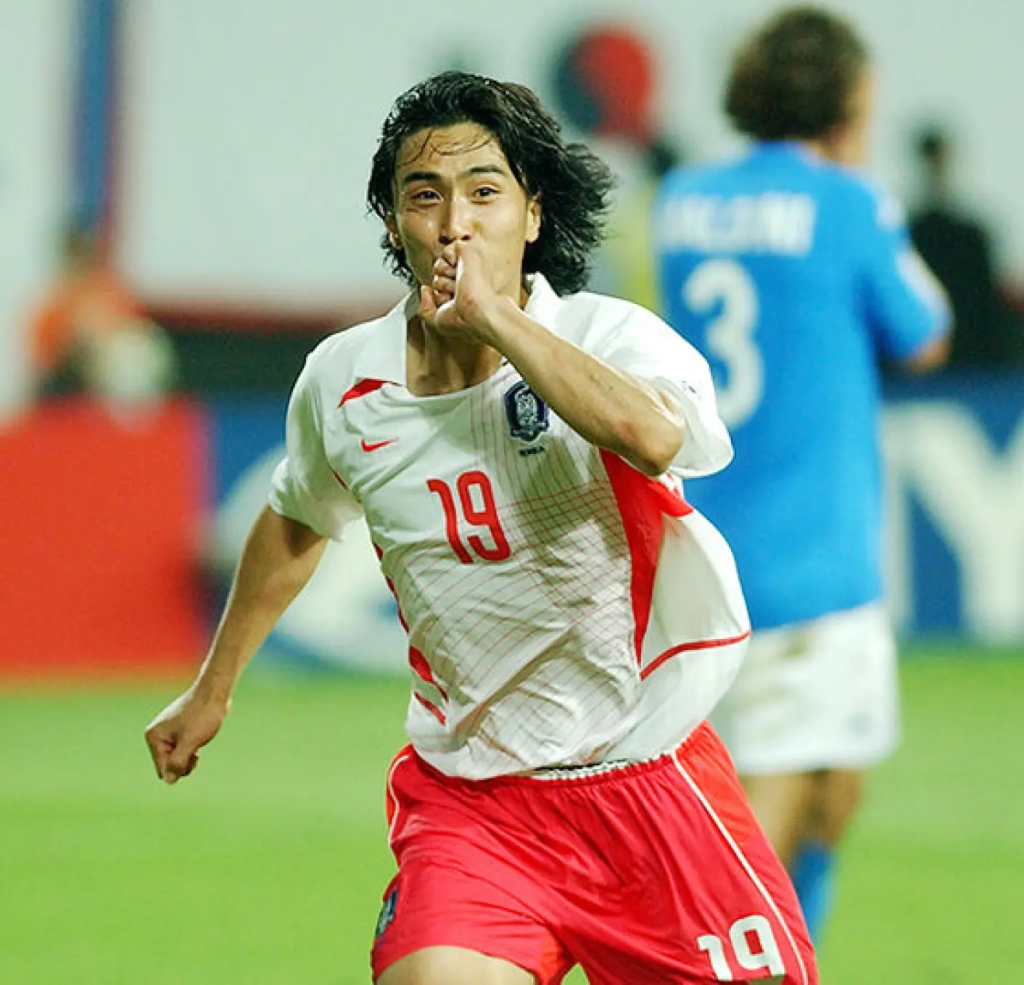
Ahn Jung-hwan, celebrating the winning goal against Italy. Source: Korea JoongAng
Across Asia, however, the sentiment was the exact opposite. For Koreans and the AAPI community, who had likely grown up seeing virtually no Asian representation in global sports, seeing South Korea press European giants into submission felt surreal. After decades of Asian soccer being dismissed on the world stage, watching a team out-run and out-work powerhouses like Italy and Spain was validation that Asian soccer could compete at the highest level.
Reducing South Korea’s run purely to questionable calls completely misses the tactical revolution engineered by manager Guus Hiddink. When the Dutchman took over the team in 2001, he identified stamina and physical presence as the team’s missing ingredients. Facing teams stocked with technically superior talent, Hiddink subjected his squad to high-intensity conditioning camps, transforming them into an exceptionally fit unit capable of running relentlessly for 120 minutes without dropping intensity. At a time when soccer favored a slower, more methodical pace, South Korea’s high-intensity style was a precursor to today’s modern game, where high-pressing tactics are commonplace.
On the pitch, this translated into a smothering, high-tempo, aggressive style. South Korea relentlessly pressured the opposition, initiating physical contact at every opportunity. This style of play unnerved their opponents, who expected time and space to breathe and think on the ball. This aggression also created a chaotic environment where challenges often straddled the line between fair play and persistent fouling, putting immense pressure on the officials.
This pressure also coincided with a flawed refereeing policy from FIFA. In a push for global representation, FIFA often selected officials from smaller confederations, many of whom had very little experience handling high-intensity European fixtures. Referees like Byron Moreno and Gamal Al-Ghandour were suddenly dropped into fast-moving, high-stakes knockout matches, where they could easily become overwhelmed.
The fallout following these matches forced FIFA into a complete overhaul. After the tournament, the then-FIFA president, Sepp Blatter, admitted that the selection process was flawed and would have to be discarded. In subsequent tournaments, FIFA overhauled its selection process to prioritize elite refereeing crews who worked together regularly, strict fitness standards for linesmen, and, in 2018, the implementation of Video Assistant Referees (VAR) – a technology designed specifically to eliminate clear errors like the disallowed goals against Spain.

Former FIFA president Sepp Blatter. Source: CNN
Over twenty years later, the story of the 2002 World Cup doesn’t fit neatly into one box. European fans and media will always see those magical weeks in June as a cautionary tale of blown calls and administrative failure. But for the millions who flooded the streets of South Korea—and for the fans watching from all over the world—the refereeing decisions are beside the point. They saw a team that stepped onto the pitch without fear, defeated the traditional blue bloods of global soccer, and forever changed how the world views Asian soccer.

Leave a Reply