This article is written by Ethan Zou.

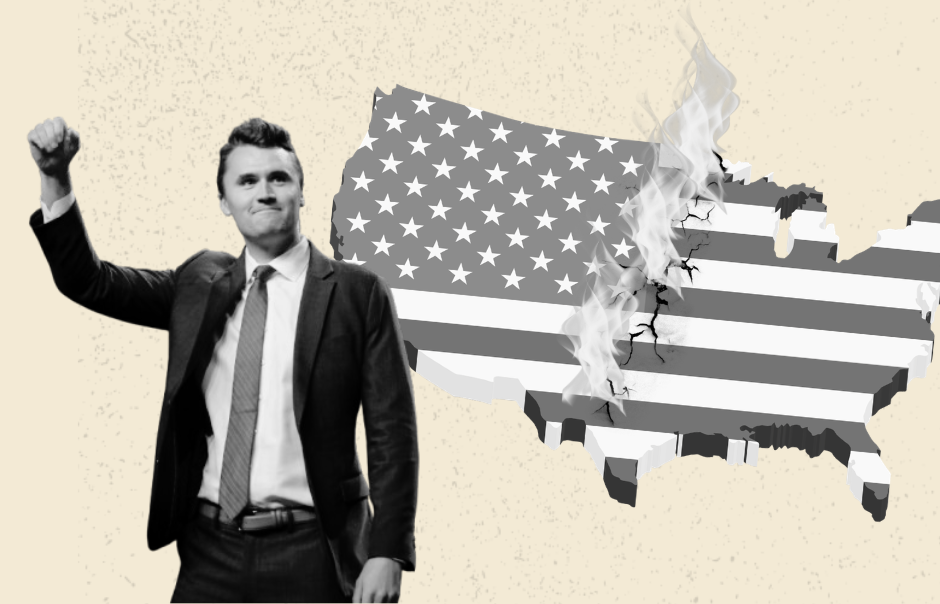
One year ago today, Charlie Kirk was assassinated while speaking at an event at Utah Valley University. For millions of Americans, his death was a personal tragedy. For others, it became something more complicated: a source of anger, grief, celebration, and another battle in an already bitter political war. After twelve whole months, the arguments surrounding Kirk’s life and death have not disappeared. If anything, they have become part of a larger question confronting America: what happens to a democracy when political disagreement is increasingly defined by violence?
As a founder and CEO of Turning Point USA (TPUSA), one of the most prominent conservative youth networks in America, Kirk was highly influential in American politics, playing a pivotal role in the 2024 presidential election. Through aggressive campus tours, digital dominance, and targeted voter registration, Kirk altered the traditionally Democratic youth vote: nationwide, Trump’s support among voters aged 18-29 jumped 11 points from 36 percent in 2020 to 47 percent in 2024, even winning the youth vote outright in battlegrounds like Michigan. Kirk’s influence extended well beyond youth political organizing, but so did the controversy surrounding his rhetoric and political positions.
A vocal advocate for fiscal conservatism and Christian nationalism, Kirk often spearheaded highly controversial views, including the “Great Replacement” theory, a debunked far-right, white nationalist conspiracy theory falsely claiming that white populations in Western nations are being deliberately replaced by non-white people of color. He rejected the concept of white privilege, calling it a “racist idea,” along with systemic racism—despite it being supported by extensive academic research and government data. He strongly opposed DEI programs and affirmative action, arguing that they undermine meritocracy. In 2023, he stated that “prowling Blacks” targeted white people; that same year, he characterized the Civil Rights Act of 1964 as a “huge mistake,” and in 2024, he famously said, “If I see a Black pilot, I’m gonna be like, ‘Boy, I hope he’s qualified.’” Kirk’s controversial stances on race have led critics to characterize him and his values as racist—an assertion agreed with by numerous civil rights coalitions, including the NAACP and the Congressional Black Caucus.
His polarizing stances went beyond racial issues. On women’s rights, Kirk advocated for traditional Christian gender roles and was openly critical of feminism. In 2025, he told Taylor Swift to “reject feminism” and “submit to your husband” when discussing her relationship with Travis Kelce. Moreover, he was extremely pro-life and supported banning abortion in almost all circumstances—including a federal abortion ban. In a debate with a college student, he made the extraordinarily controversial statement comparing abortion to genocide, arguing that it is “worse than the Holocaust.”
Kirk was also an avid defender of the Second Amendment and strongly opposed gun control measures. He consistently lobbied against universal background checks, red flag laws, waiting periods, and bans on specific types of firearms—initiatives supported by a majority of Americans. To combat school shootings, he advocated for abolishing gun-free zones and allowing trained teachers and armed guards to carry weapons for self-defense, both of which have no empirical backing. He famously argued that gun violence was an unfortunate but necessary trade-off for preserving constitutional liberties, stating that “It’s worth to have a cost of, unfortunately, some gun deaths every single year so that we can have the Second Amendment to protect our other God-given rights. That’s a prudent deal. It is rational.” He was actively discussing gun violence, transgender shooters, and religion when he was tragically shot by a gun in September 2025. His prior comments regarding gun deaths being a “prudent deal” then resurfaced, intensifying the national debate on gun safety.
By no means were Kirk’s ideas mainstream. Many Americans oppose his stances, and his provocative method of delivering his views inflamed millions nationwide. None of this, however, justified his assassination. Political speech does not become a legitimate target for violence simply because it is offensive, provocative, deeply unpopular—or even hateful. Kirk himself warned that when people stop talking to one another, they begin to see the other side as evil and “lose their humanity.”
The tragedy is that this principle did not end with Kirk’s death. Months earlier, former Speaker of the Minnesota House of Representatives Melissa Hortman was the victim of a politically motivated attack that resulted in her assassination.
A Democratic-Farmer-Labor (DFL) member of the Minnesota House of Representatives, Hortman served for 20 years and became one of the most influential figures in Minnesota politics. She served as Speaker from 2019 through 2022 and again from 2023 through 2024, leading the House through the COVID-19 pandemic, periods of divided government, and major shifts in Minnesota’s political landscape. She spearheaded paid family and medical leave, universal school meals, the child tax credit, education funding, transportation, and clean-energy policy. Yet Hortman’s significance was not limited to the policies she championed.
Her colleagues frequently described her as a legislator who understood that governing requires working with people who did not share her politics. In 2026, House Speaker Lisa Demuth—the Republican candidate in the state’s current gubernatorial race—recalled that when she was minority leader, Hortman reached out and asked to meet regularly. Legislators of both parties emphasized Hortman’s willingness to work across political divisions and reach agreements on substantial issues. This does not mean Hortman avoided partisan disagreement or compromised on every issue: as Speaker, she strongly advocated for Democratic policies that Republicans and conservatives opposed, and her record included some of the most politically contested bills in the state’s history. But there is a difference between fiercely contesting an opponent’s ideas and treating the opponent as an enemy. Hortman could strongly advocate for her principles while continuing to negotiate, communicate, and govern alongside people who disagreed with her.
Yet on June 14, 2025, the political disagreements that she had spent decades navigating through debate and negotiation followed her beyond the walls of the Capitol. That day, Melissa Hortman and her husband, Mark Hortman, were murdered at their home in Brooklyn Park, Minnesota. Federal prosecutors characterized the attack as a targeted political assassination.
Kirk and Hortman occupied very different places in American politics. One was a national conservative activist with controversial views who built a career around civil discourse and debate, while the other was a longtime Democratic legislator who spent two decades working inside government. Yet both became victims of political violence, showing that it isn’t confined to one ideology, political party, or figure.
Those who disagree with opposing ideas—whether they came from Charlie Kirk or Melissa Hortman—should substantively engage with them, prove why they are wrong, and synthesize their viewpoints—that is what democracy is all about. This principle was reflected in Hortman’s own approach to governing. Democratic government rests on the premise that citizens can hold differing beliefs while still recognizing one another as participants of the same political system. Disagreement is not a failure of democracy—it is one of its defining features. The proper response to an argument one finds offensive, misguided, or even dangerous should be to challenge it, to debate its premises, to persuade others, not to resort to ad hominem attacks, polarization, or violence. Political opponents are not enemies simply because they reach different conclusions, and treating them as such erodes the very system that allows those disagreements to be resolved peacefully.
When political disagreement becomes a justification for dehumanization and violence, the debate itself ceases to matter: there is no longer a substantive effort to persuade, only an effort to silence. The deaths of Kirk and Hortman represent more than the loss of two individuals; they vividly illustrate the danger of allowing political conflict to become political violence.
When I informed a history teacher at my school about Kirk’s assasination that day, he sighed and said, “The world needs to be a better place.” It was a simple statement, but it conveyed a profound message—something much larger than the tragedy unfolding across the country. Political violence cannot be accepted into our society. Democracy fundamentally depends on the ability of people with different beliefs to debate, disagree, and even fiercely criticize each other without resorting to violence. This idea is not revolutionary. In fact, compromise between contrasting ideologies has been foundational to America: the Constitution was written as a compromise between delegates with radically differing views on highly contentious issues, including slavery.
Our country will never be free of political conflict, but we can choose how we respond to it. Should society continue to permit violence when perspectives clash, or should we aim for civility and disagree as our nation’s founders did? I choose the latter.

Leave a Reply