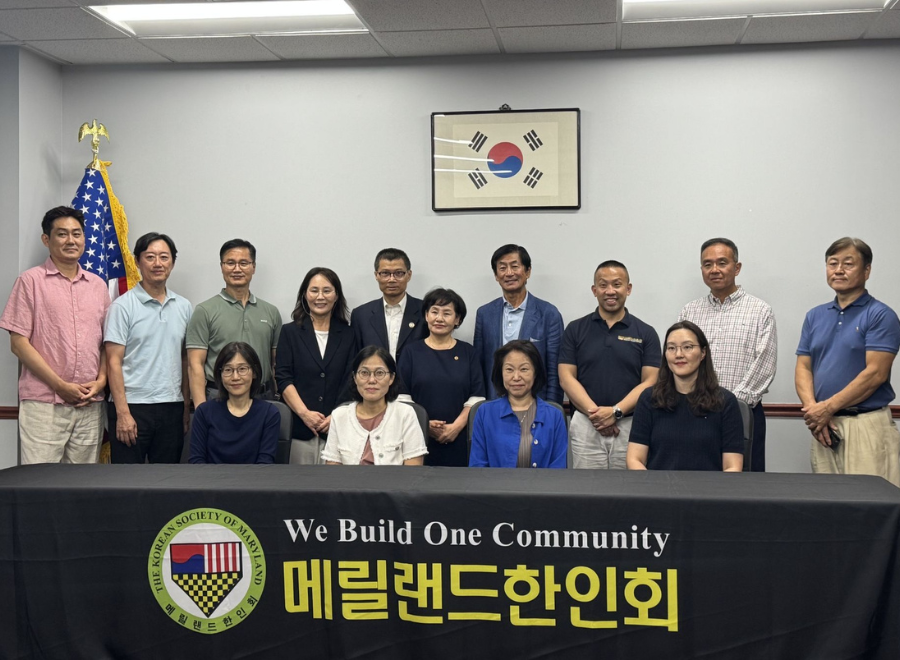
On September 7, 2026, a new Korean adult language school held its opening ceremony. According to Census.gov, Howard County’s population is 21.4% Asian-American, of whom a large proportion are Korean-American. The Korean-American community has also long had a strong presence, with organizations such as the Korean Society of Maryland and the League of Korean Americans operating in the area.
In fact, this Korean school, called the KSM IEUM Vision School, is part of the education division of the Korean Society of Maryland (KSM). Its mission statement is to “help adult learners — including 2nd and 3rd‑generation Korean Americans and learners from all backgrounds — gain confidence in reading, writing, speaking, and listening in Korean.”

Rather than merely a place to study vocabulary and grammar, organizers envision the school as a space where people can forge connections across generations and gain a deeper understanding of Korean culture. Notably, the program is open to anyone interested in learning Korean, regardless of their background.
The event brought together KSM leadership, educators, community members, and elected officials to celebrate the launch of a program designed to make Korean language and culture more accessible to the broader community.
Several Korean-language educators, who will be teachers at the new school, introduced themselves during the ceremony and spoke about what drew them to the new initiative. Among them were instructors with extensive experience teaching Korean at the University of Maryland, Baltimore County (UMBC) and other institutions.
Dr. Kyung-Eun Yoon, who has worked with UMBC’s Korean program for approximately 17 to 18 years, described the new school as an opportunity to strengthen connections between university Korean-language programs and the surrounding Korean community.
Dr. Myoung Eun Pang, now in her second year teaching at UMBC, spoke about her prior experience at institutions in Georgia and Minnesota, as well as her role in helping establish a Korean-language program there. “I’m really excited to be an instructor for this program,” she said, mentioning that this school can connect American society and Korean culture.
In general, the educators emphasized that learning Korean is not only an academic pursuit, but also a way for people from different backgrounds to understand one another. That idea was echoed by elected officials who attended the ceremony.
State Delegate Chao Wu described language as a bridge between cultures, recalling how watching Korean dramas offered an introduction to Korean culture and helped illustrate differences among East Asian societies. “Greater cultural understanding,” he said, “can help communities develop a stronger sense of belonging while also combating misunderstanding and discrimination.”
State Senator Clarence Lam drew on his own Chinese-American background and his experiences as both a child and a parent. As a second-generation Chinese-American, he grew up in the United States and recalled attending Chinese language school when he was young. “I should have paid more attention,” he said, half-jokingly and half-regretfully.
Today, Lam takes his five-year-old daughter to the Howard County Chinese School because he wants her to have the opportunity to learn about her language, culture, and heritage. Lam also noted that he has taken the opportunity to begin relearning his language whilst “sitting with [his] daughter in language school.”
For adults, learning or relearning a language can help strengthen family and community relationships while creating professional opportunities in an increasingly interconnected world. Speaking another person’s language, Lam noted, can make it easier to build relationships across cultural and national boundaries.
Perhaps one of the most personal moments of the ceremony came when State Delegate Mark Chang, who is Korean-American and currently running for a seat in the State Senate, shared his family’s story.

He talked about the American Dream, how his parents immigrated to the United States in the 1970s with only $100 in their pockets, seeking a better life at a time when South Korea was still recovering from the effects of the Korean War.
His father worked at a small carryout restaurant while his mother worked as a researcher at the University of Maryland. After his mother passed away from a brain aneurysm in 1988, his father was left to raise three young children while working long hours.
With his father sometimes working 16-hour days, there was little time to teach the children about Korean language and heritage. His father tried to send them to Saturday Korean school, he recalled, but limited resources made it difficult.
Thus, for Chang, seeing the Korean Society of Maryland establish a new language school decades later carried special significance — and it illustrates how much the cultural landscape has changed.
Growing up Korean-American in the 1980s and 1990s, he recalled facing discrimination because of his background. Today, Korean food, entertainment and popular culture have attracted worldwide attention, creating opportunities for people from many backgrounds to become interested in Korea. “Now it’s cool,” remarked Chang. “It’s cool to be Korean.”
In their speeches, the school’s organizers emphasized that Korean language education should not be limited to people of Korean descent. The school’s principal, David Han, offered an example from his own workplace. He said some of his Spanish-speaking employees had learned Korean expressions while working in Korean restaurants and supermarkets.
Han also highlighted another group that could benefit from the program’s focus on adult learners: second- or third-generation Korean-Americans seeking to relearn the language. He pointed to his own adult son, who could express simple ideas but struggled with more complex ones, as an example.
Many churches operate Korean schools for younger children, but there are fewer opportunities for adults who want to strengthen or rediscover their Korean-language skills. The new school hopes to help fill that gap.
As the ceremony concluded, organizers expressed hope that the Korean school would develop into more than a classroom, but a welcoming community space that connects Korean-Americans to each other and the wider Maryland community.
For some students, that may mean discovering Korean culture for the first time. For others, it may mean reclaiming a language their parents or grandparents once struggled to preserve. For both, the launch marks the beginning of a new opportunity to connect through language.

Leave a Reply