
This article was co-written by John Gao and Eileen Wu.
Introduction
For many ABCs (American-born Chinese) who have ancestral and familial ties to China, Chinese is an oddity – a skill that they have a native’s sense of, yet a language that they only have a beginner’s grasp of.
Attending Chinese school is a formative experience for most young Chinese-Americans, yet often an unwelcome one. For the root of many of their frustrations, look no further than the Chinese language’s complex writing system. Made up of tens of thousands of visually distinct yet oftentimes similar characters, literacy in Chinese is frequently seen as an unattainable milestone, something that is far outside the purview of someone who has not been immersed in the language the same way that a child growing up in China would be.

Just like this young girl in China learned to read characters, so can you! Source: Flickr
Yet, this viewpoint of Chinese characters, or hanzi, is fundamentally flawed. The writing system of Chinese is complicated, yes, but beneath its meandering strokes and thousands of images lie satisfying repetition and intuitive patterns. And most important of all, it has never been easier to become literate in the language. With advances in technology, widespread access to Chinese books online, and a supportive community happy to help out, all it takes to learn is a good mindset and an up-to-date device.
So, strap on your computer and hold on to your flashcards, because once you’ve finished reading this article, you’ll have an arsenal of techniques and resources that will make Chinese literacy as easy as saying “ní hǎo”!
Starting with Software – Must-Have Apps
To start, it is imperative that every serious Chinese learner knows how to install and use a spaced repetition software (or SRS). Two of the most popular (and effective) SRSs for Chinese language learners are Anki and Pleco.
Anki is a downloadable app ($25 on iOS, free on Android and all other computer platforms) that offers users powerful ways to customize their digital flashcards, offering different SRS systems. On its official platform, Ankiweb, you can also find quite a few Chinese decks with different vocabulary.
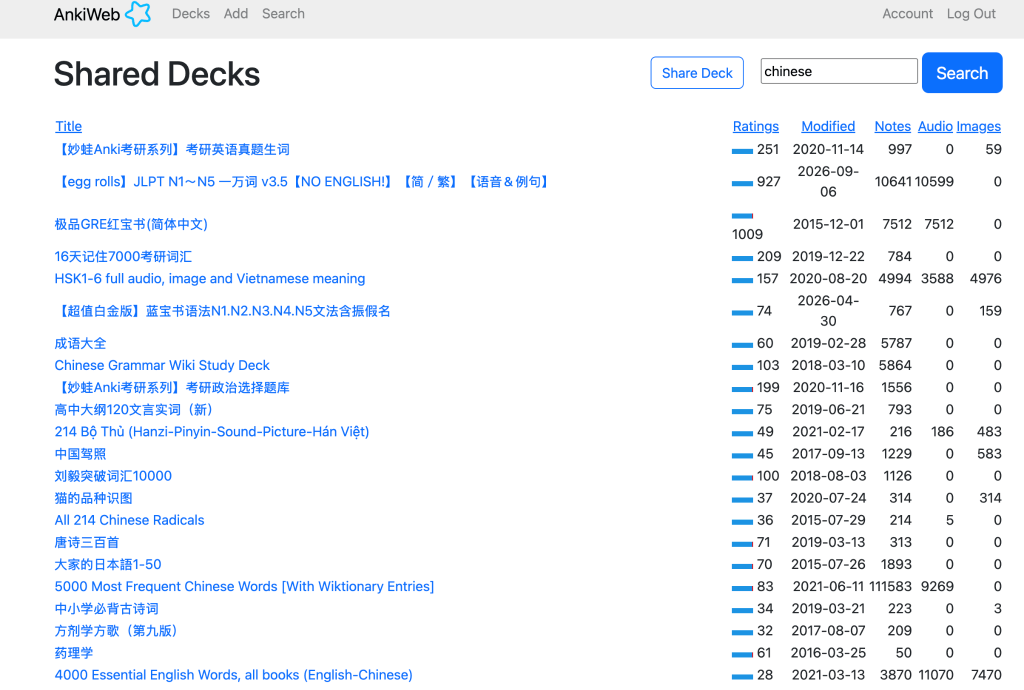
A list of popular Chinese decks on Anki. Anki is generally seen as extremely effective for users who want greater control over their flashcards, and is beloved within the learning community. Source: Ankiweb
For beginners who wish to refresh their basic vocabulary, the Chinese HSK 1 deck offers a user-friendly deck of rudimentary Chinese words and phrases. Alternatively, if you want to look over commonly used Chinese grammar, the popular Chinese Grammar deck will not let you down.

Examples of cards in the Chinese grammar deck that users interact with. Anki functions by letting users self-grade their cards into “piles,” which are eventually shown to the user after a period of time. Source: Ankiweb
Pleco is another app that Chinese learners like to use. Originally created as an accessible online dictionary, the application has grown to encompass a flashcard system that takes advantage of SRS, taking advantage of its expansive Chinese dictionary! However, Pleco’s flashcard feature (and its SRS system) does require a purchase, with the basic bundle coming out at $29.99.
Pleco operates similarly to Anki, but has some differences in how cards are created. For one, Pleco uses a one-tap system to create words from flashcards. If you’ve encountered a word that you’d like to memorize, simply click the “plus” icon above, and it’ll be added!
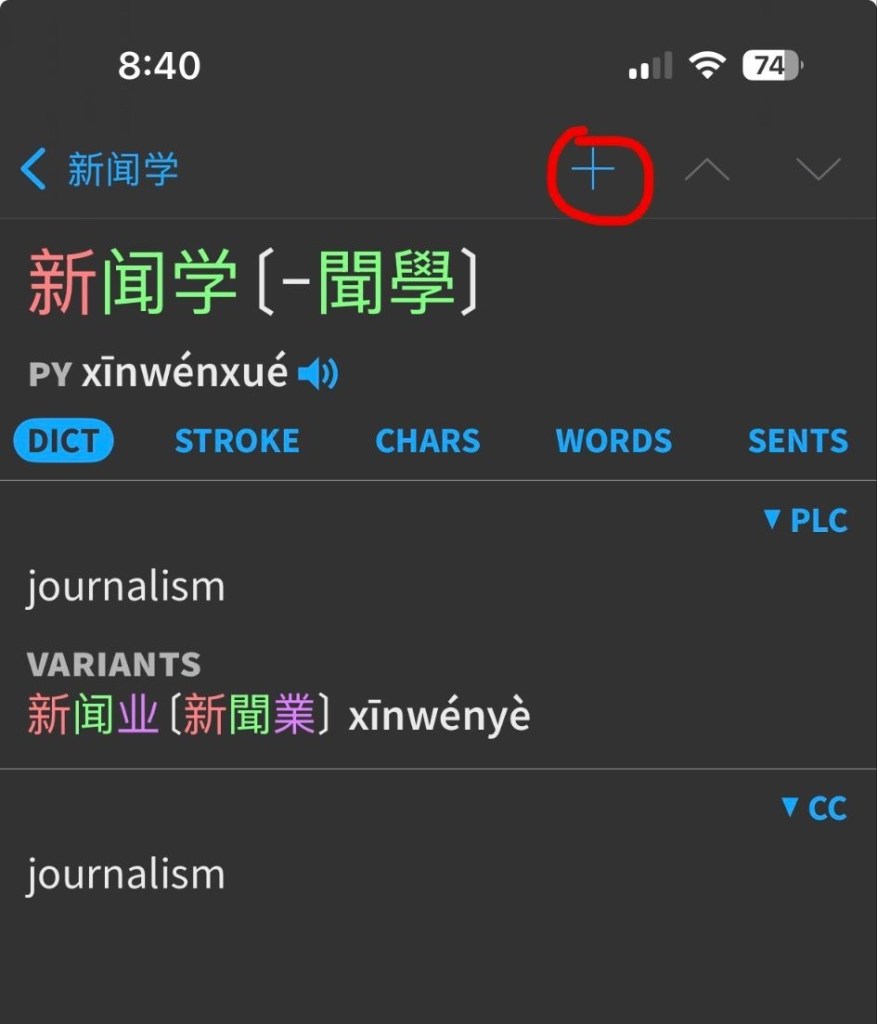
Pleco’s SRS system relies on its expansive dictionary, which includes definitions for nearly every Chinese word. To convert words into flashcards, simply click the “plus”!
Both Anki and Pleco have other intricacies too, and are jam-packed with features that would be impossible to cover in a single article. So, to help an enterprising learner like you, we’ve linked below two great guides on how to use the two apps. Just remember, don’t go overboard – start with a few words per day, and gradually ramp up according to your comfort level until you reach a good amount!
Guides:
Recommended Reading
Once you’ve become comfortable enough with Chinese characters using SRS, it’s time to begin reading native Chinese literature!
One way to become more immersed in reading Chinese literature is if the reading experience is accompanied by slightly more stimulating visual information: that of a television drama.
Many recent Chinese dramas, or C-dramas for short, are based on novels, often ones that are serialized online and available for free in Chinese. Reading these novels can provide a unique perspective on their drama adaptations. Conversely, watching the dramas can inspire greater interest in their original written versions.
One such drama is Mobius《不免日》, a crime-action C-drama from 2025. It is based on the novel Time-Reversal Investigation Squad《逆时侦察组》by Zhang Xiaomao. This work follows the premise of a police officer who sometimes encounters time loops, where he experiences one day five times, as he investigates murders surrounding a biotechnology company.
The show and the movie differ drastically in terms of plotline, providing a fresh experience no matter which one you start with. Furthermore, for those eagerly waiting for a continuation of the show, the second volume of the novel provides insights into how the drama may develop.
Another work to check out is The King’s Avatar《全职高手》, a novel by Butterfly Blue, the pen name of writer Dong Wang, which has both a drama and donghua (animated) adaptation. The King’s Avatar follows a former e-sports legend who was ostracized by his club and has to start over from scratch. With its large cast of characters and the fact that most characters also have unique in-game usernames, The King’s Avatar is a challenge for more experienced readers.
Conclusion
Learning Chinese — especially learning to read Chinese — may seem like a monumental, even insurmountable, challenge at first. However, by using software to build up foundational vocabulary and sentence recognition, then reinforcing these and fostering stronger interest through context-driven novel reading, Chinese literacy can be broken down into daily, manageable steps and eventually conquered after daily dedication.
As goes the Chinese quote from philosopher Laozi, or Lao Tzu, 千里之行始于足下 (the journey of a thousand miles begins with a single step). Perhaps, in just a month or two of learning and reading, this statement will need no translation; you will be able to read it straight off the page.


Leave a Reply