
Note to reader: For the purpose of this article, the term “football” is used to describe the sport Americans know as soccer that involves kicking a ball, rather than American football.
By all means, the 2026 FIFA World Cup, hosted in conjunction by the United States, Mexico, and Canada, was an overwhelming success. Numerous records were broken, including the all-time top goalscorer mark for the World Cup—an astonishing 22 career goals for the 27-year-old Frenchman Kylian Mbappé. It was also likely the last World Cup appearance for arguably two of the greatest forwards (and players) to ever play the sport—Lionel Messi, the 39-year-old Argentinian, and Cristiano Ronaldo, the 41-year-old Portuguese.
And even more incredulously, this year’s World Cup shattered both viewership and financial records. The final between Spain and Argentina, which culminated in a 1-0 Spain victory after extra time, garnered over 66 million views in the U.S., nearly doubling American viewership for the previous edition’s final in 2022 between France and Argentina. FIFA also announced a record $15 billion in revenue from the event, well over the governing body’s projected $11 billion figure.
But among all the nations—ranging from dominant contenders like the aforementioned Spain and Argentina to unexpected underdogs like Cabo Verde and Tunisia—at this year’s World Cup, two global superpower nations, India and China, were notably absent. In fact, they have largely always been absent, with a combined total of one appearance in World Cup history.
This lack of appearances certainly isn’t attributable to a shortage of manpower. India and China are the nations with the first- and second-largest populations, respectively, with 1.429 and 1.405 billion people, according to the U.S. Census Bureau as of July 2026. Those statistics are a stark contrast to a nation like Curaçao, which qualified for the 2026 World Cup despite holding a population of only 154,000 on a small island in the Caribbean Sea.
That’s not to say FIFA isn’t significantly interested in corralling the enormous fan bases that India and China would bring. In June, FIFA announced it had reached an agreement with ‘Z,’ a major Indian broadcasting network, to broadcast and distribute 39 FIFA events across the nation from 2026 to 2034, including the 2026 Men’s World Cup, 2027 Women’s World Cup, and the 2030 Men’s World Cup. Furthermore, FIFA has allocated over $7 million of development funds to the All India Football Federation, with specific emphasis on infrastructure projects enabling the construction of technical centers and football pitches.

Indian President Narendra Modi with FIFA President Gianni Infantino at the Opening Ceremony of the Arabian Gulf Cup in December 2024. Source: Narendra Modi’s Facebook
Similarly, FIFA struck a broadcast deal in May with China Media Group for $60 million, giving the media company the coverage rights across China for four World Cups—the 2026 and 2030 Men’s World Cups, and the 2027 and 2031 Women’s World Cups. Chinese companies also significantly invested in the 2026 World Cup, with technology firm Lenovo serving as one of the tournament’s eight top-tier sponsor partners, and dairy company Mengniu and electronics manufacturer Hisense signing second-tier sponsorship deals.
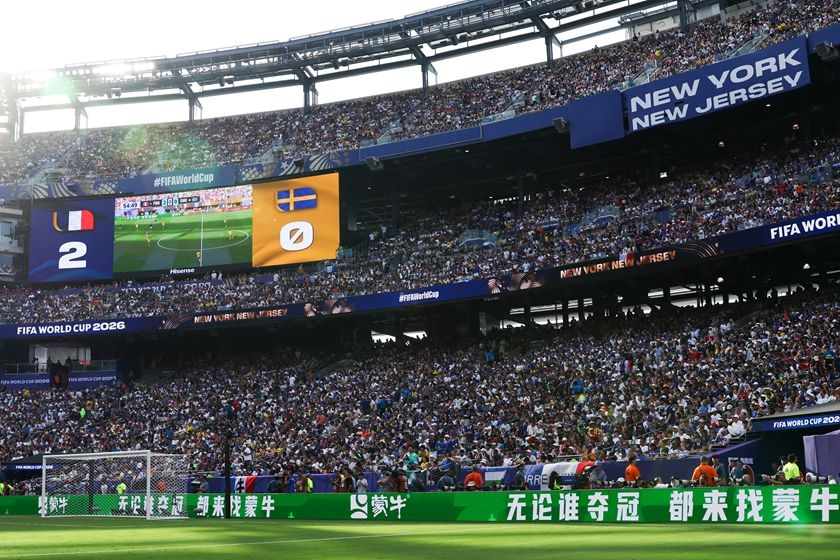
Advertisements for Chinese dairy company Mengniu at a World Cup match between France and Sweden in New York on June 30, 2026. Source: Caixing Global
The increased economic return that FIFA would receive with a Chinese and Indian team in the World Cup is hard to fathom. If Chinese sponsors are already willing to open up their pocketbooks to the World Cup when there isn’t a Chinese team in the tournament, it seems highly probable that only more money would be funneled with the presence of one. In addition, troves of tourists from China and India would likely flock to the tournament’s location to watch their home team play—greatly boosting host city economies. That’s not even to mention merchandise sales in the two nations.
But with a significant advantage in numbers and vast economic potential, it’s difficult to understand why India and China always fall short of making the tournament. In India, multiple factors contribute to the nation’s shortcomings, including a lack of interest and access as well as being stuck in a weak developmental phase. Speaking to India Today, Pradhyum Reddy, the former head coach of Shillong Lajong Football Club, expressed that “kids do not have access to [the] sport… there’s a shortage of grounds for football.”
Reddy’s beliefs, referring to the drought of football academies and year-round leagues, are not in the minority. India’s football recruiting system largely relies on young players presenting themselves at tryouts as opposed to an interconnected scouting system across the nation. In a nation with an abundance of daily wage earners, laborers in farm fields dropping a day’s work to send their child to a city to be scouted is frankly not realistic.
On top of this lack of access, there’s also a comparable lack of interest, both by the people and the government. Cricket is overwhelmingly the most popular sport in India, commonly described as a “religion.” In fact, over 90% of the world’s billion cricket fans reside on the Indian subcontinent. With a sport like cricket drawing away fans’ attention and the government’s resources, football has to fight to be seen.
In a podcast, Diaa Hadid, an NPR correspondent based in Mumbai, noted that the “[Indian government’s] investment in soccer fell by the wayside.” In 2025, the All India Football Federation struggled to attract sponsors to cover the payments needed to run games, resulting in some of India’s best soccer players making pleas on social media begging for FIFA to intervene, hence the aforesaid investment.
It’s a different story in terms of the sport’s popularity in China. When China’s national team qualified for the 2002 World Cup—its first and only appearance—half a million fans rejoiced in Beijing’s Tiananmen Square. Chinese President Xi Jinping is also a fervent fan of the sport, having famously outlined his “three wishes“: to qualify for another World Cup, to host a World Cup, and to win a World Cup.

Chinese President Xi Jinping kicking a soccer ball on a visit to Croke Park in Dublin, Ireland, in 2012. Source: Peter Muhly/AFP/Getty Images
However, China’s lack of success seems to stem from the failed execution of big dreams. In 2016, the Chinese Football Association revealed a plan to propel the country to a “world football superpower” by 2050. The blueprint, which held ambitious goals like 70,000 pitches nationwide and 30 million schoolchildren playing the sport by 2020, never found its grounding.
The Chinese men’s national team actually dropped in worldwide rankings, from 82nd in the world in 2016 to 91st as of August 2026. Jennifer Pak, NPR’s China correspondent, also attributed this regression in part to the country’s academic culture, noting that “not enough kids [are] playing into their teenage years” because sports are often seen as a distraction from the classroom.
Regardless of the various reasons behind China and India’s inability to field World Cup-qualifying teams, the simple truth is that neither nation is good enough in the status quo. Even as FIFA increased the World Cup field from 32 teams to 48 teams for the 2026 World Cup, both nations were easily knocked out of the Asian Football Confederation qualifiers.
With FIFA eyeing an even further expansion of the World Cup to 64 teams, it’s hard to say whether or not 2030 will finally be the year that India qualifies or China returns to the World Cup. But one thing is for sure: both nations will have to overcome numerous obstacles on their path to Morocco, Spain, and Portugal.
Leave a Reply