
On August 7, 2026, the nations of Saudi Arabia, Pakistan, and Turkey signed the Mecca Joint Defense Agreement. This joint defense agreement states that an attack on one nation is an attack on all, with associated consequences. Following a year of negotiations, the pact was signed in Mecca, an Islamic holy site. Pakistan has “provided training and technical assistance to Saudi forces for decades,” while Turkey and Pakistan have exchanged warships and aircraft.
On Sunday, August 9th, Pakistan’s foreign minister claimed that the agreement was “not directed against any country and remained open to other nations in the region.” In celebration, “landmarks in Pakistan’s capital, Islamabad and Saudi cities were illuminated in the colors of the Saudi, Turkish and Pakistani flags.” The three nations offer each other key advantages—Pakistan is the Middle East’s only nuclear power, Saudi Arabia has vast regional influence and economic resources, and Turkey, a NATO member, has a sophisticated defense industry and a large military.
The coalition was “formed to diversify dependence on the United States and create an opportunity for more regional defense cooperation.” In addition to filling the vacuum left by a reduced US military presence, the agreement strengthens already close relations between the three nations. Saudi’s financial power, Turkey’s drone technology, and Pakistan’s industrial and economic base “has the potential to complement the United States, especially when competing for business in smaller countries with more limited budgets.”
The agreement follows a months-long conflict in the Middle East and “months of attacks from Iran and its proxies on Gulf States.” Dr. Yoel Guzansky, head of the Gulf Research Field at the Institute for National Security Studies (INSS), says that Saudi Arabia, most affected by the continuing conflict, joined to have more options as trust in the United States wanes. “Countries need stability. Saudis need stability. It’s also a sign of, let’s say, question marks over the US’s readiness and ability to assist the Gulf states,” he says.
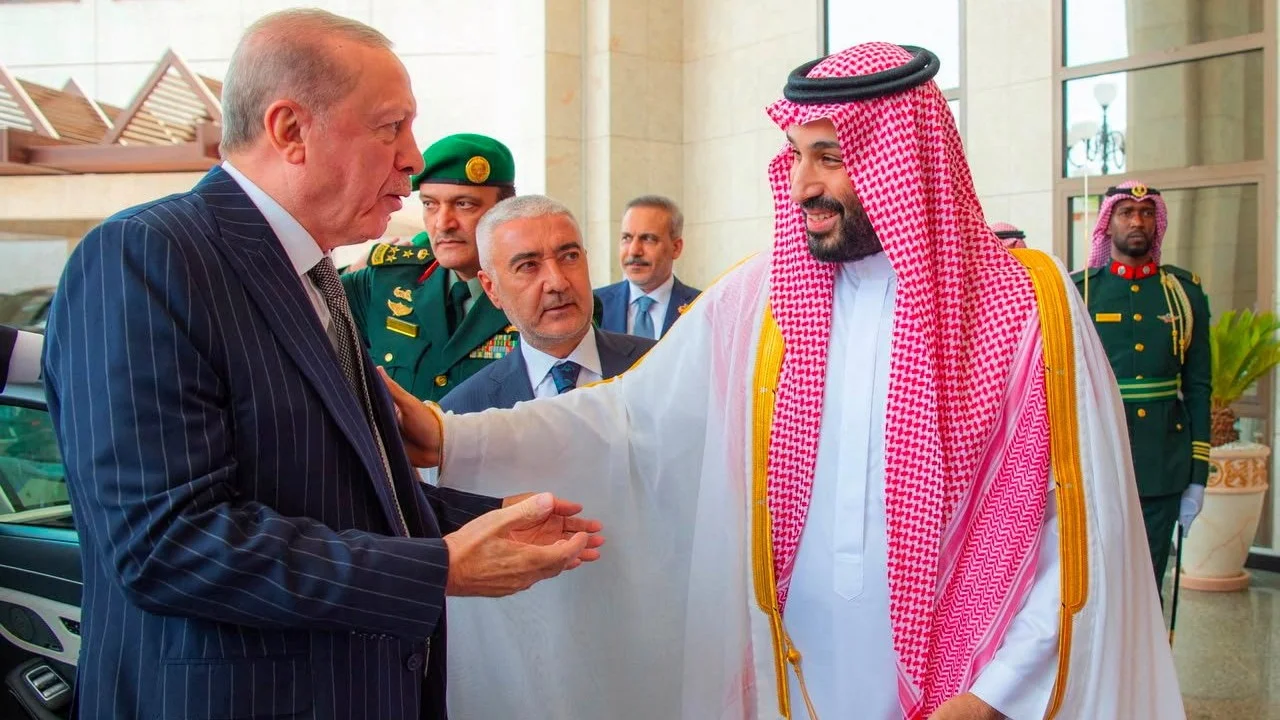
Saudi Arabia’s crown prince meets Turkey’s president. Source: Middle East Eye.
Meanwhile, Iran’s foreign ministry spokesperson stated that “Tehran saw no reason to be concerned that a new security pact is directed against Iran,” instead seeing the pact as a change in perspective toward the US and regional security in general. Some analysts have suggested that the three-country alliance is directed towards Tehran. While Saudi-Turkish relations are icy, “Turkey and Pakistan have remained relatively cordial with Tehran.” Pakistan has been a key player in negotiations between the US and Iran.
Some analysts agree with Pakistan’s position that the pact is not targeted toward any particular nation. Writing in an op-ed piece in Eurasia Review, Hani Hazaimeh argues that the Mecca agreement “should be understood primarily as a defensive partnership designed to strengthen deterrence, protect sovereignty and contribute to regional stability.” Instead, in an age where the Middle East is increasingly destabilized by “wars, missile and drone attacks, threats to maritime routes and growing uncertainty over traditional security arrangements,” the decision to strengthen security is not provocative or surprising.
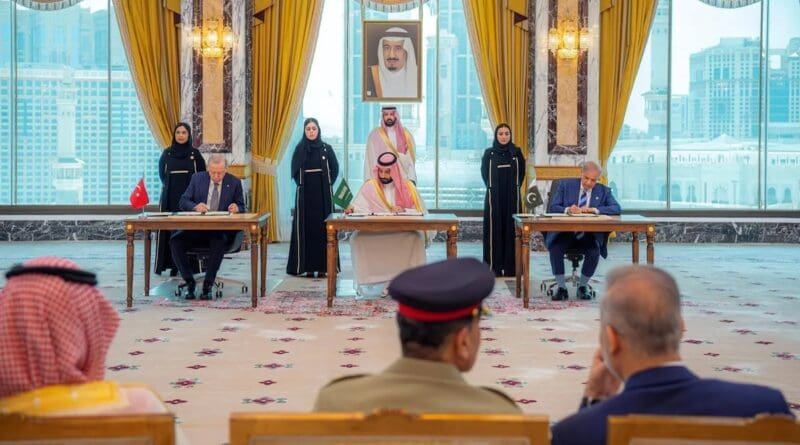
The signing of the Mecca Joint Defense Agreement. Source: Eurasia Review.
Israel, however, feels differently. “This agreement troubles us. This is an alliance aimed against Israel,” a senior Israeli officer says. Not only is it aimed against Iran, the officer feels, but also against Israel, warning that Egypt may soon join as well. The officer agrees that the pact represents a broader regional shift, and that “Israel needs to build alternative alliances, especially with the Hellenic axis, Greece and Cyprus, together with India and the United Arab Emirates.” In addition to Iran and its proxies, all three nations are concerned with Israel’s military policies and the US’s seeming inability to prevent further escalation.
“Despite participating over the past several months in a series of security meetings with the three nations focused on regional security and the U.S.–Iran conflict,” Egypt was not part of the new agreement. Egypt has not yet issued an official report on the Mecca Joint Defense Agreement. Egyptian political analyst Gamal Raif says that “Cairo does not share the same strategic motivations that led Saudi Arabia to pursue this arrangement.” The agreement is still open to other partner nations, though, and there is no evidence that Egypt was offered membership and declined.
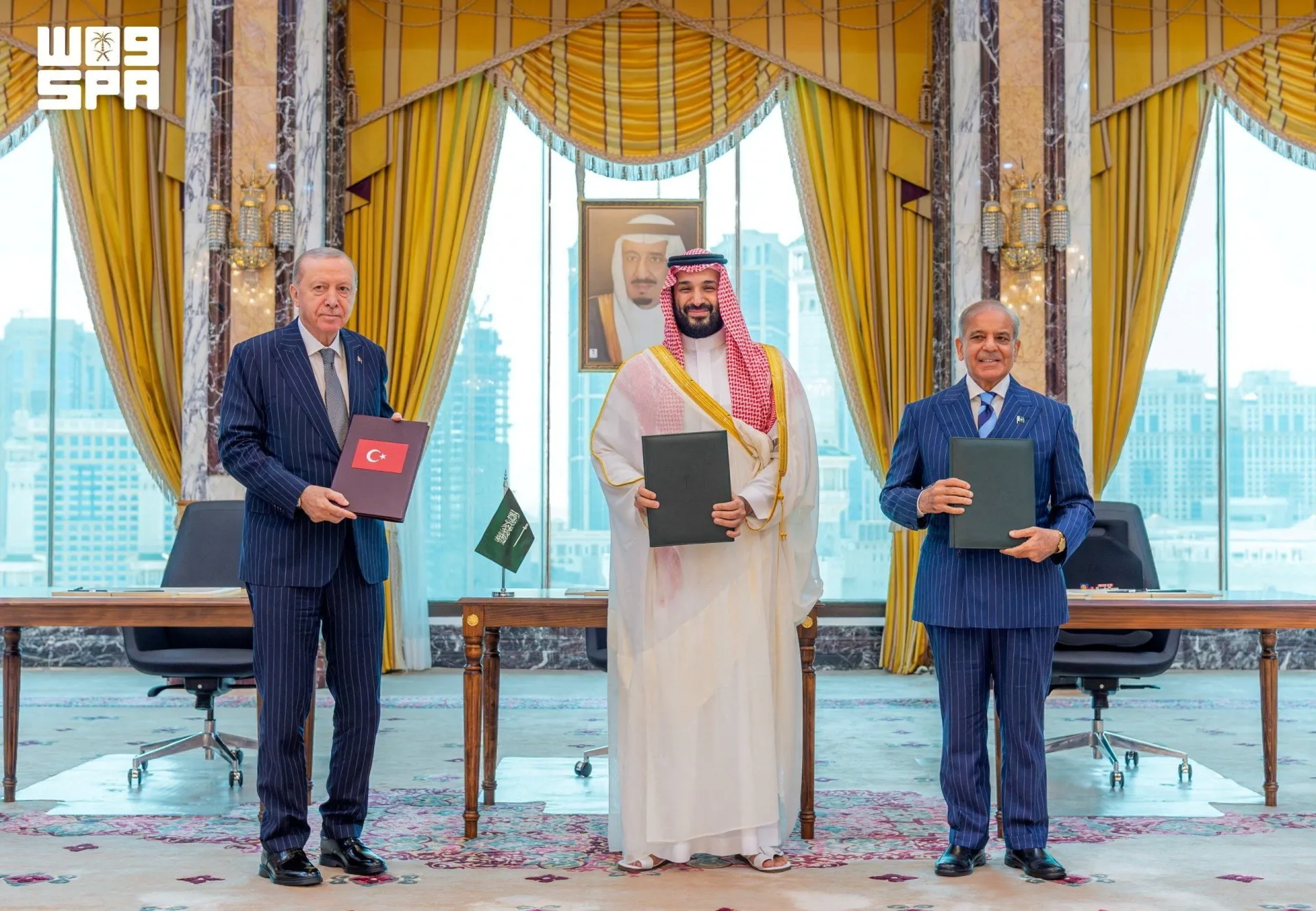
Turkish President Tayyip Erdogan, Saudi Crown Prince Mohammed bin Salman, and Pakistan’s Prime Minister Shehbaz Sharif after the signing of the agreement. Source: Saudi Press Agency/Handout via Reuters.
The signing of the Mecca Joint Defense Agreement reflects the rapidly changing political atmosphere of the Middle East. As the US-Iran conflict continues and the region is plunged into further instability, the balance of power and security will undoubtedly continue to move. Other nations may follow to reduce reliance on the US’s military power, though that is still unclear. What is, however, is that this is the beginning of a series of new developments in the Middle East.
Leave a Reply