
A mid-air axe attack. Sharp turns and sudden plunges toward the ground. What exactly happened during the attempted hijacking aboard a flydubai flight departing from Dubai?
The Boeing 737 MAX was carrying 170 people, including staff and passengers, nearly all of whom were Israeli. Flydubai flight FZ1073 departed from Dubai International Airport, en route to Tel Aviv. Two and a half hours after takeoff, data from a flight tracking website showed a rapid descent, dropping over 15,000 feet in less than two minutes.
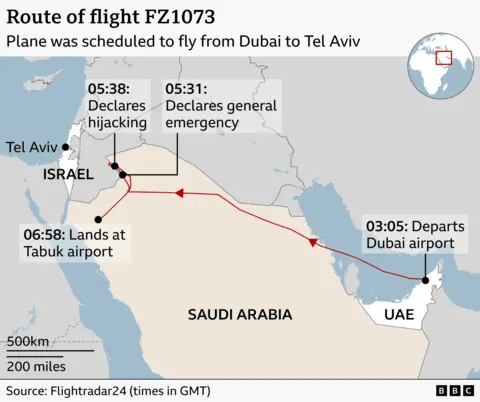
A map of the timeline and locations involved in the incident. Source: BBC.
After the plane began to lose altitude rapidly, the Israeli air force attempted to contact the flight, and after no response was received, “a pre-established committee was quickly roused and a command center established.” Fighter jets were scrambled, and Israeli airspace was closed, but they were called off once the plane turned back toward Saudi Arabia, which had also roused its own jets. If the flight had gotten within a certain distance, Israel would have sent jets to investigate and “would have gotten as close as possible to inspect the cockpit and try to make visual contact with the pilot to assess the situation.”
Eight minutes after the first plunge, the plane transmitted the signal 7700, code for a general emergency. Six minutes after that, the signal was changed to 7500, the code for unlawful interference.
While these events chaotically ensued, the co-pilot attacked the other with an emergency crash axe. The wounded captain, an Indian national named Smit Machchha, managed to click the release to open the cockpit even as he was bleeding. This allowed the passengers to enter the cockpit, and several passengers restrained the co-pilot.
Afterwards, the plane briefly entered Jordanian airspace before turning back into Saudi Arabia. Initially, only the emergency landing at Tabuk airport, Saudi Arabia, was reported. The incident that caused the landing was described as an altercation between pilots.
“I grabbed the attacker, put him in a chokehold, and pulled him out. I called the Israelis who were with us, jumped back in and pulled the controls. I started pulling them back,” Yaniv Hayun, one of the passengers who overpowered the co-pilot, recounted. At least four Israelis aided in the effort, and Hayun recalls that the co-pilot also tried to damage the aircraft’s systems. The group tied the suspect’s hands and feet before providing treatment to the injured pilot.
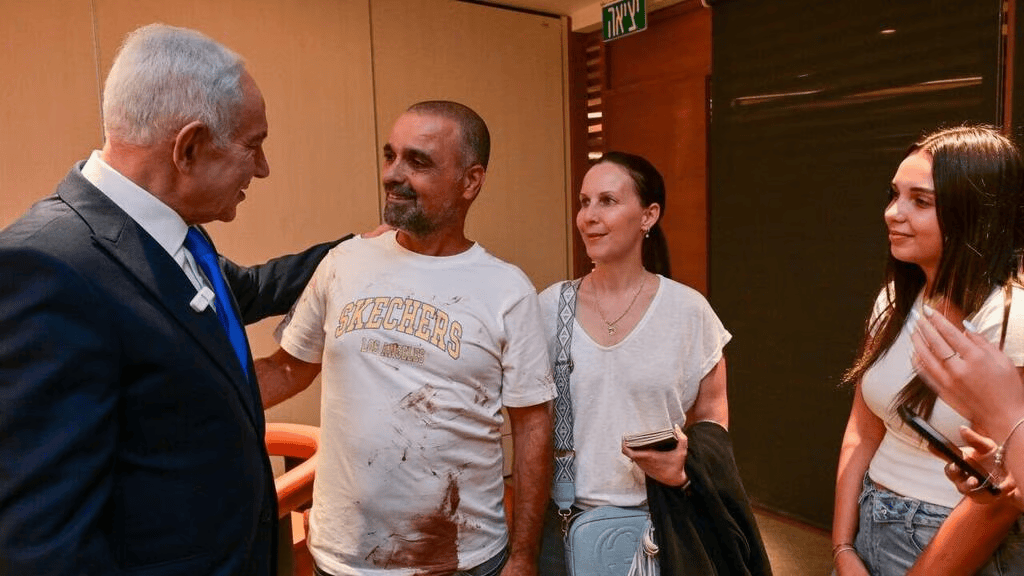
Hayun meets Prime Minister Benjamin Netanyahu at Ben Gurion Airport, his shirt still stained with blood from the cockpit struggle. Source: Reuters.
Hayun managed to pull back the aircraft’s controls and temporarily take control of it after subduing the attacker. He explained to Prime Minister Benjamin Netanyahu that he had learned the motions from the Canadian aviation documentary series Mayday.
An on-duty back-up crew was able to then take control and stabilize the plane before safely landing in Saudi Arabia. Reuters speculates that the two off-duty pilots were likely there to potentially replace tired crew. Since the US-Israeli conflict with Iran escalated, Middle Eastern flights have often had to reroute due to unsafe conditions.
After the attack, Machchha, the injured pilot, was treated by the only doctor on board, an Israeli dentist named Dr. Shota Musayev. “I was the only doctor on the plane, and eventually I managed to stop the bleeding and stabilize his blood pressure,” he said. Musayev believes his actions saved the pilot’s life.
Several hours later, the passengers, including several dozen children, returned to Israel aboard another flydubai plane. Passengers were cheering and singing as their new plane touched down at Ben Gurion Airport. There were 166 Israelis and eight other passengers, some of whom received emergency medical treatment in Saudi Arabia, where the plane stayed for six hours. Israel originally wanted to send its own aircraft, but Saudi Arabia refused.
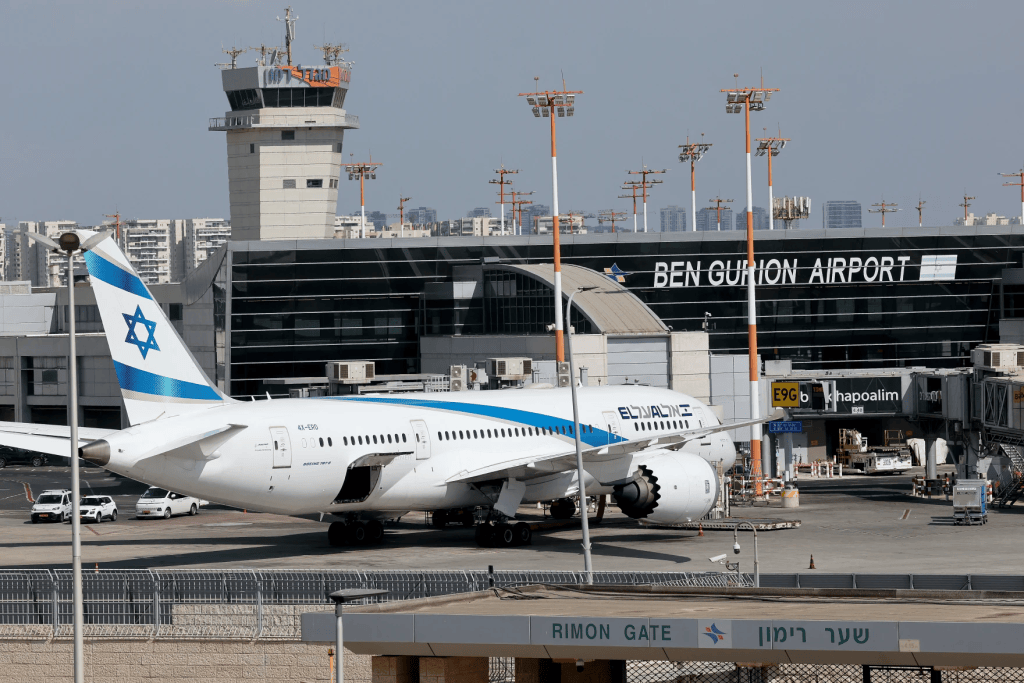
An Israeli aircraft on the tarmac of Ben Gurion Airport. Source: Iowa Public Radio.
An ongoing investigation has revealed that the hijacker intended to crash the plane into Israel’s Ben Gurion International Airport. The attacker was also stated to be an Omani national, which raised questions in Israel, which does not allow pilots from countries it lacks diplomatic connections with to fly in its airspace.
Investigators have also found that the co-pilot had originally planned his attack for July. It was postponed, however, possibly because a friend was on the crew. Several media outlets named the hijacker as Hammam al-Hammami, an Omani national, whose identity the security agencies of at least six countries are scrambling to piece together the identity of.

A picture of the alleged hijacker. Source: CNN.
Sources familiar with the matter reported to the Wall Street Journal that the co-pilot “had previously been banned from flying by Oman over concerns he had adopted radical ideological views.” Despite this, he was still hired by flydubai.
It is believed that al-Hammami was acting alone, though international investigators are still trying to find a possible motive. Israeli Prime Minister Benjamin Netanyahu told Fox News that Israel believes that he “underwent Islamist radical indoctrination,” based on the ongoing interrogation of the hijacker. US President Donald Trump has additionally suggested that al-Hammami could be linked with Iran.
Prime Minister Netanyahu told Fox that after being overpowered by the passengers, the attacker called out to the crew to kill him. He notes that “it’s clear that he was suicidal… It looks very likely that he was going to [bring] down the plane.”
A now-deleted LinkedIn profile bearing the name Hammam al-Hammami says that he worked at Oman Air for seven years, “before joining the Moroccan airline Royal Air Maroc in June 2025 and departing in January 2026.” CNN was told that the profile belonged to the same flydubai pilot.
Australian police said that counterterrorism investigators were looking into the attacker’s possible connections to the country. It was reported that he had attended university there on a student visa a decade ago. New Zealand also confirmed to CNN that al-Hammami had spent time in the country.
The incident has heightened security fears in Israel “ahead of the third anniversary of the deadly Hamas-led attack on 7 October 2023, which triggered the Gaza war, and a general election later this month.”
Some opposition candidates have attempted to highlight what they see as negligence at the hands of Netanyahu and his allies. “This is exactly what system collapse looks like,” Yair Golan, head of the opposition Democrats party, wrote on X. “A transportation minister who completely abandons our skies, and a prime minister who abandons national security.”
Nonetheless, the situation remains unclear, as the investigation is still ongoing. Many questions still remain, such as how al-Hammami was authorized to fly in Israeli airspace in the first place, and what his motive may have been.

Leave a Reply