
The 2026 midterm election cycle in America has been far from normal. Primary polls in the Midwest have been way off, democratic socialists have both triumphed and disappointed, and Republicans are at serious risk of losing their majorities in both the House and the Senate.
With such danger looming, the Republican Party took an unusual step by hosting its first GOP convention in a midterm year in Dallas, Texas, from September 9th to September 10th. The convention—meant to mobilize and rally support for the party in such a critical year—often emphasized personal attacks over true policy.
Various sitting Republican politicians and hopefuls attended the convention, among them President Trump, who delivered both nights’ keynote addresses, and candidates embroiled in tight races, such as Ken Paxton, the Republican nominee for a Senate seat in Texas, and Representative Mike Collins, the Georgian running to unseat Democratic Senator Jon Ossoff.
Yet, for all the positive attention the event was meant to garner for Republicans, one of the most memorable moments of the convention came at the expense of a Twitch streamer—Hasan Piker. During the opening day of the convention, amidst a presentation attacking the left and socialism, a photograph of Piker flexing in his underwear made its way onto the screen.

Hasan Piker reacting to an image of himself in underwear being displayed at the Republican midterm convention in September 2026. Source: Hasan Piker/Instagram
In response, Piker reacted in utter disbelief. “What the f***?” were the exact words that came out of the political commentator and streamer’s mouth upon watching footage of the event’s livestream. But the fact that such a major convention like this one would feature an attack against Piker raises the question of why a Twitch streamer would be notable enough to be featured on the biggest Republican stage in the nation.
Born in 1991 to Turkish parents in New Brunswick, New Jersey, Piker spent part of his childhood in Ankara, Turkey’s capital. His father, Mehmet Piker, is an influential businessman and politician in Turkey, rising to the position of Vice President for one of Turkey’s largest business conglomerates, Sabanci Holding. Mehmet Piker was also a founding member of the Future Party in Turkey, which later dissolved in 2026.
Notably, Piker’s uncle is Cenk Ugyur, a Turkish-American left-wing political commentator. Uygur is the co-founder of the progressive group Young Turks, the same group that Piker got his political footing on before switching to streaming-based commentary.

Hasan Piker, left, and his uncle Cenk Uygur, second from the right, at a Young Turks event. Source: Getty Images
Yet none of this explains Piker’s rise to fame and his subsequent controversies within both the Republican and Democratic Parties. For one, Piker’s use of Twitch speaks to younger generations, and he is also known for weighing in on prominent campaigns, such as Abdul El-Sayed’s.
Piker is also a strong critic of Israel, at times making comments that are inflammatory and even considered anti-Semitic. One recent example of a controversial comment by Piker was in August 2026, when he discussed Michigan State Senator Jeremy Moss on a stream and stated: “Eventually someone will come around and take action not against Israel, but against American Jews.”
In fact, both Piker and Uygur were barred from entering the United Kingdom’s in June 2026 “on the grounds that their presence in the UK may not be conducive to the public good,” according to the nation’s Home Office. Piker’s association with the aforementioned El-Sayed, the Democratic nominee for U.S. Senator in Michigan, has also drawn significant scrutiny, with Jewish Democrats calling for El-Sayed to condemn Piker.
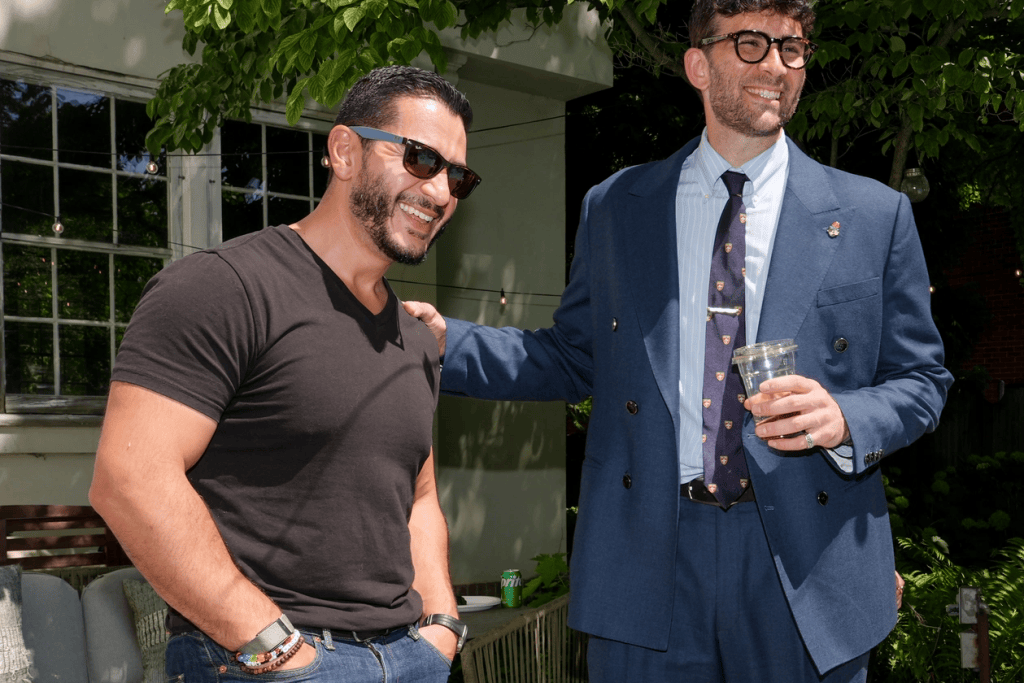
Abdul El-Sayed, the Democratic nominee for U.S. Senate in Michigan, on the right, and Piker on the left. Source: AP/Julie Demaree Nikhinson
Piker’s story ultimately exceeds the controversies surrounding him. He represents an increasingly important form of political influence: one not built through traditional avenues like elected office or television, but through livestreams and enormous online fanbases.
That may explain why his appearance at the Republican convention was more significant than the bizarre photograph itself. By placing Piker on the giant screen, the Republican Party was acknowledging the political relevance of someone who gained his fame outside of traditional political institutions.
Whether one agrees with Piker or not, his trajectory illustrates a shifting American political landscape in which political influence isn’t exclusive to pundits, presidents, and senators but also to creators who command online audiences.

Leave a Reply