
Over the years, Major League Baseball teams have turned to Japan’s top flight of baseball, Nippon Professional Baseball (NPB), in search of game-changing talent. The likes of Hideo Nomo, Ichiro Suzuki, and Shohei Ohtani removed any doubt about the potential of Japanese players, proving that Japan’s top talents could make the leap to MLB superstardom. With the 2026 MLB season entering its final stretch, it is time to evaluate the latest class of Japanese newcomers–headlined by sluggers Munetaka Murakami and Kazuma Okamoto, and flamethrower Tatsuya Imai.
- Munetaka Murakami
Munetaka Murakami slugging a hit in the 2020 Tokyo Olympics. Source: Baseball America
Coming into the season, Murakami had no shortage of detractors. Critics routinely pointed to his hefty strikeout rate, lack of clear position, and history of struggling against high-velocity pitching. These concerns meant that the market for Murakami wasn’t as large, leading him to sign a short-term, two-year $34 million deal with the Chicago White Sox. However, he has completely silenced those doubters, having established himself as one of MLB’s top power hitters.
Murakami’s debut campaign began with a historic April, completely obliterating big-league pitching, highlighted by a stretch in which he homered in five straight games. This scorching start earned him an AL All-Star selection. This momentum was briefly halted when he was sidelined for 35 games with a Grade 2 hamstring strain, but Murakami returned without missing a beat.
Through 100 games, Murakami has logged 29 HRs and 58 RBIs. While his .221 batting average reflects his swing-and-miss tendencies, his .361 OBP and 140 OPS+ reflect his elite plate discipline and game-changing power. Crucially, he is slugging .568 against 95+ mph pitches, putting to rest concerns about his ability to adjust to high-velocity pitching. He has frequently drawn comparisons to Phillies star slugger Kyle Schwarber, posting a massive 57.6 Three True Outcome rate (HR, BB, or SO).
- Kazuma Okamoto
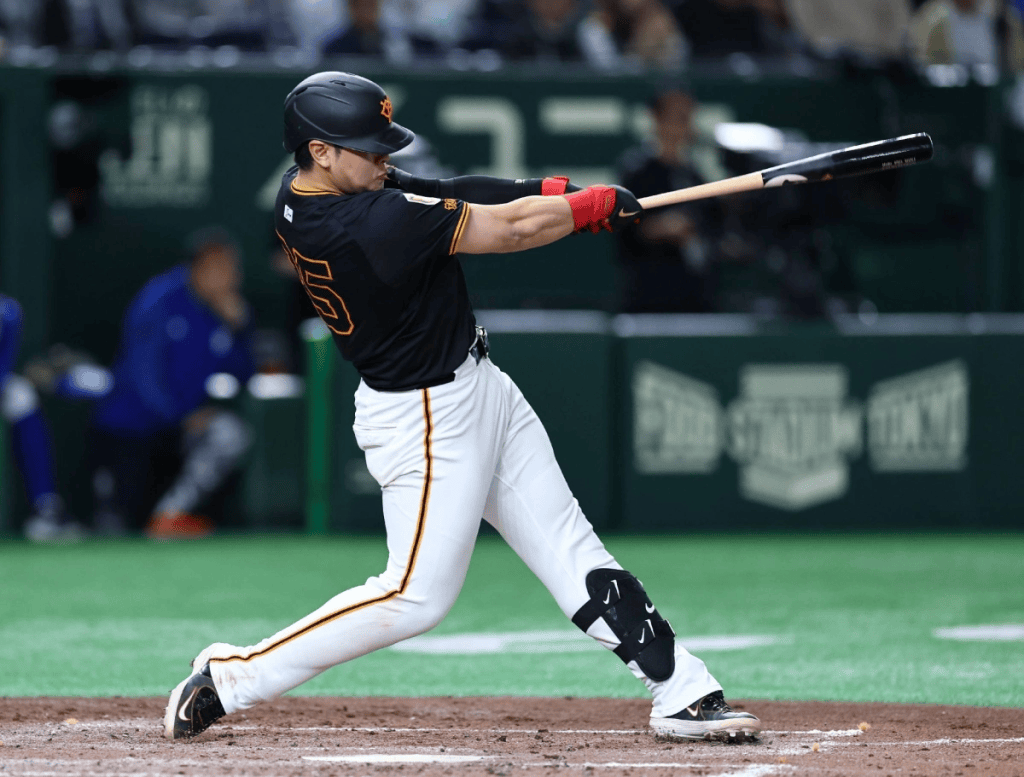
Kazuma Okamoto mid-swing during a NPB baseball game. Source: Japan Times
In contrast to Murakami’s volatile profile, Kazuma Okamoto was projected as a safer option, with a higher floor but a lower ceiling. While Murakami had doubts about his ability to make contact and adjust to MLB pitching, Okamoto took a more contact-oriented approach at the plate while still hitting for power, providing a steadier offensive baseline. Additionally, Okamoto also brings in above-average defense at corner infield to complement his consistent offensive production, making his four-year, $60 million contract look like a steal for the Toronto Blue Jays
Early on in his debut campaign, the projections were right. Okamoto had an explosive start to his MLB career, winning AL Rookie of the Month in June after slashing .286/.353/.560 with seven home runs. However, big-league pitching staffs will eventually adjust. Pitchers began throwing a lot more off-speed pitches down and away to him. Consequently, his strikeout rate has ballooned – the ~15-18% rates he was posting in NPB jumped to 29.7%.
This adjustment has dragged his batting average down to .230 as of this writing. Furthermore, Statcast metrics grade his defense as slightly below average at -3 Fielding Run Value (FRV), though he is still completely serviceable to fulfill the Blue Jay’s needs. Despite this, Okamoto’s power production remains. With 27 HRs and 77 RBIs through 132 games, he has delivered everything the Blue Jays wanted when they signed him: reliable run production on a team-friendly deal.
- Tatsuya Imai
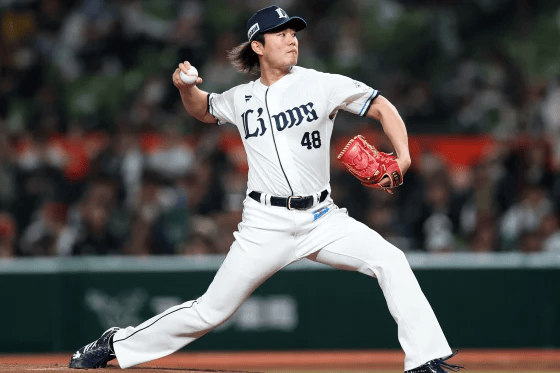
Tatsuya Imai mid-pitch for the Saitama Seibu Lions during a NPB game. Source: NBC News
Backed by bold comparisons to Dodgers ace Yoshinobu Yamamoto, Tatsuya Imai arrived stateside with a contract and profile that promised front-line starter upside. Coming off of a career year with the Saitama Seibu Lions where he posted a 1.92 ERA, agent Scott Boras drew parallels to Yamamoto’s dominance in NPB. Of course, this comparison was way overblown: Yamamoto was considered a generational ace, while Imai was considered a higher-variance arm that was still struggling with command. Despite these concerns, Imai landed a 3-year $54 million deal with the Houston Astros. MLB scouts loved his electrifying pitch mix, with a mid-90s fastball and a unique, “wrong-way” slider.
Imai’s debut campaign has played out exactly how the scouting report projected. In May, Imai pitched six hitless innings, kicking off a combined no-hitter against the Texas Rangers. However, as the season wore on, Imai struggled to transition to the game in the States. The tighter pitching rotation schedules in MLB led to physical fatigue, which in turn led to command lapses and a higher walk rate. Imai himself admitted that he has had major trouble adjusting to life across the Pacific, citing the different meal timings, the heavy travel schedule, and the cooler outdoor temperatures as differences between NPB and MLB. These struggles have led the Astros to move him to a multi-inning bullpen role. He currently sits at a 5.32 ERA through 18 appearances (15 starts), certainly not what the Astros had in mind when they signed him.
While his season has been underwhelming, the underlying metrics highlight how his swing-and-miss stuff is still present. His unique slider is bamboozling hitters this season, boasting an elite 38.4% whiff rate, and his 11.0 K/9 shows he has no trouble striking them out. Furthermore, his xFIP (~4.23) and SIERA (~4.31) are well below his ERA, suggesting that some bad luck has inflated it. With a truly elite pitch in his arsenal, and a likely regression to the mean, Imai’s long-term outlook looks bright. The levels that he achieves will hinge on refining his command and building the physical durability necessary to weather the MLB schedule.

Leave a Reply